


STC Ratings Explained: What Texas Business Owners Need to Know

Updated: Jun 26

An STC (Sound Transmission Class) rating measures how well a building material or wall assembly blocks airborne sounds like human speech and office noise. For STC ratings commercial soundproofing Texas, understanding these ratings is crucial for lease compliance, employee productivity, and maintaining private, professional environments.
What Is an STC Rating?
An STC (Sound Transmission Class) rating is a single number that measures how effectively a wall, door, floor, or window blocks airborne sound - including speech, office equipment noise, and music. The higher the STC number, the better the sound-blocking performance of that assembly.
For STC ratings commercial soundproofing Texas, the International Building Code (IBC) sets a minimum STC 50 for most shared wall assemblies between occupied spaces. Healthcare facilities, law firms, and hospitality businesses typically need STC 55 to 60 to satisfy HIPAA regulations, attorney-client confidentiality obligations, and franchise brand standards.
Here is what the rating means in the simplest terms:
STC 25–35 - Normal speech clearly heard through the wall. No meaningful privacy.
STC 40–45 - Loud speech audible but muffled. Minimal privacy at best.
STC 50 - IBC code minimum. Loud speech barely perceptible but still present.
STC 55–60 - Near silence. Required for medical, legal, and premium hospitality.
STC 60+ - Professional-grade isolation. Used for legal suites, C-suite, and studios.
If you own, lease, or manage commercial space anywhere in Texas - a medical office in Houston, a hotel in Austin, a law firm in Dallas, or a co-working space in Frisco - understanding STC ratings is not optional. It is the difference between a space that actively protects your business and one that quietly works against it.
Why So Many Texas Business Owners Get This Wrong From the Start
Here is the hard truth most general contractors will not volunteer: the majority of commercial wall noise problems in Texas are not caused by poor construction quality. They are caused by the wrong acoustic specification from day one.
A business owner in a Dallas mixed-use building recently learned this firsthand. Patients in the waiting room could clearly hear conversations from the exam room next door. The walls had been built to code. They passed inspection without a single issue. The problem was that "built to code" and "built for your specific business type" are two entirely different standards - and that distinction was never explained before construction began.
This scenario repeats itself every week across Texas:
Hotels failing franchise brand audits because their walls test at STC 48 when the brand mandate is STC 55.
Law offices where client consultations drift into reception areas, creating real confidentiality exposure.
Co-working spaces where every phone call becomes ambient background noise for the entire floor.
Medical clinics where a patient's diagnosis can be heard two exam rooms away.
Open-plan offices where constant background conversation destroys team focus and drives up staff turnover.
Restaurants where kitchen noise dominates the dining room because the dividing wall was never acoustically specified.
By the end of this guide, you will know:
What each STC number means in real-world Texas commercial terms.
What your specific city's code requires - Houston, Dallas, Austin, San Antonio, and beyond.
The exact STC target your business type needs to stay compliant and protect revenue.
How to achieve that target without overspending on the wrong solutions.
Why even well-built walls fail in the field - and how to prevent it on your project.
Understanding STC Ratings for Commercial Soundproofing in Texas

Why the Scale Is Logarithmic - Not Linear
Most business owners assume an STC 60 wall is only "a little better" than an STC 50 wall. That assumption leads to costly under-specifications. The STC scale is logarithmic, meaning every 10-point increase represents roughly a 50% reduction in perceived noise.
Here is what that looks like in a real Texas commercial space:
A normal conversation registers at approximately 60 to 65 decibels.
Through an STC 35 wall, that conversation is still plainly audible and intelligible on the other side.
Through an STC 50 wall, it drops to the level of a soft, indistinct whisper - present but not understandable.
Through an STC 60 wall, it becomes nearly inaudible under normal occupancy conditions.
Two STC numbers every Texas business owner should memorise:
STC 50 - The IBC legal minimum for most commercial wall assemblies in Texas. This is where code compliance starts, not where adequate business performance ends.
3-point increase - The minimum STC improvement a human ear can actually perceive as "noticeably quieter." Any upgrade smaller than 3 points delivers no perceptible change.
The STC Ratings Chart for Texas Commercial Buildings
STC Rating | What You Actually Hear | IBC Code Status | Real-World Texas Application |
25–30 | Normal speech fully intelligible | Well below code | Bare drywall, cheap strip mall partitions |
35–40 | Loud speech audible and mostly clear | Below code | Basic retail dividers, older open-plan offices |
45 | Loud speech audible but mostly muffled | Approaching code | Minimum tolerable for a private office |
50 | Loud speech barely perceptible | IBC minimum | TX hotel guestrooms, assisted living - the legal floor |
55 | Near silence - occasional presence only | Above code | Medical suites, corporate boardrooms, HR offices |
60+ | Essentially silent | Premium commercial | Legal consultation rooms, C-suite, media production |
The critical distinction every Texas business owner must know: STC 50 is the legal floor. For most Texas commercial businesses, it should be the starting point of your specification conversation - not the finish line. Our team at De-Walls helps business owners identify the right target before a single wall is specified.
What STC Ratings Do NOT Measure - And Why It Matters for Texas Businesses
Most online acoustic guides leave Texas business owners partially - and sometimes dangerously - misinformed on this point. STC only measures airborne sound transmission across mid-to-high frequencies, roughly 125 Hz to 4,000 Hz. That covers human speech, office equipment, and moderate music. It does not cover everything your business may need to address.
There are two additional ratings that apply depending on your Texas business type:
OITC - Outdoor-Indoor Transmission Class
Measures low-frequency sound transmission: bass-heavy music, heavy truck traffic, aircraft, and HVAC rumble.
The frequencies OITC targets fall entirely below the STC measurement range.
Relevant for: Texas gyms, bars, live music venues, and any commercial space adjacent to a highway, rail corridor, or airport flight path.
A wall can post an excellent STC rating and still transmit substantial bass energy - because STC never measured those frequencies.
IIC - Impact Isolation Class
Measures structure-borne impact noise: footsteps, dropped objects, and dragged furniture.
Relevant for: Any multi-story Texas commercial building with active tenants above or below.
IIC determines whether the footfall from the spin studio above or the restaurant kitchen one floor down becomes a constant distraction in your space.
Quick summary - which metric applies to your noise problem:
Your Noise Problem | Metric to Specify |
Speech, phone calls, office equipment | STC |
Bass music, trucks, HVAC rumble, aircraft | OITC |
Footsteps, dropped objects, mechanical vibration | IIC |
Multi-story buildings with diverse tenants | All three |
Many Texas gyms, restaurants, and multi-floor office buildings discover this gap only after construction is complete and complaints begin. Knowing which metric your specific noise problem requires is the first question to answer - before any acoustic investment is made.
Texas Commercial Soundproofing Code Requirements - City by City

The Statewide Foundation
Texas does not operate a single statewide building enforcement department. Each city adopts and enforces the International Building Code independently, with its own local amendments. The Texas Commission of Licensing and Regulation formally adopted the IBC 2021 Edition effective July 1, 2024, which now governs all industrialised commercial construction across the state.
The core acoustic mandate - IBC 2021 Section 1206.2 - requires:
A minimum laboratory STC 50 for wall and floor-ceiling assemblies separating dwelling units, sleeping units, and those units from public corridors.
A minimum field-tested FSTC of 45 as an acceptable compliance alternative, explicitly accounting for the performance drop that real-world installation introduces.
The same STC 50 / FSTC 45 thresholds apply to floor-ceiling assemblies under IBC Section 1206.3 for impact isolation.
Two critical points every Texas business owner must understand about this language:
The field tolerance of FSTC 45 acknowledges construction reality. It is not an invitation to target STC 45 as your design goal.
Section 1206 specifically addresses dwelling and sleeping units. Commercial offices, retail, and professional services are not automatically subject to the same threshold. This is exactly why many Texas tenant build-outs pass inspection with STC 35 to 40 walls. Passing code inspection and being acoustically adequate for your business are entirely different outcomes.
Houston - Commercial Soundproofing Code and Local Conditions
Houston operates under the Houston Code of Ordinances alongside the adopted IBC 2021. Local enforcement and plan review are managed entirely by the City of Houston's Department of Public Works and Engineering, with no statewide oversight layer.
The Houston-specific issues every commercial tenant must know:
Houston's strip mall and flex-space construction legacy - most of it built from the 1980s through the early 2000s - means many existing tenant spaces share the following conditions:
Shared HVAC ductwork runs between separate tenant units, carrying sound across the full building.
Open ceiling plenums spanning the full building width above the drop-tile ceiling.
Structural framing elements that cross multiple tenancies without acoustic breaks.
The practical result: Installing STC 50 walls without addressing the shared plenum above the ceiling grid frequently results in actual STC 30 field performance. Sound travels over the walls through the open plenum - not through them. This is not a code violation. It is a specification gap, and it is the most commonly missed acoustic problem in Houston commercial projects.
Dallas - Commercial Soundproofing Requirements
Dallas enforces the IBC through the Dallas Development Code, with plan review handled by Dallas Development Services.
What Dallas commercial tenants need to verify before finalising specs:
Whether the building sits within a mixed-use entertainment overlay district (Uptown, Deep Ellum).
Whether Dallas Development Services plan review applies occupancy-specific acoustic requirements beyond the IBC baseline.
That demising wall specifications are calibrated to the actual tenant mix - not just the minimum code threshold.
Austin - The Strictest Acoustic Environment in Texas
Austin is, without question, the most stringent commercial acoustic code environment among major Texas cities. Austin City Code Chapter 9-2 governs commercial noise, and enforcement activity has intensified as mixed-use development accelerates around the downtown core, 6th Street, and Rainey Street corridors.
Why Austin demands a higher default specification:
Entertainment district adjacency is common in Austin commercial spaces.
The city's noise ordinance is actively enforced - not just written into law.
Residential density immediately adjacent to commercial buildings is the highest in Texas.
Mixed-use vertical developments layer office, retail, hospitality, and residential tenants in shared structures at scale.
For any Austin commercial tenant near an entertainment district or dense mixed-use building, treating STC 55 as the default starting specification - rather than a premium upgrade - is standard practice for any experienced Texas acoustic contractor.
San Antonio - River Walk and Medical Corridor Considerations
San Antonio's commercial construction is governed by its Unified Development Code (UDC) alongside the adopted IBC. Two corridors carry specific acoustic implications:
River Walk corridor:
The combination of outdoor ambient noise, adjacent entertainment venues, and premium hospitality guest expectations makes STC 55 to 60 the practical baseline for any quality hotel or restaurant project in downtown San Antonio.
Meeting code and meeting guest expectations are not the same number in this environment.
Medical Center and UTSA corridor:
Healthcare and professional development in this area requires the same HIPAA-compliant acoustic standards as anywhere in Texas.
STC 55 to 60 is the expected standard for clinical spaces - not an exceptional upgrade.
Fort Worth, Frisco, and Plano - Fast-Growth Markets, Frequent Under-Specification
These three markets share a common dynamic: rapid commercial construction pace, aggressive value engineering, and tenant spaces being built before the occupying business type is clearly defined.
What applies across all three fast-growth Texas markets:
IBC 2021 is the code baseline in each municipality, but local amendments vary.
Verify directly with each local building department before finalising wall specifications.
Do not assume specifications used in a previous Texas city project automatically apply here.
Fast-growth corridors in Frisco and Plano are seeing new mixed-use commercial construction where acoustic performance is routinely treated as a line-item to cut - rather than a compliance and risk management investment.
What STC Rating Does Your Texas Business Type Actually Need?

The IBC establishes the legal minimum. Your business type, federal compliance obligations, and brand standards establish the number you actually need. Here is how those requirements translate across Texas commercial sectors.
Medical and Dental Offices in Texas - HIPAA and STC Compliance
HIPAA's Privacy Rule, under 45 CFR §164.530(c), requires covered entities to implement physical safeguards to protect protected health information (PHI). Oral communication between a physician and a patient is directly covered under this obligation.
HIPAA does not cite a specific STC number. It requires "reasonable safeguards" to prevent PHI from being overheard. The practical implication: if normal speech is intelligible through an exam room wall, the space does not meet a reasonable standard of acoustic privacy under HIPAA.
The financial exposure is not hypothetical:
2024 HIPAA penalty enforcement by the HHS Office for Civil Rights ranged from $141 for unknowing violations to a $4.75 million settlement against Montefiore Medical Center.
Legal defence costs for a single HIPAA enforcement action frequently exceed the total cost of a full acoustic upgrade.
A wall upgrade from STC 44 to STC 57 in a typical Texas medical suite costs approximately $8,000 to $15,000 - a fraction of the liability exposure.
Recommended STC targets for Texas medical and dental offices:
Space Type | Recommended STC |
Exam rooms | STC 55–60 |
Therapy and counselling offices | STC 55–60 |
Patient consultation rooms | STC 55 |
Billing and admin areas where PHI is discussed | STC 50 minimum |
All clinical walls | Deck-to-deck - no plenum gaps permitted |
What good acoustic compliance looks like in a Texas medical suite:
Walls run deck-to-deck - not to the top of the ceiling grid.
Exam room doors are solid-core acoustic assemblies with perimeter seals.
Back-to-back electrical outlets are treated with acoustic putty pads.
HVAC ductwork between exam rooms is isolated or lined.
Post-construction FSTC field testing confirms actual performance before occupancy.
Need help assessing your Texas medical office? De-Walls provides free commercial acoustic assessments for healthcare facilities across Houston, Dallas, Austin, and San Antonio.
Law Firms and Financial Services in Texas - Confidentiality and STC
Attorney-client privilege has a physical dimension that Texas law firms consistently underestimate. Rule 1.05 of the Texas Disciplinary Rules of Professional Conduct imposes a duty of confidentiality that creates an implicit obligation to take reasonable precautions against unauthorised disclosure.
A client conversation audible from an adjacent conference room is not a theoretical privacy risk. It is an unauthorised disclosure in progress.
Recommended STC targets for Texas legal and financial offices:
Client consultation rooms: STC 55 minimum; STC 60 for high-stakes litigation, criminal defence, or sensitive financial advisory work.
Conference rooms: STC 55.
Reception-to-office wall: STC 50 minimum.
Executive offices: STC 50 to 55 depending on the sensitivity of matters discussed.
The most common acoustic failure points in Texas law firm build-outs:
Conference room walls that stop at the ceiling grid instead of running to the structural deck.
Glass sidelites beside solid-core doors - glass typically tests at STC 26 to 32.
Standard hollow-core interior doors that test at STC 20 to 28.
Back-to-back electrical outlets on conference room walls with no putty pad treatment.
HVAC supply and return air grilles shared between the conference room and adjacent corridor.
Hotels and Hospitality in Texas - Franchise Brand STC Standards
Texas hotel operators face two distinct acoustic layers: the IBC code floor and the franchise brand standard. The brand standard always governs a quality assurance audit - and it is always higher than the IBC minimum.
Brand STC requirements by hotel tier:
Hotel Brand Tier | Guestroom Walls | Corridor Walls | Guestroom Doors |
Mid-scale select-service (Hampton Inn, Courtyard, HIE) | STC 50–52 | STC 50 | STC 35 |
Upper-midscale / full-service (Hilton, Marriott, Hyatt) | STC 54–57 | STC 52 | STC 38–40 |
Upper-upscale / luxury (JW Marriott, Waldorf, Kimpton) | STC 57–60+ | STC 55 | STC 40+ |
The hotel door problem operators consistently miss:
A guestroom door rated at STC 28 to 32 - the standard range for hollow-core or basic solid-core doors - neutralises a significant share of what an STC 55 wall assembly achieves. The door becomes the weakest acoustic link, and no wall investment compensates for it.
The audit math is straightforward:
A failed franchise acoustic audit triggers a remediation requirement typically due within 30 to 60 days.
In an operating hotel, that means construction disruption compounds the existing noise complaint issue.
Retroactive remediation in finished, occupied guestrooms costs 3 to 5 times more than specifying correctly during the design phase.
Texas remains one of the most active hotel development markets in the country. In Houston, Austin, Dallas, and San Antonio, the acoustic specification conversation belongs in design development - not in a QA remediation letter.
Fitness Centers and Gyms in Texas - Beyond STC to OITC
Fitness centres present an acoustic challenge that STC ratings alone cannot fully resolve. This is where many Texas gym operators run into expensive post-construction surprises.
The core issue:
High-energy group fitness music generates significant bass energy in the 50 Hz to 125 Hz range. STC measurement begins at 125 Hz and emphasises mid-to-high frequencies. A wall that tests at STC 52 may still transmit substantial bass because those low frequencies were never part of the STC measurement.
What Texas fitness facilities actually need:
STC 50+ for speech-range airborne isolation from adjacent tenants.
OITC 45+ to address bass and low-frequency energy from group fitness and cycling rooms.
IIC 50+ for any floor-ceiling assembly between the gym floor and occupied space above or below.
The 24-hour gym risk in Texas mixed-use buildings:
Ambient building noise drops significantly after 10 PM.
Bass that was unnoticeable during daytime peak hours becomes a serious complaint by midnight.
Lease disputes over inadequate acoustic separation from gym operations are more common than most operators expect.
The problem is almost always preventable with correct initial specification - and almost always expensive to fix after the fact.
Corporate Offices and Co-Working Spaces in Texas - STC and Productivity
The research on open-office noise is unambiguous:
A 2024 Jabra survey of 2,000 knowledge workers across four countries found that 63% struggle with concentration due to workplace noise, and 47% described office noise as actively stressful.
The Gensler Research Institute's Global Workplace Survey found that seven in ten employees experience regular disruption from conversations and ambient noise in open-plan environments.
A 2023 peer-reviewed study in the Journal of the Acoustical Society found noise-related dissatisfaction affects more than 50% of all open-plan office workers, with irrelevant speech and phone calls cited as the dominant causes.
Oxford Economics research found that workers in the noisiest office environments are significantly more likely to leave their employer within six months.
Recommended STC targets for Texas commercial offices:
Space Type | Recommended STC |
Open-plan workstations | Sound masking system - walls alone are not the solution |
Standard private offices | STC 45–50 |
HR offices (personnel conversations) | STC 50–55 |
Executive offices | STC 55 |
Boardrooms and conference rooms | STC 55 |
Phone booths and focus pods | STC 35–40 (if fully enclosed) |
The glass partition problem in modern Texas offices:
Floor-to-ceiling glass partitions are a dominant feature in contemporary Texas office design - and a consistent source of acoustic failure.
Standard tempered glass panels test at STC 28 to 35 depending on thickness.
Laminated acoustic glass achieves STC 38 to 45.
Full acoustic glazing assemblies reach STC 48 to 52.
A glass wall between a conference room and an open floor plan is acoustic theatre: it looks private without being private. If speech privacy is the genuine goal, glass specifications must reflect that.
Restaurants and Bars in Texas - Noise Ordinance Compliance and STC
The acoustic goal in food and beverage operations is not total sound elimination - ambient energy is part of the hospitality experience. The goal is controlling where sound travels and managing regulatory compliance.
The Texas-specific compliance angle:
TABC-licensed venues are subject to city noise ordinances that can directly affect licence renewal. In Austin, noise ordinance violations can result in:
Conditional use permit restrictions.
Reduced operating hours.
Denial of licence renewal.
Recommended STC targets for Texas restaurant and bar operations:
Kitchen-to-dining walls: STC 45 minimum. Commercial kitchens are among the loudest spaces in any building and the most consistently underspecified.
Bar-to-adjacent-tenant walls: STC 50 to 55, depending on operating hours and proximity to residential tenants.
Mechanical and equipment rooms: STC 50 minimum, with supplemental low-frequency treatment for HVAC and refrigeration noise.
Enclosed patio structures: Require explicit acoustic treatment - enclosing an open patio without acoustic design amplifies rather than contains sound energy.
K-12 Schools and Daycares in Texas - TEA Acoustic Standards
The Texas Education Agency (TEA) Facility Standards set specific acoustic performance requirements for public educational construction:
Classroom-to-classroom walls: STC 45 minimum.
Music rooms and performing arts spaces: STC 55 minimum.
Administrative offices: STC 45.
Daycares adjacent to active noise sources: OITC evaluation required in addition to interior STC specification.
How to Achieve Your STC Target: The Three Core Principles of Commercial Soundproofing
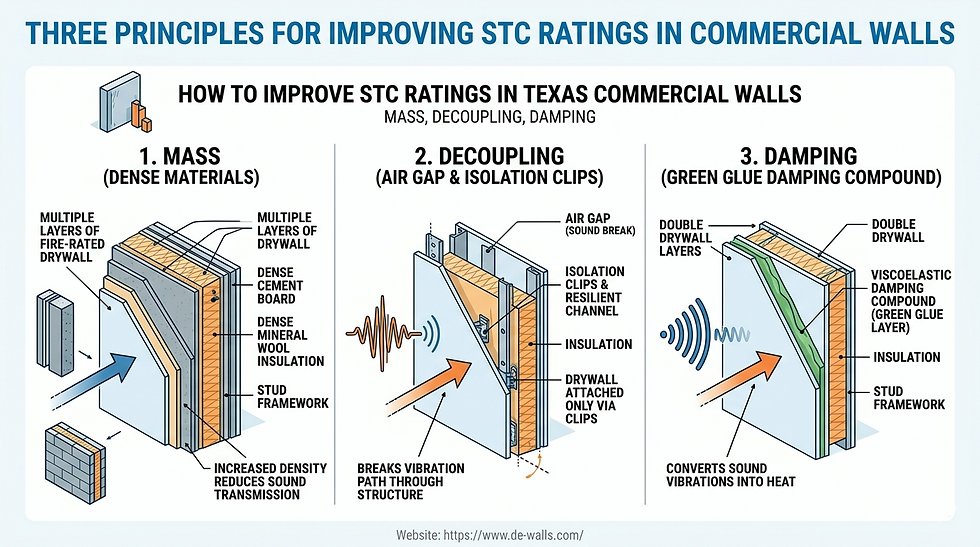
Every effective acoustic wall assembly is built on three physics-based principles: Mass, Decoupling, and Damping. Used together, they can push a wall assembly from STC 35 to STC 60 or beyond. Used in isolation, each has real limits.
Principle 1: Mass - More Material Means More Resistance
Sound is energy. Moving that energy through a wall requires vibrating the wall material. The more mass a wall contains, the more energy is required to move it, and the less arrives on the other side.
Mass options and their real STC contributions:
Wall Configuration | Approximate STC |
Single 5/8" drywall on standard steel studs | ~STC 35 |
Double 5/8" drywall on standard steel studs | ~STC 38–40 |
Double drywall + fiberglass batt insulation | ~STC 43–45 |
QuietRock 510 on 3-5/8" steel studs (24" o.c.) | STC 50–57 depending on cavity fill |
Key facts about QuietRock 510 for Texas commercial projects:
A 1/2-inch acoustic gypsum panel with a built-in viscoelastic damping layer.
According to manufacturer data, a single sheet performs comparably to approximately eight layers of standard drywall.
Installs using exactly the same process as standard drywall - no special tools or retraining required.
Material cost: approximately $50 to $60 per 4x8 sheet versus $10 to $15 for standard 5/8-inch drywall.
In Texas retrofit projects where floor area loss matters, its space efficiency frequently justifies the material premium.
Principle 2: Decoupling - Breaking the Vibration Path
Decoupling is the single most effective upgrade available in most Texas commercial acoustic projects. When drywall is screwed directly to studs on both sides of a wall, sound vibration travels from one face, through the screw, into the stud, and out the other side. The path is mechanical and efficient. Decoupling breaks that path.
Three decoupling methods, ranked by reliability and performance:
1. Resilient Channels (RC-1)
Material cost: approximately $0.30 to $0.50 per linear foot.
STC improvement: 5 to 8 points when correctly installed.
Critical warning: If drywall screws penetrate through the channel and contact the stud beneath - a mistake known as "short-circuiting" - the decoupling effect is completely eliminated. The channel becomes cosmetic and the STC gain drops to zero. This error is invisible after finishing and occurs on a significant percentage of Texas commercial builds.
2. Isolation Clips (RSIC-1 or equivalent)
Use a rubber isolator between the bracket and the framing for a more complete mechanical break.
Material cost: approximately $2 to $4 per clip.
STC improvement: 8 to 12 points in most commercial applications.
Significantly more tolerant of installation variation than resilient channels.
Recommended for any Texas project targeting STC 55 or higher.
3. Double Stud Walls
Two completely separate stud walls with an air gap - no shared framing at any point.
STC performance: 60 to 65+ with proper cavity fill and finishing.
Best for: recording studios, medical imaging suites, legal deposition rooms, and broadcast facilities.
Trade-off: consumes 6 to 8 inches of net floor area and costs $10 to $15 per square foot or more.
Principle 3: Damping - Converting Sound Energy Into Heat
Damping converts sound vibration energy into an imperceptible amount of heat through constrained layer damping. A viscoelastic compound placed between two rigid surfaces dissipates energy as those layers flex - stopping it from propagating as sound.
Green Glue Noiseproofing Compound:
Application: two tubes per standard 4x8 sheet (covers 32 square feet), applied in a random pattern between drywall layers.
STC improvement: up to 12 points per manufacturer data; typically 6 to 9 STC points in real-world Texas conditions when cavity insulation is also present.
Material cost: approximately $0.80 to $1.10 per square foot for the compound alone.
Acoustic sealant - the most underestimated investment in Texas commercial soundproofing:
Applied at all wall perimeters: floor-to-wall joint, ceiling-to-wall joint, and around every penetration.
A single 1/8-inch air gap at a wall perimeter can reduce effective STC performance by 5 to 10 points.
Standard silicone caulk hardens over time and develops micro-cracks that restore air paths.
Non-hardening acoustic sealant maintains its seal for the full life of the assembly.
At a few dollars per linear foot, it protects a multi-thousand-dollar wall investment.
The Cost-Per-STC-Point Table: What No Texas Contractor Will Show You

Use this table to evaluate whether a contractor's specification delivers real acoustic value - or just looks like it does on paper.
Upgrade Method | Approx. Material Cost/SF | Typical STC Gain | Key Limitation |
Extra 5/8" drywall layer only | $0.50–$0.75 | +3–5 pts | Lowest return per dollar invested |
Green Glue + extra drywall | $1.30–$1.85 | +6–9 pts | Excellent value when adding drywall is already planned |
Resilient channels (RC-1) | $0.30–$0.50/LF | +5–8 pts | Zero gain if short-circuited; high installation risk |
Isolation clips (RSIC-1) | $2.00–$4.00/clip | +8–12 pts | Most reliable; tolerates installation variation |
QuietRock 510 single layer | $1.70–$2.00 | +10–15 pts | Space-efficient; best Texas retrofit option |
Double stud wall assembly | $8.00–$15.00 | +15–25 pts | Maximum performance; significant floor area loss |
Note: Material cost estimates only. Installed labour in Texas commercial construction adds approximately $1.50 to $4.00 per square foot depending on project complexity and market. Always obtain a project-specific bid from a qualified Texas commercial acoustic contractor.
Flanking Paths: The Real Reason High-STC Walls Fail in Texas Commercial Buildings

Sound always takes the path of least resistance.
A correctly specified, properly installed STC 60 wall can still field-test at STC 40 - because sound is travelling around the wall rather than through it. These bypass routes are called flanking paths, and they are the leading cause of acoustic failure in Texas commercial spaces that look correct on paper.
A real-world Texas example: A mixed-use commercial project specified STC 55 demising walls between tenant suites. Post-construction field testing measured effective performance at STC 40. Investigation found that shared HVAC return air ducts had been left open between the two tenant spaces. Sealing the ductwork and addressing the ceiling junction brought tested performance back to STC 53 - without touching the walls.
The Seven Flanking Paths Most Common in Texas Commercial Construction
1. Back-to-Back Electrical Outlets
The single most common acoustic failure point in Texas commercial construction.
When electrical boxes are installed on opposite sides of the same stud cavity with no treatment, they create an open acoustic channel between spaces.
A pair of back-to-back outlets can reduce effective STC by 5 to 10 points.
The fix: Acoustic putty pads wrapped around each electrical box before drywall installation - a $5 solution protecting a $5,000 wall investment.
The reality: Missed on a substantial percentage of Texas commercial builds.
2. Shared HVAC Ductwork
The epidemic flanking path in Texas commercial strip centres and older flex-space buildings.
Structures built from the 1980s through the early 2000s frequently share HVAC ductwork between tenant spaces - sometimes across the entire building.
Sound travels efficiently through metal ductwork - a conversation in one suite can be understood two doors down.
Solutions, in order of effectiveness:
Reroute ductwork to give each tenant space a fully isolated HVAC run.
Install acoustic silencers or baffles at all penetration points.
Line duct interiors with fiberglass or closed-cell foam acoustic liner.
3. Suspended Ceiling Plenum
In most Texas commercial tenant spaces, the wall terminates at the ceiling grid - not at the structural deck. The plenum above the drop tiles is open and shared between adjacent tenancies.
Sound travels over the top of the wall through this plenum as easily as through an open doorway.
Two approaches to address this:
Deck-to-deck walls: Run the wall assembly from slab to structural deck. Most reliable solution for new construction and major renovations.
Plenum barrier: Acoustic batt insulation and a rigid barrier above the ceiling grid at the wall line, fully sealed to the deck. The most common retrofit approach in occupied Texas spaces.
4. Hollow-Core Doors
A standard hollow-core door tests at STC 20 to 28. A conference room with STC 55 walls and a hollow-core door has an effective acoustic performance governed entirely by the door - not the walls.
Door performance by type:
Hollow-core door: STC 20–28.
Solid-core wood door: STC 32–38.
Acoustic door with perimeter seals and automatic door bottom: STC 40–48.
For any space targeting STC 50 or higher: Specify the door as a complete system - frame, leaf, perimeter seal, and threshold seal.
5. Pipe and Conduit Penetrations
Every pipe, conduit, or duct passing through a wall creates a potential acoustic bypass.
Unsealed penetrations, even small ones, create direct air paths that measurably reduce effective STC.
All penetrations must be sealed with non-hardening acoustic sealant immediately after installation - before finish work covers them.
This applies to electrical conduit, plumbing, data cabling, and fire sprinkler lines.
6. Structural Connections
In concrete or steel frame Texas commercial buildings, sound vibration travels through the structural frame itself - bypassing wall assemblies by moving through shared columns, beams, and floor plates.
Most relevant for high-rise and mid-rise Texas commercial construction.
Requires acoustic engineering input at the structural detailing level - not just the wall specification level.
Particularly important in downtown Houston, Dallas, and Austin high-rise office construction.
7. Windows and Glass Partitions
Standard 1/4-inch tempered commercial glass tests at approximately STC 26 to 32.
Glass walls, sidelites, and corridor view windows are frequently the weakest acoustic link in an otherwise well-designed Texas office assembly.
Laminated glass: STC 36 to 42.
Full acoustic glazing assemblies: STC 48 to 52.
Glass that looks private is not acoustically private - specify accordingly.
The Flanking Audit Checklist - Use Before and After Construction
Use this checklist before construction begins and again before walls are closed. De-Walls includes a full flanking path audit as a standard part of every Texas commercial acoustic assessment.
All electrical outlets treated with acoustic putty pads - no back-to-back placement without treatment.
HVAC ductwork: no shared runs between tenant spaces; duct lining or silencers where sharing cannot be avoided.
Ceiling plenum addressed at wall termination - deck-to-deck construction or a fully sealed plenum barrier.
All doors: solid-core minimum STC 38+; acoustic door assemblies for all spaces targeting STC 50 or above.
All pipe and conduit penetrations sealed with non-hardening acoustic sealant before finish work.
Glass elements: laminated or acoustic glazing specified for all privacy-sensitive spaces.
Structural connections reviewed by an acoustic engineer in multi-story or concrete-frame Texas buildings.
Lab vs. Field STC: The 5-Point Gap Texas Business Owners Must Account For

Every wall assembly has two STC ratings. Knowing both - and the predictable gap between them - is what separates a specification that performs from one that only looks good in a submittal.
The three ratings defined:
Rating | What It Measures | When It Applies |
LSTC (Laboratory STC) | Best-case performance in a sealed, controlled lab | Product datasheets, manufacturer specifications |
FSTC (Field STC) | Real-world performance in a completed building | Post-construction testing; typically 2–5 pts below lab |
ASTC (Apparent STC) | Field performance including flanking transmission | Most honest real-world metric; used in compliance audits |
The Spec Rule for Texas Commercial Projects: Always Add 5 Points
Whatever your required field performance level, specify an LSTC assembly at least 5 points higher.
Required Field Performance | Specify This LSTC Assembly |
FSTC 50 (IBC code minimum) | LSTC 55 wall assembly |
FSTC 55 (medical, legal, hotel brand standard) | LSTC 60 wall assembly |
FSTC 60 (luxury hospitality, C-suite, legal suites) | LSTC 65 wall assembly |
This is not over-specification. It is realistic accounting for the predictable gap between certified lab conditions and Texas field construction reality. Franchise brand audits test field performance. HIPAA assessments evaluate real conditions. The 5-point buffer determines whether those evaluations pass or fail.
What Creates the Lab-to-Field STC Gap - And How to Prevent Each Cause
1. Resilient channel short-circuiting
Screws penetrate through the channel and contact the stud - eliminating decoupling entirely.
Performance loss: 5 to 10 STC points.
Invisible after finishing. Preventable only through installation inspection during construction.
2. Unsealed wall perimeters
The joint between wall and floor, ceiling, and adjacent elements must be sealed with non-hardening acoustic sealant.
Standard silicone hardens over time, cracks, and restores air paths.
Prevention: specify acoustic sealant by product name in the construction documents.
3. Missing cavity insulation
An unfilled stud cavity allows the internal air column to act as a sound transmission medium.
Adding unfaced fiberglass batt insulation is one of the least expensive acoustic improvements available - and one of the most consistently missed on Texas commercial builds.
Prevention: explicitly include insulation in wall assembly specification, not as a separate allowance.
4. Single versus double drywall layer
Specifications calling for two drywall layers sometimes arrive on-site as one - through misread documents or field substitution.
Prevention: verify layer counts during rough inspection, before finish work covers the wall.
How to Assess Your Existing Texas Commercial Space for STC Performance
Before committing to acoustic upgrades, establishing a performance baseline matters - whether you are inheriting an older space, evaluating a lease renewal, or auditing a franchise build-out that may have been constructed to minimum code rather than brand standard.
The Practical DIY Speech Test (Mapped to STC Estimates)
This is not a substitute for professional field testing. It provides a working estimate that indicates whether formal evaluation is warranted.
How to conduct the test:
Place one person in Room A, speaking at varying volumes.
Place a second person in Room B, listening at the wall surface with all background noise eliminated.
Test at multiple points along the wall: near outlets, near the ceiling line, and near the door frame.
Map what you hear to the table below.
What You Hear Through the Wall | Estimated STC Range |
Normal conversational voice fully intelligible | STC 25–30 |
Raised voice intelligible; normal voice muffled | STC 30–35 |
Loud voice audible and mostly understandable | STC 35–40 |
Loud voice audible but words inconsistently clear | STC 40–45 |
Loud voice present but not intelligible | STC 45–50 |
Shouting barely perceptible | STC 50–55 |
When to Bring in a Professional Acoustic Consultant
Engage a qualified consultant when any of the following apply:
Your business carries regulatory compliance obligations - healthcare, legal, or financial services.
A franchise quality assurance audit is within 12 months.
Your target STC is 55 or higher and you are working from existing construction.
Post-construction complaints or failed tests have already occurred.
The project involves multi-story construction with potential structural flanking.
The acoustic investment scope exceeds $25,000.
Three Questions to Ask Every Texas Commercial Acoustic Contractor
These questions separate contractors who understand commercial acoustics from those who are selling drywall work:
Question 1: "What is the FSTC-rated assembly you are specifying - not the lab rating?"
The answer you need includes a specific tested assembly reference number from a third-party testing report. A product name and an STC claim without a tested assembly reference is not a sufficient answer.
Question 2: "How are you addressing the ceiling plenum at the wall termination?"
If the answer is "walls go to the top of the ceiling grid," the contractor is leaving one of the most common acoustic failure points in Texas commercial construction completely unaddressed.
Question 3: "What acoustic sealant specification are you using, and exactly where is it being applied?"
The answer should name a specific non-hardening product and identify application at all wall perimeters, all penetrations, and all wall terminations. Confusion about this question is a meaningful signal.
Red Flags in Contractor Acoustic Bids
Watch for these warning signals in every Texas commercial acoustic proposal:
STC rating cited without a tested assembly reference number - only a product name and a claim.
No mention of plenum treatment or deck-to-deck wall specification.
Resilient channels listed with no installation verification protocol discussed.
Post-construction field testing not offered or available as a service.
Flanking path mitigation entirely absent from the scope of work.
Acoustic upgrades treated as a line-item add-on rather than a system-level specification.
Getting the Specification Right the First Time
Regardless of business type, the pattern behind every costly acoustic retrofit in Texas commercial spaces follows the same trajectory: the acoustic specification was made without input from someone who understands where real buildings fail - not just where products perform in a laboratory.
The difference between specifying STC correctly in the design phase and discovering the problem after occupancy involves three compounding costs:
Construction cost - Retroactive remediation in finished spaces costs 3 to 5 times more than specifying correctly upfront.
Operational cost - Noise complaints, failed franchise audits, and compliance violations generate measurable revenue impact.
Compliance cost - HIPAA enforcement, professional conduct exposure, and franchise penalty fees can dwarf the original construction budget.
For Texas business owners planning a new commercial build-out, a tenant improvement project, or a pre-audit franchise upgrade, the right time to get acoustic specifications reviewed is before construction drawings are finalised - not after the walls are closed and the complaints begin.
The team at De-Walls works with Texas commercial business owners, developers, architects, and contractors to get acoustic specifications right the first time. Whether the project involves a Houston medical clinic navigating HIPAA compliance, a Dallas law firm protecting client confidentiality, an Austin hotel preparing for a franchise QA audit, or a San Antonio corporate office addressing open-plan noise - the process starts with understanding what the space actually requires, not just what passes a code inspection.
Frequently Asked Questions

What is a good STC rating for a commercial building in Texas?
STC 50 is the IBC code minimum for most Texas commercial buildings. A genuinely good rating depends on your business type: medical and legal offices need STC 55 to 60, hotels need STC 54 to 60 depending on brand standards, and corporate conference rooms perform best at STC 55.
What STC rating is required by Texas building code?
Texas follows IBC 2021, which mandates a minimum laboratory STC 50 - or a field-tested FSTC 45 - for wall and floor-ceiling assemblies between dwelling units, sleeping units, and public corridors. Commercial office and retail spaces are not automatically covered by this threshold. Verify requirements with your specific city's building department before finalising any specification.
What does an STC rating of 50 mean?
STC 50 means loud speech is barely perceptible on the other side of the wall - present as a faint presence but not intelligible. It is the IBC minimum for Texas hotel guestrooms and assisted living. It is adequate for general commercial use but falls short of HIPAA, attorney-client confidentiality, or most franchise brand standards.
How do I increase the STC rating of an existing wall without tearing it down?
The three most effective retrofit methods are:
Add a second drywall layer with Green Glue damping compound - gains 6 to 9 STC points.
Address all flanking paths: outlet putty pads, plenum barrier above the ceiling grid, and solid-core door replacement.
Install a sound masking system to raise the ambient noise floor and reduce speech intelligibility.
Full decoupling upgrades require opening the wall and are done as part of a broader renovation scope.
What is the difference between STC and OITC?
STC measures mid-to-high frequency airborne sound (125 Hz to 4,000 Hz) - covering speech and office noise. OITC measures low-frequency sound below 125 Hz - bass music, HVAC rumble, truck traffic, and aircraft. Texas gyms, bars, and buildings near highways or airports need both metrics specified to fully address their noise environment.
Why does my STC 50 wall still let sound through?
Most likely, sound is travelling around the wall through a flanking path. Common causes include:
An open ceiling plenum above the wall termination.
Back-to-back electrical outlets with no putty pad treatment.
Shared HVAC ductwork running between spaces.
A hollow-core door rated at STC 20 to 28.
Unsealed pipe or conduit penetrations.
A single unaddressed flanking path can reduce effective field performance by 5 to 20 STC points.
How much does commercial soundproofing cost in Texas?
Commercial soundproofing in Texas typically runs $10 to $30 per square foot installed, depending on the method, materials, and target STC level. Basic Green Glue and drywall upgrades start at the lower end. Full double-stud wall assemblies with isolation clips and acoustic gypsum reach the higher range. Most Texas commercial acoustic projects run between $8,000 and $50,000+ depending on scope and performance target.
What is the STC rating of standard drywall?
Single 5/8" drywall on standard steel studs (no insulation): ~STC 35.
Double 5/8" drywall on standard steel studs: ~STC 38 to 40.
Double drywall with fiberglass batt insulation in the cavity: ~STC 43 to 45.
Achieving STC 50 or higher requires decoupling, damping compounds, or acoustic gypsum products such as QuietRock 510.
The Texas Business Owner's STC Quick Reference Checklist

Print this and keep it accessible through every phase of your next Texas commercial build-out or renovation.
Before Design is Finalised:
Identify your business type and confirm your required STC target using the business-type section above.
Verify your specific Texas city's code requirements - do not assume the IBC baseline is the only applicable standard.
Confirm whether your noise problem is STC (speech), OITC (bass/low frequency), or IIC (impact) - specify accordingly.
Engage an acoustic consultant or contact De-Walls before construction documents are finalised.
In the Specification Phase:
Specify LSTC assemblies 5 points above your target FSTC to account for predictable real-world field performance loss.
Specify plenum treatment explicitly in scope: deck-to-deck walls or a fully sealed plenum barrier at all wall heads.
Specify solid-core acoustic door assemblies for all privacy-sensitive spaces - hollow-core doors negate wall investment.
Request FSTC-rated tested assembly documentation from your contractor - product names and lab ratings alone are not sufficient.
During and After Construction:
Address all seven flanking paths before walls are closed: outlets, HVAC, plenum, doors, penetrations, structural, and glass.
Verify resilient channel installation has not been short-circuited before drywall is applied.
Confirm cavity insulation is installed in all specified wall assemblies.
Schedule post-construction FSTC verification before franchise brand audits, certificate of occupancy inspections, or HIPAA-sensitive space occupancy.
De-Walls is a Texas-based commercial acoustic wall specialist. For a project acoustic assessment, wall specification review, or post-construction FSTC field testing, visit de-walls.com. Serving commercial clients across Houston, Dallas, Austin, San Antonio, Fort Worth, Frisco, Plano, and throughout Texas.


Comments