


Acoustic Panels for Restaurants
Premium Sound Control That Lasts
Acoustic panels for restaurants are commercial-grade sound-absorption solutions engineered to reduce echo, reverberation, and background noise inside busy dining environments. Manufactured from high-performance materials - including fabric-wrapped fiberglass, high-density polyester, and natural wood fibre - premium restaurant acoustic panels can reduce in-room echo by up to 50% and are built to Class A fire safety standards required for commercial hospitality use. Available as wall-mounted panels, suspended ceiling baffles, and ceiling clouds, they integrate into any restaurant interior without sacrificing your design aesthetic.
Noise is the number one complaint in restaurant reviews - ranked above slow service, portion sizes, and high prices. The Zagat Dining Trends Survey confirmed it. Consumer Reports confirmed it. And yet, most restaurants open their doors with bare concrete floors, exposed ceilings, bare plaster walls, and glass partitions - every surface a near-perfect sound reflector - without a single acoustic treatment in sight.
The result is a dining room where guests strain to hear each other across the table, voices rise to compete with the background noise, and the room gets louder as it fills. This is not random. It is a documented physical phenomenon called the Lombard Effect, and it will happen in any untreated space regardless of how well your food is cooked or how attentive your service team is.
At De-Walls, we design, manufacture, and install acoustic wall panels and ceiling treatment solutions for restaurants that are built for the demands of a commercial hospitality environment - Class A fire-rated, durable under commercial cleaning regimes, and available in designs that complement rather than compromise your interior.
Why Restaurants Are So Loud - And Why It Is Getting Worse
Understanding the cause of restaurant noise is the first step toward fixing it. The problem is not simply a busy room. It is a room designed - often unintentionally - to amplify sound, combined with a physical phenomenon that accelerates the problem as the room fills.
The Lombard Effect: Why Your Dining Room Gets Louder as It Fills
The Lombard Effect is a well-documented acoustic and neurological phenomenon. Here is how it works, step by step:
-
The room fills. Four tables talk at a normal conversational level - around 60 dB.
-
Background noise rises. As more guests arrive, the ambient noise level increases.
-
Voices compensate. Everyone at every table unconsciously raises their voice to be heard above the noise.
-
The room gets louder. The increased voice level raises the background noise further.
-
The cycle accelerates. By a full service, guests are near-shouting across tables - and nobody planned it that way.
Here is where a typical busy restaurant sits on the decibel scale:
Key finding (2024 research): Diner noise complaints begin spiking at approximately 70 decibels. Reviews that mention excessive noise average a full star lower than those that do not. That is a direct, measurable commercial signal tied to the acoustic condition of your dining room.
How Modern Restaurant Design Creates an Acoustic Nightmare
The design trends that have dominated hospitality interiors for the past twenty years have systematically removed every element that once controlled noise organically. The changes that made restaurants look better made them sound significantly worse.
What has been removed - and what it was doing acoustically:
-
Carpet → bare concrete or hardwood: carpet absorbed mid and high-frequency sound across the entire floor plane. Bare floors reflect it.
-
Wallpaper and soft wall treatments → exposed brick and bare plaster: textured and soft wall surfaces diffused and absorbed sound. Hard surfaces reflect it.
-
Suspended acoustic ceilings → exposed industrial structure: acoustic tiles absorbed upward-travelling sound before it reflected back down. Open ceilings send it straight back.
-
Upholstered furniture → hard chairs and banquettes: padded seating absorbed sound at table level. Hard surfaces reflect it.
-
Heavy drapes and curtains → minimal window treatments: thick fabric at glazed surfaces absorbed sound. Bare glass reflects it at near-full energy.
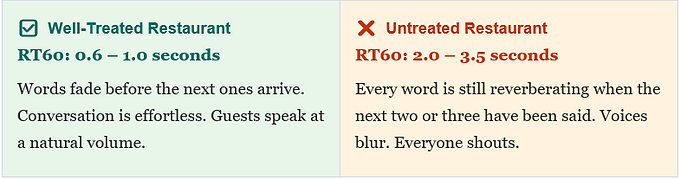
The result is a room where sound has nowhere to go but back into the faces of your guests. The measurement that captures this is called Reverberation Time (RT60): the number of seconds it takes for a sound to fade by 60 decibels after the source stops.
The Four Business Consequences of Poor Restaurant Acoustics
Excessive noise creates four specific, measurable commercial impacts that erode revenue quietly and consistently - none of which appear clearly on a profit and loss statement:
-
⭐ −1: Reviews mentioning excessive noise average a full star lower than those that do not (2024, University of Nebraska-Lincoln). A one-star increase in average online rating correlates with a 5–9% revenue uplift (Harvard Business School, Professor Michael Luca).
-
30–49: A half-star improvement on Google or Yelp makes a restaurant 30–49% more likely to sell out at peak hours (University of California, Berkeley).
-
Lower review scores and lost bookings. Noise complaints directly suppress ratings. With over 90% of diners checking reviews before choosing a restaurant, a suppressed rating is a lead-generation failure before the guest sets foot inside.
-
Shorter dwell time and reduced spend per cover. Exposure to noise above 75 dB triggers cortisol release - the physiological signal to leave. Guests in loud spaces eat faster, skip dessert and coffee, and decline upsells. Every one of these is lost revenue.
-
Accelerated staff burnout and turnover. US Health and Safety regulations require action when staff noise exposure exceeds 80 dB. Most busy restaurants operate at or above this level. Sustained exposure causes cognitive fatigue, more frequent service errors, and accelerated burnout, driving experienced staff to resign.
-
Suppressed taste perception. Research has shown that sustained high-decibel noise flattens the perception of sweetness and saltiness in food by triggering the release of stress hormones. A loud dining room does not just impair conversation - it literally makes your food taste worse to your guests.
What Are Acoustic Panels for Restaurants - And How Do They Work?
Acoustic panels for restaurants are wall-mounted or ceiling-mounted sound-absorption panels constructed from porous, high-density materials - such as fiberglass board, compressed polyester fibre, or wood wool - wrapped in acoustically transparent fabric or finished with a perforated surface. They work by converting sound wave energy into a negligible amount of heat through friction as sound passes through the panel's internal fibres, preventing it from reflecting back into the dining room.
Sound Absorption vs. Soundproofing: Do You Know the Difference?
This is the single most common point of confusion - and getting it wrong leads to the wrong investment. The distinction is straightforward:
The key question to ask: Does your noise problem exist inside the dining room - echo, reverberation, voice fatigue? Or does sound physically pass through shared walls to neighbours? The vast majority of restaurants need absorption. Acoustic wall and ceiling panels solve this directly.
The NRC Rating: What It Means and What to Specify
NRC stands for Noise Reduction Coefficient. It measures how effectively a material absorbs sound on a scale of 0.00 to 1.00, tested across the frequency range of 250 Hz to 2,000 Hz - which covers the entire human voice range and most restaurant noise sources.
Specification rule: Always specify NRC 0.85 or higher for restaurant acoustic panels. Panels below this threshold require a significantly higher quantity to achieve the same result - making them a false economy regardless of the lower unit cost.
How Acoustic Panels Physically Trap and Eliminate Sound
The physics behind acoustic panels is straightforward. Here is the step-by-step process:
-
Sound energy travels through the air as pressure waves - oscillating air particles moving outward from the source (a voice, music, clattering crockery).
-
The wave enters the panel surface through a porous or perforated face - the acoustically transparent fabric or covering.
-
The wave encounters the internal fibres of the core material - fiberglass, polyester, or wood wool - and friction occurs between the oscillating air and the fixed fibres.
-
Kinetic energy converts to heat. The friction converts the sound wave's energy into a negligible amount of heat. The energy is removed from the room.
-
The sound does not reflect back. Without the hard surface bounce, reverberation is eliminated at that point.
The two performance variables to understand:
-
Thickness - controls which frequencies are absorbed. 25mm handles high-frequency sounds (sharp consonants, glass clinks). 50mm covers the core speech range. 75–100mm reaches mid-bass (music, extractor fans). For most restaurants, 50mm is the practical sweet spot.
-
Density - determines how much energy is absorbed per square metre. Higher-density cores (such as 6 lb/ft³ fiberglass board) absorb more per unit than low-density foam. Density is the single biggest performance difference between commercial-grade panels and retail acoustic products.
The Best Types of Acoustic Panels for Restaurants in 2026
Not every panel type performs equally well in every area of a restaurant. The right specification depends on the room, the surfaces, the design aesthetic, and the specific noise challenge you are solving. Here are the five main types used in commercial restaurant acoustic treatment - with honest performance data and placement logic included.
1. Fabric-Wrapped Fiberglass Panels - The Commercial Benchmark
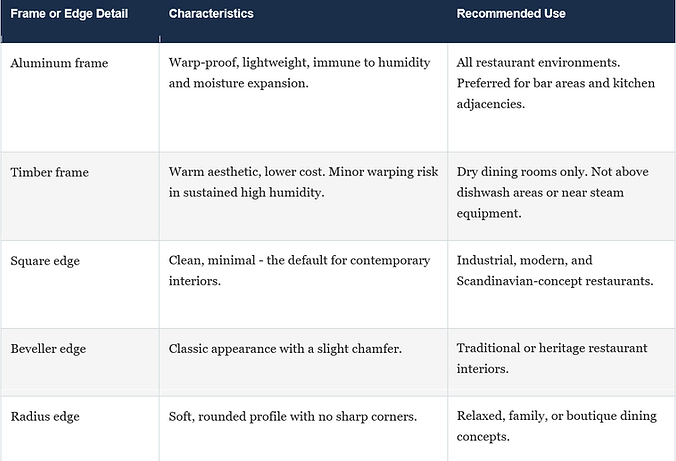
Fabric-wrapped fiberglass panels are the industry standard for commercial restaurant acoustic treatment. A rigid fiberglass core at 50mm thickness is wrapped in contract-grade acoustically transparent woven fabric and set in an aluminium or timber frame.
Performance specifications:
-
NRC rating: 0.90 to 1.05 - the highest available in the commercial panel market. Values above 1.0 may result from edge diffraction effects.
-
Fabric choice: 60 or more colours from contract fabric ranges - coordinate precisely with your interior palette or brand colour scheme.
-
Lifespan: 20 to 25 years with correct installation - significantly longer than any foam-based alternative.
-
Fire rating: Class A as standard when specified with FR (flame-retardant) contract fabric to BS EN 13501-1.
-
Frame material: Aluminium (warp-proof, ideal for humid environments) or timber (warm aesthetic, dry rooms only).
Best placement locations:
-
Rear and side walls of the main dining room.
-
Feature walls behind banquette seating and booth dividers.
-
Corridor panels between dining zones.
-
Private dining room walls.
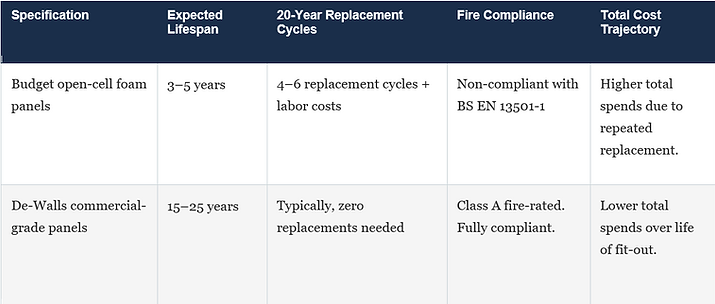
Why fiberglass outperforms foam: Open-cell acoustic foam loses its NRC performance as it compresses and degrades - typically within 3 to 5 years in a commercial environment. It also fails US commercial fire codes (BS EN 13501-1). It is not a compliant product for use in a working restaurant, regardless of its lower unit cost.
2. Acoustic Ceiling Baffles and Clouds - The Most Underused Solution
The ceiling is the single largest, most consistently reflective surface in most restaurant dining rooms - and the most neglected. Sound travels upward, hits the ceiling at full energy, and reflects back directly into the dining room. Wall panels alone cannot intercept this path. Ceiling treatment is required.
Two ceiling treatment options:
-
Ceiling baffles: vertically suspended rectangular panels that absorb sound on both faces simultaneously - effectively doubling the active absorption area per unit.
-
Ceiling clouds: horizontal panels suspended at a fixed height, creating a lower acoustic ceiling layer that intercepts upward-travelling sound before it reaches the hard structural ceiling above.
Key performance data and placement guidance:
-
NRC rating: 0.85 to 1.0 or above (both faces active on baffles).
-
RT60 reduction: ceiling treatment alone can reduce RT60 by up to 40% in large, open-plan dining rooms.
-
Best venues: industrial-style restaurants, converted warehouses, high-ceiling gastropubs, open-plan dining rooms, and venues where wall space is limited by windows or service equipment.
-
Aesthetic opportunity: baffles installed at varied heights and orientations create a striking three-dimensional ceiling feature - a deliberate design choice, not a fix.
-
Installation: adjustable wire suspension systems attached to the ceiling structure - height can be modified post-installation if required.
3. Decorative Acoustic Art Panels - Branding and Sound Control in One Investment
Custom-printed acoustic panels have become the fastest-growing category in commercial hospitality acoustics. High-resolution UV printing is applied directly to an acoustically transparent fabric surface, allowing any image, photograph, illustration, or design to appear at full panel scale without reducing sound absorption performance.
What makes these panels commercially powerful:
-
Same performance as standard panels: NRC 0.85 to 1.0 - the printed surface does not reduce acoustic performance.
-
Dual investment: a single installation budget covers both interior design and acoustic treatment. A standard panel is a cost. A branded panel is a décor investment.
-
Design options: restaurant logo, food photography, thematic artwork, abstract patterns, local landmarks, seasonal visuals.
-
Best for: branded restaurant groups, themed dining concepts, design-forward interiors, and spaces where the panel must contribute both visually and acoustically.
The De-Walls design process:
-
Submit your brief, existing artwork, or visual reference to De-Walls.
-
De-Walls produces a scaled, colour-accurate panel mockup for review.
-
You approve the design - or request revisions.
-
Panels are fabricated and installed to specification.
4. Wood Fibre and Natural Acoustic Panels - Premium Tactile Finish
For fine dining rooms, boutique wine bars, and design-led restaurants where materiality and tactile quality matter as much as function, compressed wood fibre panels - such as Timberwool™, cork composites, and pressed felt offer a warmth and character that no synthetic panel can replicate.
Technical specification:
-
NRC rating: 0.70 to 0.90 depending on thickness and material density.
-
Humidity resistance: most wood fibre panels are engineered to handle the moisture levels of a working kitchen or bar environment - always verify per product specification.
-
Fire classification: Class A or Class B, depending on specification - always confirm compliance before installation in a commercial space.
-
Best for: wine bars, farm-to-table restaurants, Scandinavian aesthetic dining rooms, fine dining rooms, and boutique hotel restaurants.
Design note: Natural fibre panels typically achieve slightly lower NRC ratings than fiberglass at comparable thickness. In a treatment plan, this means slightly higher surface coverage may be required. The trade-off is a material that contributes far more strongly to the room's design character - and for premium hospitality spaces, that is often the right specification.
5. High-Density Polyester Panels - Durable and Eco-Conscious
High-density polyester acoustic panels are manufactured from compressed recycled PET fibres, typically with 60–80% post-consumer recycled content sourced from plastic bottles. They deliver strong acoustic performance, carry Class A fire ratings, and resist moisture and mould under commercial cleaning regimes.
Performance and sustainability credentials:
-
NRC rating: 0.80 to 0.95 depending on thickness (standard range: 25mm to 50mm).
-
Moisture resistance: suitable for bar areas and spaces with regular humidity variation.
-
Mould and mildew resistance: important for ventilated kitchen adjacencies and dishwash-adjacent areas.
-
Sustainability: 60–80% post-consumer recycled content - valuable for restaurants pursuing sustainability certifications or operating under an ESG framework.
-
Lightweight: significantly easier to install in leased premises or spaces where drilling into structural elements is restricted.
-
Best for: fast-casual chains, café groups, food halls, high-footfall commercial environments, and leased premises.
Acoustic Panel Types at a Glance
Where to Place Acoustic Panels in a Restaurant - Room-by-Room Guide
Specifying the right panels is half the task. Placing them correctly is the other half. Even premium panels placed in the wrong locations will underperform. The following room-by-room guide provides specific, actionable placement logic for every zone of a working restaurant.
The coverage rule of thumb: Aim to treat 15–25% of combined wall and ceiling surface area to achieve a meaningful reduction in echo and reverberation. In rooms with particularly hard or reflective surfaces - bare concrete, full-height glass, polished tile - treatment at the higher end of this range will deliver the best results. Distribute panels evenly across the space rather than grouping them on a single wall.
The Main Dining Room - The Primary Acoustic Priority
Step 1: Diagnose before you specify.
-
The clap test: stand in the centre of your empty dining room and clap once, sharply. Count how long the sound rings. A ring lasting more than 1 second indicates an RT60 issue affecting every service you run.
-
Identify the hardest surfaces: bare rear wall, exposed ceiling, glass front elevation, and hard floor are the primary reflection offenders and the priority surfaces for treatment.
-
Plan even distribution: spread panels across the room. Clustering all treatments on a single feature wall creates an uneven acoustic environment rather than a well-balanced one.
Key placement principles for the dining room:
-
Treat the rear wall first - it carries the longest reflection path back to diners and is typically the highest-impact single surface.
-
Place panels at upper wall height - not just at eye level. Mid-ceiling reflections are the primary source of echo in most dining rooms.
-
Include ceiling treatment wherever possible - even one or two ceiling clouds above the main seating area produce a measurable improvement.
-
Use booth dividers as panel carriers- fabric-wrapped panels on them reduce the noise path between adjacent tables.
-
Avoid parallel reflective surfaces without treatment - a hard rear wall facing a hard front wall creates a flutter echo that panels on both ends can resolve.
The Bar Area - The Most Acoustically Demanding Zone
Bars within restaurants concentrate the most reflective surfaces into the smallest area: hard bar tops, ceramic tile, glass shelving, mirrored back bars, metal bar stools, and stone or concrete floors. This makes the bar area acoustically the hardest zone to treat in any restaurant - and often the loudest per square metre.
Priority interventions for the bar area:
-
Ceiling cloud above bar seating - even a single 1,200 × 600mm ceiling cloud above the bar seating area intercepts the primary vertical reflection path and makes an immediately measurable difference.
-
Fabric panels behind the back bar - panels placed between or behind shelving on the bar back wall address the primary reflective surface that guests face across the counter.
-
Parallel surface mitigation - if the back bar has a mirrored surface facing a glass front elevation, place panels on side walls to interrupt the parallel reflection path between them.
-
Under-bar soft elements - rubber bar mats, upholstered under-bar padding, and cork rail covers reduce the impact noise layer from glass setting and bottle handling - a small addition with a noticeable effect on the bar noise profile.
Private Dining Rooms and Event Spaces - Speech Clarity Over Volume
Private rooms require a different acoustic objective than the main dining room. In a general dining room, the goal is to reduce the overall noise floor. In a private dining room, the goal is speech intelligibility - ensuring every guest can hear clearly during toasts, presentations, or business discussions.
Specification targets for private dining rooms:
-
Target RT60: 0.4 to 0.6 seconds - tighter than a main dining room due to the smaller volume and single dominant conversation.
-
Coverage in small rooms: treat all four walls at 40–50% surface coverage in rooms under 30m² - small enclosed spaces build reverberation very quickly.
-
Speech Transmission Index (STI): for corporate private dining and event spaces, specify panels to achieve an STI of 0.60 or above for comfortable speech clarity end-to-end of a long table.
-
Confidentiality requirements: combine wall panels with brush-seal door sets and laminated double-glazed partitions for spaces where client confidentiality is required.
Open Kitchens - A Growing Design Trend With Acoustic Consequences
The open kitchen has become one of the defining trends of contemporary restaurant design. The energy it creates is commercially valuable. The acoustic consequence is real: every clatter, sizzle, and extractor fan previously contained behind a door is now delivered directly into the dining room.
How to manage open kitchen acoustics without losing the theatre:
-
Ceiling baffles above the pass - placed directly above the service pass and prep stations, baffles intercept kitchen noise before it spreads into the dining room air column.
-
Acoustic glazed screens - a glazed partition fitted with acoustic PVB-laminated glass (STC 35 or above)- reduce kitchen noise by a significant amount without compromising the visual concept.
-
Kitchen-side wall panels - fabric-wrapped or polyester panels on the wall immediately behind the kitchen line absorb reflected energy before it re-enters the dining room.
-
Do not over-treat the kitchen - the ambient sound of cooking is intentional in an open kitchen concept. The goal is to filter the noise, not to eliminate the experience.
Entrance Lobbies and Waiting Areas - First Acoustic Impressions
Acoustic impressions form within seconds of entering a space. A loud, reverberant entrance signals a stressful evening before guests are seated. A controlled lobby creates calm and positive anticipation. The lobby sets the acoustic expectation for the entire dining experience.
Practical lobby treatment steps:
-
Two to four panels on the softest available wall surfaces - ensuring fire exit routes remain unobstructed. Small enclosed spaces respond quickly to even minimal treatment.
-
A single ceiling cloud above the host station - dramatically improves speech clarity for the host and guest check-in exchange, a practical benefit guests notice immediately.
-
Dual-purpose artwork panels - a fabric-wrapped acoustic panel dressed as a framed artwork serves as both the first visual impression and the first acoustic treatment in a single installation.
What Makes Acoustic Panels 'Premium' - Fire Safety, Durability, and Long-Term Value
The acoustic panel market ranges from inexpensive foam tiles sold online to precisely engineered commercial panels built for decades of service. Understanding what separates them is essential before specifying any product for a working restaurant - particularly regarding fire safety compliance, fabric durability under commercial cleaning, and the total cost of ownership
Class A Fire Rating - The Non-Negotiable Commercial Requirement
Class A fire rating - tested to BS EN 13501-1 in the US and EU and ASTM E84 in North America - is the highest fire resistance classification for surface materials in commercial buildings. US Building Regulations (Approved Document B) require a minimum of Class B for wall and ceiling linings in commercial interiors. Class A is the gold standard and the specification De-Walls recommends for all restaurant installations.
Why this matters in practice:
-
Open-cell acoustic foam is NOT commercially compliant. It carries no BS EN 13501-1 classification; it is combustible in ways that rated panels are not, and installing it in a commercial restaurant may invalidate your fire risk assessment and buildings insurance.
-
Documentation provided: all De-Walls panels are supplied with fire test certification available for landlord approval, building control submission, and insurance documentation.
-
Listed buildings: De-Walls provides supporting specification documents for conservation officer review where required.
-
Specify Class A from the outset: retrofitting fire rating with sprays or coatings after installation does not achieve the same performance as a panel manufactured to the standard.
Fabric Durability in a Working Restaurant Environment
A restaurant acoustic panel must survive a demanding hospitality environment. The fabric choice determines whether your panels look pristine at year five or whether they are yellowing and sagging by year two.
What a working restaurant subjects panels to:
-
Grease vapour from cooking and open kitchen environments.
-
Steam from dishwash areas and hot-plate service.
-
UV exposure from front-of-house glazing.
-
Commercial cleaning chemicals applied to nearby surfaces.
-
Physical contact from staff and guests in tight dining spaces.
How to specify fabric correctly:
-
Contract-grade FR woven fabric: specify from ranges such as Camira, Guilford of Maine, or Cara Fabrics - tested to a minimum of 25,000 Martindale abrasion rubs and treated for soil resistance.
-
PVC-woven fabric for high-risk areas: for bar adjacencies and kitchen zones, PVC-woven fabric is fully wipeable with disinfectant-grade cleaners without colour degradation.
Maintenance guide - three steps:
-
Weekly: dry brush or light vacuum to remove airborne dust and grease particles.
-
Monthly: damp cloth with a mild, pH-neutral detergent. Do not saturate the fabric.
-
Spot cleaning: attend to splashes immediately with a clean, damp cloth. Avoid solvent-based cleaners, bleach, or ammonia - these degrade the FR treatment and alter fabric colour.
Frame Construction - What Is Inside the Panel Matters
The frame determines the panel's long-term structural integrity, particularly in environments with regular temperature and humidity variation.
Mounting system guide:
-
French cleat: allows panels to be removed and remounted - ideal for leased premises where reversibility is required at end of tenancy.
-
Impaling clips: permanent, high-strength fix - used for heavy panels or installations where removal is not required.
-
Adhesive: suitable only for lightweight panels under 4 kg. Should not be the sole fixing method for panels above eye height in a public space.
Total Cost of Ownership - Why Premium Specification Pays
The upfront investment in commercial-grade acoustic panels is higher than budget alternatives. The total cost over the life of the fit-out tells a different story:
The investment reframe: Quality acoustic panels installed in a mid-size restaurant represent one of the lowest annual cost line items in the entire fit-out when amortised over their lifespan. The commercial benefits - improved review scores, greater dwell time, lower staff turnover - compound from day one. Request a free consultation from De-Walls to understand the specification and investment for your specific space.
How De-Walls Supplies and Installs Acoustic Panels for Restaurants
Buying acoustic panels off a shelf is one thing. Getting the right panels, correctly specified, precisely placed, and professionally installed - with documented performance outcomes and full fire safety certification - is a fundamentally different service. Here is how our end-to-end process works.
Our 6-Step Restaurant Acoustic Treatment Process
-
Site Assessment. An in-person visit to your restaurant or a structured review of your architect's floor plans, room dimensions, and surface material schedule. We identify primary noise sources, existing reflective surfaces, ceiling heights, and any constraints - listed building status, lease restrictions, or kitchen adjacencies.
-
Room Analysis. Using acoustic modelling, we calculate your estimated current RT60, identify the highest-impact surfaces for treatment, and determine the quantity and panel specification required to achieve a target acoustic performance. For complex or large venues, we conduct on-site RT60 measurements.
-
Panel Specification and Layout Design. A full written specification covering panel type, NRC rating, thickness, dimensions, fabric or surface finish - alongside a room layout drawing showing the exact placement of every panel. You see the outcome before anything is manufactured.
-
Custom Fabrication. Every De-Walls panel is manufactured to your specification. We do not stock generic off-the-shelf panels and guess what will work. All panels are made to your room's exact requirements - including custom dimensions, colours, and printed surface finishes.
-
Professional Installation. Our team fits all panels, all fixings, and all finishing details. We schedule installation around your trading hours wherever possible. Most restaurant installations are completed within one to two days without requiring a full trading closure.
-
Post-Installation Review and Sign-Off. A final walkthrough and, where on-site measurements were taken pre-installation, a comparative acoustic check. You receive written performance documentation and a maintenance guide for your records.
Custom Design and Bespoke Fabrication Capabilities
De-Walls offers a full custom design service for restaurant clients who want panels that function as interior features. Our custom acoustic panel service includes:
-
Full-colour UV printing: submit any artwork, photography, logo, or design brief and we produce a full-scale printed acoustic panel.
-
Bespoke shapes: hexagonal, circular, irregular, and dimensional panel designs are all available - not limited to standard rectangles.
-
Custom frame finishes: RAL colour-matched powder-coat frames to match any interior paint scheme.
-
Architect and designer collaboration: De-Walls accepts AutoCAD and PDF room plans for integration into specifications as part of a wider fit-out project.
Who De-Walls Works With
De-Walls provides acoustic wall panels for restaurants, cafés, bars, and hospitality venues across the full commercial spectrum - from independent neighbourhood restaurants to national groups, from fast-casual café fits to Michelin-level fine dining rooms. We work directly with:
-
Restaurant owners and operators.
-
Hospitality interior designers and architects.
-
Main contractors managing fit-out programmes.
-
Hotel groups with restaurant and bar operations.
-
Property developers fitting out commercial dining spaces.
If you have a fit-out in planning, a new venue under construction, or an existing space generating noise complaints, contact De-Walls for a free, no-obligation initial consultation. Provide your room dimensions and we will produce a panel quantity estimate and indicative specification at no charge - with no obligation to proceed.
The Return on Investment: Why Acoustic Panels Are Worth It for Your Restaurant
Acoustic treatment is less visible as an investment than a new oven or a kitchen hire. Its financial return is therefore less obvious - but the evidence for it is consistent, well-documented, and significant across three specific commercial drivers.
ROI Driver 1 - Improving Review Scores and Online Visibility
Noise is the top complaint in restaurant reviews across every major platform: Google, TripAdvisor, and Yelp. Reviews that explicitly mention noise or loudness average a full star lower than those that do not. Given that over 90% of diners check reviews before choosing where to eat, a suppressed star rating is a direct barrier to acquiring new guests, before they have even considered visiting.
The revenue evidence is unambiguous:
-
Harvard Business School (Professor Michael Luca, 2016): a one-star increase in average online rating correlates with a 5–9% revenue increase
-
University of California, Berkeley (Anderson & Magruder, 2012): a half-star improvement makes a restaurant 30–49% more likely to sell out at peak hours
-
2024 research (University of Nebraska-Lincoln): noise complaints begin at 70 dB and reviews mentioning noise average one star lower than those that do not.
What this means practically: If noise complaints are currently dragging your rating from a potential 4.4 down to 3.8, eliminating those complaints is not a satisfaction improvement - it is a revenue intervention. Acoustic panels that remove noise reviews directly move the needle on one of the highest-leverage commercial metrics available to a restaurant owner.
ROI Driver 2 - Increasing Dwell Time and Spend Per Cover
Guests in a comfortable acoustic environment stay longer and spend more. The mechanism operates on two levels:
Physiological level:
-
Sustained noise above 75 dB triggers cortisol release - the stress hormone that increases the subconscious urge to leave a space.
-
Comfortable guests experience lower cortisol levels, linger naturally, and are more receptive to dessert menus, additional drinks, and upsell from attentive service.
Sensory level:
-
Research has shown that loud environments suppress the perception of sweetness and saltiness in food by interfering with the gustatory system through cortisol and adrenaline.
-
A loud dining room makes your food taste objectively worse to your guests - regardless of what your kitchen produces.
-
Controlled acoustics allow the quality of your food to land as intended, which supports positive reviews, repeat visits, and word-of-mouth recommendations.
ROI Driver 3 - Reducing Staff Fatigue and Turnover Costs
The US hospitality sector experiences annual staff turnover of 75–80%, among the highest of any industry. Chronic noise exposure is a consistent, underacknowledged contributor. Here is the chain of consequence:
-
Service exposure to 85 dB or above causes measurable cognitive fatigue.
-
Fatigue increases service errors and lapses in attentiveness.
-
Accumulated fatigue across a working week contributes to burnout.
-
Burnout drives experienced staff to resign - often to less demanding sectors.
-
Each replacement hire costs between £1,500 and £3,000 in recruitment, onboarding, and productivity gap costs.
Acoustic treatment does not, by itself, solve the problem of staff retention. But it removes one of the most persistent environmental stressors in a restaurant workplace - and for a team already working long hours under significant pressure, reducing the noise load materially improves working conditions and the quality of the service environment.
Frequently Asked Questions
Do acoustic panels actually work in restaurants?
Yes - acoustic panels are the single most effective non-structural intervention for reducing echo and reverberation in a commercial restaurant. When correctly specified and installed, they can reduce in-room echo by up to 50% and lower RT60 to the comfortable target range of 0.6 to 1.0 seconds.
-
They absorb sound energy that would otherwise bounce between hard surfaces.
-
Wall panels and ceiling baffles used in combination deliver the most complete result.
-
Results are immediate - no curing or settling time is required after installation.
-
Browse De-Walls' restaurant acoustic panel range to see product options.
What is the difference between acoustic panels and soundproofing?
Acoustic panels reduce echo inside a room. Soundproofing prevents sound from travelling between rooms. These are different problems that require different solutions.
-
Acoustic panels: absorb reverberation - they control noise that is already inside your dining room.
-
Soundproofing: uses mass, decoupling, and sealing to block sound from entering or leaving a space.
-
Most restaurants need acoustic absorption. If sound is also penetrating shared walls or floors, both solutions may be required.
How many acoustic panels do I need for a restaurant?
As a starting point, treat 15–25% of combined wall and ceiling surface area to achieve a noticeable improvement in echo and reverberation.
-
A 100m² dining room with 3m ceilings typically requires 15 to 25 standard panels (1,200 × 600mm).
-
Rooms with harder surfaces or higher ceilings require treatment toward the higher end of the range.
-
Distribute panels evenly - clustering all panels on one wall is less effective than spreading them across the space.
-
Request a free panel quantity estimate from De-Walls - provide your room dimensions and we calculate the requirement at no charge.
Where should acoustic panels be placed in a restaurant?
Place panels at the primary reflection points: the rear wall, upper side walls, and the ceiling above the main seating area.
-
Start with the rear wall and upper wall surfaces - these carry the longest and most damaging reflections.
-
Add ceiling baffles or clouds above the main dining zone for the highest single-area impact.
-
Treat bar areas with ceiling clouds directly above bar seating and panels behind the bar back wall.
-
Avoid placing all panels at eye level - this misses the ceiling-bounce reflection path entirely.
Are acoustic panels worth it for a restaurant?
Yes - the return on investment is measurable across three specific areas: review score improvement, increased spend per cover, and reduced staff turnover.
-
Reviews mentioning noise average one star lower - removing noise complaints directly improves ratings.
-
A one-star rating increase correlates with a 5–9% revenue uplift (Harvard Business School).
-
Comfortable guests linger longer, order more, and are more likely to return and recommend.
-
Read about De-Walls' restaurant acoustic solutions and request a free initial assessment.
How do I reduce noise in my restaurant without major building work?
Acoustic wall and ceiling panels require no structural work whatsoever - they are surface-mounted and can be installed in one to two days with no disruption to the building fabric.
-
Wall panels fix directly to existing wall surfaces using French cleats, impaling clips, or heavy-duty fixings.
-
Ceiling baffles suspend from wire systems attached to the ceiling structure - no ceiling penetration required.
-
French cleat mounting systems are fully reversible - ideal for leased premises with dilapidation clauses.
-
No plastering, rewiring, or structural alteration of any kind is required.
Can acoustic panels be cleaned in a restaurant?
Yes. Commercial-grade acoustic panels use contract fabric rated for regular cleaning in a hospitality environment.
-
Weekly: dry brush or light vacuum to remove airborne dust and grease particles.
-
Monthly: damp cloth with a mild, pH-neutral detergent. Do not saturate the fabric.
-
Spot cleaning: attend to splashes immediately with a clean damp cloth. Contract fabrics are soil-resistant when treated promptly.
-
Avoid: solvent-based cleaners, bleach, ammonia, or high-pressure steam - these degrade the FR treatment and alter colour.
-
Bar and kitchen areas: specify PVC-woven fabric panels for full wipeability with disinfectant-grade products.
Will acoustic panels make my restaurant feel too quiet or 'dead'?
No. The goal of acoustic treatment is comfort, not silence. A properly treated restaurant retains its ambient energy, music, and the natural hum of a full-service restaurant.
-
The target RT60 for a restaurant is 0.6–1.0 seconds - a live, energetic acoustic environment, not a recording studio.
-
What treatment removes is the painful echo, the voice-straining Lombard Effect spiral, and the fatigue of a wall of muddied sound.
-
Guests still hear each other, feel the energy of the room, and enjoy a busy service - without having to shout to participate in it.
-
Good acoustic design uses absorption to control the harshest reflections while allowing the room to feel alive and social.
Get Your Free Restaurant Acoustic Assessment from De-Walls





Why Choose Us?
Premium Quality Materials
Our soundproofing materials are crafted from high-quality, durable materials that effectively block out unwanted noise, ensuring maximum sound reduction.
Expert Installation Services
Leave the installation process to our team of experienced professionals. We ensure that your soundproofing solution is installed seamlessly and efficiently, minimizing disruption to your daily routine.
Customized Solutions
Every space is unique, and we understand that one size does not fit all. That's why we offer customized soundproofing solutions tailored to your specific needs and requirements.
Enhanced Comfort and Privacy
Every space is unique, and we understand that one size does not fit all. That's why we offer customized soundproofing solutions tailored to your specific needs and requirements.

Get Started Today
Transform your living or working space into a peaceful sanctuary with De-Walls Acoustic Specialties. Say goodbye to noisy distractions and hello to uninterrupted tranquility. Contact us today to schedule a consultation with one of our soundproofing experts and take the first step towards a quieter environment. Experience the De-Walls difference today!