


Acoustic Doors for Noise Reduction Supply & Installation
Acoustic doors are engineered door systems purpose-built to block noise between spaces. They achieve noise reduction ratings from STC 30 up to STC 64 - using dense core materials, perimeter compression seals, automatic door bottoms, and acoustically sealed frames. DeWalls supplies and professionally installs acoustic doors across Texas and Florida for commercial offices, recording studios, healthcare facilities, hotels, industrial facilities, and residential properties.
Noise does not read floor plans. It travels through the smallest gap, turns corners without effort, and always finds the weakest point in a room’s construction. In the vast majority of US buildings - offices, hotels, hospitals, and homes alike - that weakest point is not the wall or the ceiling. It is the door.
Think about the corporate conference room where every sensitive conversation bleeds into the open office outside. Or the recording studio where thousands of dollars of equipment cannot overcome the sound leaking through a hollow interior door. Or the HIPAA-protected exam room where a patient’s diagnosis drifts into the waiting area.
These are not edge cases. They happen every day in buildings across the country that were never designed with proper acoustic control in mind. The solution is rarely to rebuild the walls. In almost every case, the answer is to replace the door with a properly specified, professionally installed acoustic door.
Acoustic doors are complete systems - not simply heavier doors. They combine engineered core mass, precision perimeter sealing, specialist acoustic hardware, and acoustically sealed frames to deliver a certified, measurable level of noise reduction. When every element is correctly specified and installed, an acoustic door is the single highest-impact upgrade available in any soundproofing project.
What Is an Acoustic Door? How It Works & Why Standard Doors Fail
An acoustic door is a specially engineered door system designed to reduce sound transmission between two spaces. It combines high-density core materials, a four-point perimeter sealing system, an automatic door bottom, and a precision-fitted acoustic frame to achieve measurable noise reduction - rated in decibels (dB) using the internationally recognised STC (Sound Transmission Class) standard (ASTM E413) and the European equivalent Rw (Weighted Sound Reduction Index) (ISO 717-1).
One important distinction to make from the outset: the terms acoustic door and soundproof door are frequently used interchangeably, but they do not mean the same thing.
-
Soundproof door implies total elimination of sound - which is physically impossible in any real building.
-
Acoustic door is the correct technical term. It refers to a door that has been independently tested and rated to deliver a specific, measurable level of noise reduction. The rating is verified under laboratory conditions to ASTM E90 (laboratory measurement of airborne sound attenuation of building partitions and elements).
Why Standard Doors Fail at Noise Reduction
Most interior doors found in US offices, hotels, hospitals, and homes provide virtually no meaningful acoustic performance. A standard hollow-core door typically achieves somewhere between STC 20 and STC 25 - barely better than an open doorway in real-world terms. There are three compounding reasons for this failure.
-
No core mass. Hollow-core doors weigh between 15 and 25 pounds. Sound energy passes through lightweight materials almost unimpeded.
-
No perimeter sealing. Standard door frames are not sealed against the surrounding structure, leaving continuous air paths through which sound travels freely around all four edges of the door.
-
No threshold seal. The gap beneath a standard door - often 3/8 to 1/2 inch - is the single largest acoustic failure point in any room. Research shows that a gap of just 1/8 inch under a door can reduce an otherwise well-specified assembly from STC 52 to an effective field performance of STC 21.
This is what acoustic engineers call the weakest-link principle. Sound follows the same path as air. Close every gap in the wall but leave a gap under the door, and that one gap transmits more noise than the entire wall combined. Acoustic doors are engineered to eliminate all three failure points simultaneously. If you are experiencing this in your building, our noise control solutions page explains the full range of options available beyond the door itself.
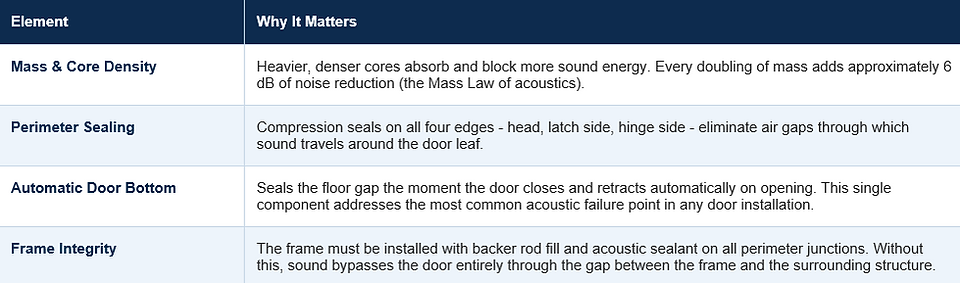
The Four Non-Negotiable Elements of a True Acoustic Door
Every acoustic door that performs to specification shares four fundamental characteristics. Remove any single one and performance degrades significantly.
⚠️ Important
The system only works when all four elements are present and correctly installed. Buying an acoustic-rated door leaf and fitting it in a standard frame with standard hardware delivers very little real improvement. This is one of the most common and expensive mistakes made in acoustic door installations.
How Acoustic Doors Block Noise – The 3 Core Engineering Principles
Understanding how acoustic doors actually work enables better specification decisions and ensures correct installation. Three engineering principles govern performance - and each has a direct practical implication for how a door is built and fitted.
Principle 1 - Mass Law: Why Weight Is the Starting Point
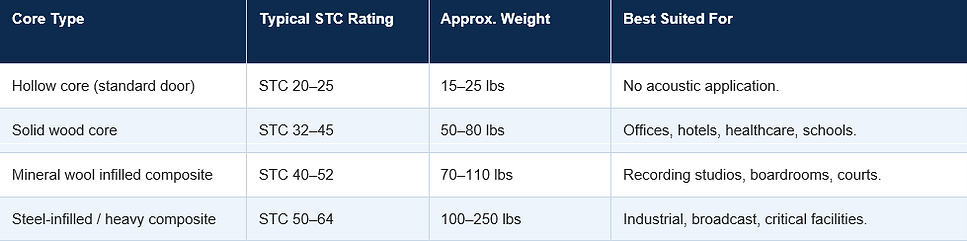
The Mass Law of acoustics states that doubling the mass of a panel increases its sound reduction index by approximately 6 dB. In practical terms, this is why an acoustic door is dramatically heavier than a standard interior door. A hollow-core door weighs between 15 and 25 pounds. A heavy-duty steel acoustic door can weigh over 250 pounds. Here is what that mass difference means across the available core types.
What this means for specification:
-
Hollow-core doors should never be used in any acoustic application, regardless of the sealing system applied.
-
Solid wood core doors are the correct starting point for offices, hotels, and healthcare applications.
-
Mineral wool infilled composite doors deliver the next level of performance for studios and boardrooms.
-
Steel-infilled doors are required where STC 50 and above is specified - typical in industrial, broadcast, and critical facility applications. See our industrial noise control services for context on where these specifications arise.
Principle 2 - The Four-Point Sealing System
Mass alone is never sufficient. Even the densest door leaf will allow sound to bypass it through perimeter gaps that are invisible to the naked eye. A complete acoustic door sealing system closes four distinct points of potential leakage.
-
Head Seal (Top Seal). A compression seal fitted to the top of the door frame, closing the gap between the door leaf and the frame head. Without this seal, high-frequency sound bypasses the door at its highest point - a path most people never think to check.
-
Adjustable Jamb Seals. Compression seals running down both the hinge side and the latch side of the door. The word “adjustable” matters - door frames shift as buildings settle, especially in Texas where seasonal temperature swings cause significant expansion and contraction of wood framing. Regular re-tensioning maintains consistent contact.
-
Automatic Door Bottom (ADB). The single most critical component in any acoustic door assembly. When the door is open, the ADB retracts flush with the door base. As the door closes, a plunger engages against the door stop and drops a neoprene seal across the full width of the threshold. It retracts automatically on opening. No dragging. No manual adjustment on each use.
-
Magnetic Perimeter Seal. Used in the highest-specification applications. Full-perimeter magnetic seals operate on the same principle as a refrigerator door - self-aligning, consistently compressed on every close, and less dependent on mechanical adjustment over time.
One component that is frequently overlooked but essential on high-performance doors is the cam-lift hinge. These specialist hinges lift the door slightly during its opening swing and lower it precisely into position on closing - ensuring the automatic door bottom engages cleanly with the threshold every single time.
⚠️ Critical Installation Note
All four seal points must perform simultaneously and completely. A single broken or worn seal creates a sound leakage path that can reduce the effective performance of the entire assembly by 30 to 50 percent or more.
Principle 3 - Frame & Installation Integrity
The door leaf and sealing system attract most attention during specification. The frame installation is the element that most often determines whether the door achieves its rated performance in the field.
Here is what correct acoustic frame installation involves:
-
Remove the existing door, frame, and all perimeter finishes back to the structural opening.
-
Pack every gap between the new acoustic frame and the surrounding wall with backer rod and acoustic-grade sealant.
-
Seal all exposed junctions on both faces - front and back of the wall - with acoustic caulk, ensuring zero air pathways remain.
-
Install the acoustic frame to plumb, level, and square before any door leaf or hardware is fitted.
Failing to follow this sequence creates flanking paths - continuous air passages that allow sound to bypass the door entirely through the gap between the frame and the surrounding structure. An acoustic door rated STC 50 installed in a poorly sealed frame can deliver real-world field performance of STC 35 or less. The door has not changed. The installation has failed it. This is why our professional installation team handles every project from frame prep through final seal commissioning - nothing is left to a general contractor unfamiliar with acoustic standards.
Acoustic Door Performance Ratings Explained – STC, Rw & NIC in Plain English
Performance ratings are the language of acoustic specification. You cannot choose the right acoustic door without understanding what these numbers represent and how they apply to your specific project.
The Three Ratings You Will Encounter
-
STC (Sound Transmission Class). The primary US standard is defined under ASTM E413. A laboratory-measured figure expressed in decibels, representing the average noise reduction capacity of the door across a standard range of frequencies from 125 Hz to 4,000 Hz. STC is the rating you will see on almost every acoustic door data sheet supplied in the United States. Read more about how this rating works on the STC.
-
Rw (Weighted Sound Reduction Index). The European equivalent is defined under ISO 717-1. Broadly comparable to STC in most practical applications, though the two methodologies differ slightly in how they weight low frequencies. Many premium acoustic door manufacturers publish both figures.
-
NIC (Noise Isolation Class). A field-measured rating rather than a laboratory figure. NIC represents the acoustic performance actually achieved between two spaces after installation, accounting for real-world variables including flanking paths, installation quality, and structural imperfections. NIC is almost always lower than the laboratory STC or Rw rating - sometimes by 10 to 15 dB. This gap is why a professional site consultation before specification is always worthwhile.
Acoustic Door Performance Reference Guide
Use this table as a practical guide to selecting the right performance specification for your project.
⚠️ Important Buyer Guidance
The Weakest-Link Rule: A room’s total acoustic performance is determined by its weakest element. An STC 55 acoustic door in a wall rated STC 35 will deliver combined performance of approximately STC 35. Walls, floor, ceiling, and door must all be specified to comparable ratings for the target performance to be achieved.
Key takeaways from the performance data:
-
Every 10-point STC increase roughly halves the sound energy passing through the assembly.
-
STC 40 is the practical minimum for meaningful speech privacy in offices, healthcare, and hospitality settings.
-
STC 50 is the baseline for professional recording studios, boardrooms, and courtrooms.
-
STC 55 and above is reserved for broadcast facilities, critical infrastructure, and high-demand industrial applications.
Acoustic Door Types – Solid Wood, Steel, Glazed & Sliding Options
Choosing the right acoustic door means matching the product to the application, the performance requirement, and the aesthetic context. We supply five acoustic door types across solid wood, steel, glazed, and sliding configurations.
1. Solid Core Wood Acoustic Doors
Solid core wood acoustic doors are the most widely specified type for commercial interiors and the preferred choice wherever aesthetics matter alongside performance. A solid core wood acoustic door is an engineered assembly - not simply a heavy piece of lumber.
What is inside a solid-core wood acoustic door:
-
Multiple laminated wood layers for structural rigidity and mass.
-
Acoustic infill material - typically mineral wool or acoustic foam board - to absorb sound energy within the core.
-
Hardwood lipping on all four edges to support the precision sealing system.
-
A decorative surface finish in paint, lacquer, or veneer.
Key specifications:
-
Performance range: STC 32 to STC 45, depending on core specification and sealing system.
-
Best suited to: Corporate offices, hotels, healthcare facilities, K-12 and higher education buildings, and residential properties.
-
Finish options: Any paint color, natural wood veneer, high-gloss lacquer, or fire-rated paint finish.
-
Configurations: Single-leaf, double-leaf, over-height, and any non-standard width - all manufactured to the exact dimensions of the surveyed opening.
-
Hardware: Standard lever sets, electronic access control, electromagnetic hold-open devices, panic hardware, and emergency exit devices.
The aesthetic advantage of solid-core wood acoustic doors is significant. In spaces where interior design matters - a premium hotel lobby, a corporate reception, a healthcare consulting suite - the acoustic solution should be invisible. See our commercial soundproofing work for real project examples where this balance was achieved.
2. Heavy-Duty Steel Acoustic Doors
When the performance requirement exceeds what wood construction can reliably deliver - or when security and fire resistance are required alongside acoustic performance - steel acoustic doors are the correct specification.
What is inside a heavy-duty steel acoustic door:
-
Heavy-gauge outer steel skins over a high-density acoustic infill core.
-
Mineral wool or lead-composite infill material for maximum sound absorption.
-
Welded steel sub-frame for structural rigidity and seal support.
Key specifications:
-
Performance range: STC 50 to STC 64.
-
Best suited to: Recording studios, broadcast facilities, mechanical rooms, data centers, server rooms, and secure communications rooms.
-
Fire rating: Combinable with 20-minute, 45-minute, 60-minute, or 90-minute fire resistance in a single UL-listed certified product.
-
Security: Heavy-gauge steel construction provides inherent forced-entry resistance.
-
Supply option: Available as pre-hung, factory-assembled units for straightforward installation by approved contractors.
For industrial and manufacturing environments across Texas and Florida, our industrial noise control and vibration services explain how steel acoustic doors fit into a broader OSHA-compliant noise engineering strategy.
3. Acoustic Glazed Doors with Vision Panels
A persistent misconception is that acoustic doors cannot include glazing. This is not correct. Acoustic vision panels using laminated double or triple-glazed units with specialist interlayer films can be incorporated into both wood and steel door leaves without significantly compromising the overall acoustic rating.
Key specifications:
-
Performance: Acoustic laminated glazing achieves STC 38 to STC 45 or higher when correctly specified.
-
Best suited to: Conference rooms, broadcast studio observation points, school classrooms, healthcare consulting corridors, and open-plan office screens.
-
Glazing types: Laminated acoustic glass, double or triple-glazed acoustic units, and spaced cassette glazing systems.
-
Panel sizes: Bespoke to project requirements, from small observation panels to full-height glazed leaves.
4. Acoustic Sliding Doors
Where a swing door is not practical due to space constraints, unusually wide openings, or specific operational requirements, acoustic sliding doors provide an effective alternative. A well-specified sliding acoustic door can achieve STC 35 to STC 45.
Key specifications:
-
Sealing method: Specialist magnetic edge seals and drop-down threshold seals replace the compression system used on swing doors.
-
Best suited to: Wide openings in hospitality spaces, home theater rooms, open-plan office dividers, and residential entertainment spaces.
-
Important consideration: Single-leaf sliding doors are limited in maximum width before their weight requires specialist track and support hardware.
-
Double-leaf options: Wider openings can be addressed with double-leaf sliding systems, though these introduce additional sealing challenges at the central meeting stile.
If you are specifying acoustic sliding doors for a home theater or dedicated media space, our media rooms service page covers the full acoustic design approach for entertainment spaces.
5. Bespoke Acoustic Doors for Non-Standard Openings
A significant proportion of acoustic door projects involve non-standard openings. We treat every opening as a custom project. Every acoustic door we manufacture is made to the exact dimensions of the surveyed opening - no standard sizes trimmed or forced to fit.
Bespoke options available:
-
Factory-fitted glazing panels, pre-selected and confirmed before manufacture.
-
Pre-mortised hardware cutouts for access control, panic bars, and vision panels.
-
UL fire-label certification on delivery.
-
Custom powder-coat or wet-paint finishes to any color specification.
-
Full CSI specification section support for architects and contractors.
Where Are Acoustic Doors Used? Applications Across Every Sector
The right performance specification varies significantly between applications. Here is how acoustic doors deliver measurable results across every major US industry - and what to look for in each.
Corporate Offices & Conference Rooms - Speech Privacy & Confidentiality
In modern corporate environments, conference room acoustic performance is both a comfort requirement and a legal consideration.
-
Privacy compliance: Legal briefings, HR conversations, performance reviews, and client calls involve information that must not be audible outside the room.
-
Productivity impact: Studies show workers in noisy environments experience a 66% drop in productivity and require an average of 23 minutes to regain focus after a distraction.
-
Recommended specification: STC 40 to STC 45 for boardrooms, interview rooms, and confidential meeting spaces.
-
Explore our dedicated office acoustics services for a full overview of commercial acoustic treatment options that work alongside acoustic doors.
Recording Studios & Music Rehearsal Rooms - Professional Sound Isolation
Professional recording requires near-complete acoustic isolation in both directions.
-
External noise control: Traffic, HVAC systems, and neighboring spaces must not contaminate recordings captured by studio microphones.
-
Internal containment: High-volume monitoring levels must be prevented from bleeding into adjacent areas of the building.
-
Recommended specification: Steel acoustic doors rated STC 50 and above for studio control rooms and live rooms. Home studios used for professional output should not be specified to a lower standard.
-
For full acoustic design of recording environments, see our acoustic treatment contractor services.
Healthcare & Medical Facilities - HIPAA Compliance & Patient Confidentiality
Patient confidentiality is a federal requirement under HIPAA. That obligation extends beyond digital records to the spoken word.
-
HIPAA compliance: A clinical consultation must not be audible in the waiting area or corridor. Acoustic doors are a direct engineering control for speech privacy compliance.
-
Minimum specification: STC 40 for consultation rooms, therapy suites, and waiting area separations.
-
Fire rating requirement: UL-listed 45-minute or 90-minute fire resistance as a simultaneous requirement in most healthcare building classifications.
-
Higher-demand spaces: Procedure rooms, behavioral health facilities, and operating suites frequently require STC 45 or above.
Hotels & Hospitality - Guest Comfort & Review Scores
Noise complaints are consistently among the most frequent and most damaging online reviews for hotels across the US.
-
Primary noise sources: Corridor noise, function room sound, mechanical room equipment, and external traffic.
-
Key installation points: Guest corridor entries, event space separations, back-of-house boundaries, and mechanical room entries.
-
Recommended specification: STC 40 to STC 45 for guest room acoustic door installations.
-
Return on investment: A correctly specified acoustic door programme at the fit-out stage is a fraction of the reputational damage caused by chronic noise complaints post-opening.
Schools, Universities & Educational Buildings - ANSI S12.60 Compliance
School acoustic design in the US is governed by ANSI S12.60, the national standard for acoustical performance criteria in school buildings.
-
Music practice rooms: Require the highest specification within an educational building - typically STC 45 minimum.
-
Drama studios, language labs, and testing rooms: Each carries distinct acoustic requirements under ANSI S12.60.
-
General classrooms: require acoustic doors that balance performance with heavy daily student use.
-
Durability requirements: Robust cam-lift hinges, durable perimeter seals, and impact-resistant door leaf construction are essential for high-traffic educational settings.
Industrial & Manufacturing Facilities - OSHA Noise Compliance
Under OSHA 29 CFR 1910.95, US employers are legally required to implement a hearing conservation program when workers are exposed to noise at or above 85 dB(A) as an 8-hour time-weighted average.
-
OSHA thresholds: The action level is 85 dB(A) TWA; the permissible exposure limit (PEL) is 90 dB(A) TWA for an 8-hour shift.
-
NIOSH data: The National Institute for Occupational Safety and Health (NIOSH) reports that approximately 22 million US workers are exposed to potentially damaging noise at work each year.
-
Key installation points: Mechanical rooms, machinery enclosures, control rooms, and operator cabins.
-
Recommended specification: Steel acoustic doors rated STC 50 and above as the standard in industrial noise engineering.
Broadcast & Media Studios - Zero-Tolerance Acoustic Standards
Television and radio broadcast environments operate to the strictest acoustic standard of any commercial application.
-
Zero tolerance for breakthrough noise: Any audible noise during a live broadcast cannot be corrected in post-production.
-
Recommended specification: STC 55 to STC 64 with full magnetic sealing systems and silent door-closing mechanisms as standard.
-
Operational requirements: Silent closers, soft-close mechanisms, and zero audible movement - no squeaks or rattles under repeated daily use.
Residential - Home Studios, Home Offices & Home Theaters
Demand for residential acoustic doors has grown significantly since the widespread shift to remote work and home entertainment.
-
Home offices: Require speech privacy for calls and video meetings, particularly in properties shared with family members or roommates.
-
Home recording studios: Need to meet professional output standards without structural alteration to the building.
-
Home theaters: Require isolation from the rest of the household, particularly at high listening levels.
-
Recommended specification: Solid core wood acoustic doors rated STC 38 to STC 45, professionally installed with a sealed frame and fully operational automatic door bottom.
-
For residential projects, explore our residential soundproofing services and media rooms for home theater acoustic design.
Acoustic Door Supply & Installation – DeWalls’ 5-Step Process
The difference between an acoustic door that achieves its rated performance and one that falls short is almost always installation quality. Our installation process has been refined across 23+ years and hundreds of projects in every sector and building type across the United States. You can view real project examples on the portfolio page.
Step 1 - Free On-Site Consultation & Acoustic Assessment
Our Every acoustic door project begins with a free on-site consultation carried out by one of our acoustic specialists. This is a technical assessment, not a sales visit.
During the site visit, our specialist will:
-
Measure every opening to exact dimensions.
-
Assess the condition of the existing door, frame, and surrounding structure.
-
Inspect for flanking transmission paths that would limit achievable performance.
-
Discuss the acoustic performance requirement in the context of the space’s use and the noise sources present.
-
Confirm the building’s fire strategy and whether a combined acoustic and fire-rated door is required.
-
Identify any access control, emergency egress, or ADA operational requirements that affect specification.
Output: A written site assessment report and a specific product recommendation - provided before any order is placed. No obligation and no commitment at this stage. Contact us to schedule yours.
Step 2 - Acoustic Specification & Product Selection
Once the site consultation is confirmed, our team prepares a comprehensive written acoustic specification. For multi-door projects, a complete door schedule is produced with each individual opening specified and documented.
The specification includes:
-
Door type and core construction.
-
Performance rating (STC and Rw).
-
Sealing system and hardware specification.
-
Surface finish and factory glazing requirements.
-
UL fire rating certification if required.
-
CSI specification section for architects and contractors upon request.
Step 3 - Bespoke Manufacture & Pre-Delivery Quality Control
Every acoustic door we supply is manufactured to the exact confirmed specification. There are no standard-size doors trimmed to fit.
Before delivery, each unit is checked for:
-
Frame geometry - confirmed square on all four sides.
-
Seal operation - automatic door bottom and perimeter seals verified for function.
-
Hardware operation - all ironmongery tested before the unit leaves the factory.
-
Surface finish - visual inspection for any handling damage.
Step 4 - Professional Acoustic Door Installation
We install acoustic doors using specialist teams who work exclusively on acoustic projects. The installation sequence is as follows:
-
Remove the existing door leaf, frame, and all perimeter finishes back to the structural opening.
-
Check the structural opening for square, plumb, and level. Correct any deviation before proceeding.
-
Install the new acoustic door frame, filling the perimeter gap with backer rod and sealing all exposed junctions with acoustic-grade caulk on both faces.
-
Hang the door leaf on cam-lift hinges, setting the lift height to ensure the automatic door bottom clears the floor on opening and drops cleanly on closing.
-
Fit and tension all perimeter seals - head seal, both jamb seals, and the automatic door bottom - verifying compression and contact at every point.
-
Install and commission all ironmongery and hardware, including lever sets or handles, locksets, door closers, access control readers (if specified), and emergency exit devices where required.
Sequence matters: The automatic door bottom must be set after the hinges are in their final adjusted position. Perimeter seals must be tensioned after the frame is confirmed to be plumb and the door is at its final position. Explore our full soundproofing services to understand how acoustic door installation fits within a complete acoustic project.
Step 5 - Performance Verification, Handover & Aftercare
After installation is complete, our carries out a systematic performance check before any handover.
The verification process includes:
-
Every seal point checked for compression and consistent contact.
-
The door cycled multiple times to confirm reliable seal engagement on every close.
-
All hardware operated and confirmed to function correctly under normal use conditions.
The client handover includes:
-
A walkthrough covering correct door operation.
-
Guidance on identifying when seal adjustment is needed over time.
-
Warranty documentation covering the product and installation.
-
Information on our annual aftercare programme. You can also find answers to common post-installation questions on the FAQ page.
Acoustic door seals are wear items. They perform reliably for years but will eventually require inspection and re-tensioning as the frame settles. We offer a scheduled annual aftercare programme to keep every door performing to specification throughout its operational life.
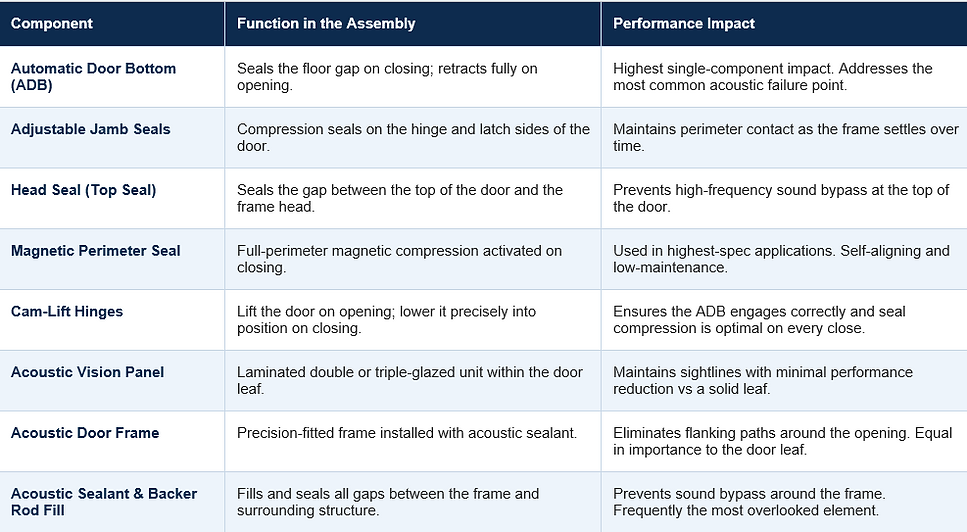
Acoustic Door Components – Full System Reference Guide
Specifying an acoustic door correctly means specifying the complete system - not just the door leaf. Every component in the reference table below plays a defined role in the door’s overall performance. Remove or downgrade any single item, and the acoustic rating of the entire assembly is compromised.
Key principles to carry into any acoustic door specification:
-
The door leaf and the frame are equally critical. A high-performance door leaf in a poorly installed frame will not achieve its rated performance.
-
The automatic door bottom is the highest-impact single component. It should always be the first item confirmed in the specification and the last adjusted after installation.
-
Magnetic seals outperform compression seals over time. They are self-aligning, consistent, and require less periodic adjustment in high-use applications.
-
Cam-lift hinges are not optional on high-performance doors. They are the mechanical link between the closing motion and the ADB seal engagement.
-
Acoustic sealant and backer rod fill are structural - not cosmetic. They are critical components of the assembly's acoustic performance.
Acoustic Door Supply-Only – For Architects, General Contractors & Acoustic Consultants
Not every project requires us to install. For architects, general contractors, fit-out companies, acoustic consultants, and specialist installers with their own site teams, we offer a complete supply-only service.
Every supply-only order from us includes:
-
Pre-hung, factory-assembled acoustic door unit - including frame, door leaf, and sealing system.
-
Full hardware pack - cam-lift hinges, automatic door bottom, perimeter seals, and all required fasteners, pre-fitted where possible.
-
Technical installation guide - frame preparation requirements, sealant specification, backer rod procedure, and seal adjustment method.
-
Product data sheet - independently tested STC and Rw performance data to ASTM E90.
-
CSI specification section - available on request for inclusion in bid or permit documentation.
-
Technical support - available to the installing contractor by phone or on-site throughout the project.
We work regularly with general contractors on multi-door hotel, healthcare, and commercial projects where supply-only is the preferred procurement route. Contact our team to discuss scheduling and project-specific requirements. For a broader overview of how acoustic doors complement the rest of a building’s acoustic envelope, the best acoustic panels for soundproofing guide on our blog is a useful starting point.
US Building Codes, OSHA Standards & Acoustic Door Compliance
Understanding the US regulatory context helps buyers specify with confidence and ensures acoustic doors actively support the building’s compliance obligations.
Relevant US Standards for Acoustic Door Testing & Specification
-
ASTM E90. The standard for laboratory measurement of airborne sound attenuation of building partitions and elements. All acoustic door STC performance data tested to this standard is the basis for verified product specifications.
-
ASTM E413. The standard defining how the STC single-number rating is calculated from ASTM E90 test data. STC is the primary rating used in all US acoustic door specifications and product data sheets.
-
ASTM E336. The field measurement equivalent of ASTM E90. Used to measure Noise Isolation Class (NIC) - the actual in-field performance of an installed acoustic door assembly.
-
ANSI S12.60. Acoustical Performance Criteria, Design Requirements and Guidelines for Schools. The national standard governing acoustic performance in K-12 educational buildings, including minimum STC requirements for different room types.
-
IBC (International Building Code). Adopted with local amendments across most US states, the IBC contains sound insulation requirements for specific occupancy types including residential, hotel, and healthcare construction.
Fire Rating Compatibility - Acoustic and Fire in One UL-Listed Product
Many applications that carry an acoustic performance requirement also have fire safety obligations under the IBC and local fire codes. Acoustic and fire performance are not mutually exclusive. We supplies doors that simultaneously satisfy both requirements from a single UL-listed certified product.
Fire resistance ratings for doors in the US:
-
20-Minute Rating: Required in corridor walls, tenant separation walls, and certain occupancy separations.
-
45-Minute Rating: Required in 1-hour fire-rated wall assemblies - the most common requirement in commercial construction.
-
60-Minute Rating: Required in 2-hour rated assemblies in specific occupancy classifications.
-
90-Minute Rating: Required in high-rise, industrial, and specific hazardous occupancy applications.
Combined acoustic and fire-rated doors are tested and listed to both UL 10C (fire resistance) and ASTM E90 (acoustic performance). Any acoustic door specified in a rated wall assembly must carry the appropriate UL listing and be installed in strict accordance with the listing’s conditions of use.
OSHA 29 CFR 1910.95 - Occupational Noise Exposure Compliance
For industrial, manufacturing, and entertainment sector clients, acoustic doors are a direct engineering control under OSHA’s Occupational Noise Exposure standard. Key thresholds include:
-
Action Level - 85 dB(A) TWA: At this level, employers must enroll affected employees in a hearing conservation program including audiometric testing, hearing protection, and training.
-
Permissible Exposure Limit (PEL) - 90 dB(A) TWA: Workers must not be exposed above this level. Engineering controls must be implemented before requiring personal protective equipment.
-
Engineering Control Priority: OSHA requires that engineering controls - which include acoustic barriers and doors - be considered before relying on hearing protection devices.
NIOSH reports that 22 million US workers are exposed to potentially damaging noise at work each year, and noise-induced hearing loss is the most common work-related illness in the US. Acoustic doors rated STC 50 and above, fitted to mechanical rooms and machinery enclosures, directly support OSHA engineering control requirements. See our industrial noise control services and vibration and industrial acoustics page for the complete industrial approach.
Frequently Asked Questions
How much noise does an acoustic door block?
Acoustic doors reduce noise transmission by STC 30 to STC 64, depending on specification. In practical terms, an STC 45 door reduces perceived loudness by roughly 99% compared to an open doorway. Actual performance depends on core type, the sealing system, and installation quality. All four perimeter seal points must perform simultaneously to achieve the rated figure.
What is the difference between a soundproof door and an acoustic door?
Soundproof door and acoustic door are used interchangeably, but acoustic door is the technically correct term. Soundproof implies total elimination of sound, which is physically impossible in a real building. Acoustic doors are tested and rated to deliver a specific, measurable level of noise reduction using the STC standard (ASTM E413) or the international Rw equivalent.
Do acoustic doors work without soundproofed walls?
Yes, acoustic doors improve performance even in standard wall assemblies, but total results are limited by the weakest element. A door rated STC 50 installed in a wall rated STC 35 will deliver combined performance closer to STC 35. For best results, walls, ceiling, floor, and door should all be specified to comparable performance ratings.
Can acoustic doors also be fire rated?
Yes. Acoustic doors can be simultaneously UL-listed fire rated - 20-minute, 45-minute, 60-minute, or 90-minute - and acoustically rated. Combined doors are tested to both UL 10C (fire resistance) and ASTM E90 (acoustic performance). we supplies doors satisfying both requirements from a single certified product.
What STC rating do I need for my acoustic door?
STC 40 suits general office speech privacy and hotel guest rooms. STC 45 to STC 50 suits recording studios and boardrooms. STC 50 to STC 64 suits industrial machinery enclosures, broadcast studios, and critical facilities. A professional on-site consultation is the most reliable way to confirm the correct specification for your specific application.
How long does acoustic door installation take?
A single acoustic door installation typically takes one to two working days - including removing the existing door and frame, preparing the structural opening, installing the new acoustic frame with full perimeter sealing, hanging the door leaf, and commissioning all seals and hardware. Multi-door projects are programmed opening by opening to minimize disruption.
How do you maintain acoustic door seals?
Acoustic door seals require annual inspection and periodic re-tensioning as the door frame settles over time. Signs that adjustment is needed include visible light gaps around the frame when the door is closed, or a noticeable increase in sound transmission. Replacement seals are available for all our door types, and annual maintenance visits can be scheduled in advance.
Are acoustic doors available in custom sizes?
Yes. Every acoustic door we manufactures is made to the exact dimensions of the surveyed opening. Bespoke sizing is standard, not an optional extra. A correctly fitted door is the foundation on which the sealing system depends - an undersized door creates gaps that compromise performance across the entire assembly.
What is the best acoustic door for a home studio?
A solid core wood acoustic door rated STC 38 to STC 45 is the recommended starting point for a home studio. For higher performance requirements, a mineral wool infilled composite door at STC 48 to STC 52 is more appropriate. In both cases, the automatic door bottom and a fully sealed acoustic frame are essential - the door leaf rating alone will not be achieved without them.
Do acoustic doors need special frames?
Yes. Acoustic doors require purpose-built acoustic frames installed with backer rod fill and acoustic-grade caulk at all perimeter junctions. A standard door frame provides no acoustic benefit and will create flanking paths that allow sound to bypass the door entirely. The frame is as important to performance as the door leaf itself.


Why Choose Us?
Premium Quality Materials
Our soundproofing materials are crafted from high-quality, durable materials that effectively block out unwanted noise, ensuring maximum sound reduction.
Expert Installation Services
Leave the installation process to our team of experienced professionals. We ensure that your soundproofing solution is installed seamlessly and efficiently, minimizing disruption to your daily routine.
Customized Solutions
Every space is unique, and we understand that one size does not fit all. That's why we offer customized soundproofing solutions tailored to your specific needs and requirements.
Enhanced Comfort and Privacy
Every space is unique, and we understand that one size does not fit all. That's why we offer customized soundproofing solutions tailored to your specific needs and requirements.

Get Started Today
Transform your living or working space into a peaceful sanctuary with De-Walls Acoustic Specialties. Say goodbye to noisy distractions and hello to uninterrupted tranquility. Contact us today to schedule a consultation with one of our soundproofing experts and take the first step towards a quieter environment. Experience the De-Walls difference today!