


Healthcare Acoustic Panels | Custom Sound Control for Hospitals & Clinics
Healthcare acoustic panels are specialist sound-absorbing wall and ceiling systems engineered specifically for clinical environments - including US hospitals, outpatient clinics, urgent care centers, private practices, care homes, and mental health facilities.
Standard commercial acoustic panels are not suitable for clinical settings. Healthcare-grade panels are manufactured with fire-rated materials (Class A per ASTM E84), low- or zero-VOC emissions, antimicrobial surfaces, and hygiene coatings that withstand repeated clinical disinfection with hospital-grade agents.
Noise in US Hospitals Is a Clinical Problem, not a Comfort Issue
Most patients and staff accept hospital noise as part of the environment - the beeping monitors, the rolling carts, the overhead announcements, the shift changes. It feels like the unavoidable backdrop of a busy clinical facility. The research, however, paints a measurably more serious picture.
The World Health Organization (WHO) recommends that noise in patient care areas should not exceed 35 dB(A) during the day and 30 dB(A) at night - roughly equivalent to a quiet library. Measured reality in US hospitals tells a different story. Studies consistently record average noise levels of 55 to 70 dB(A) across general wards, with intensive care units and emergency departments regularly exceeding 80 dB(A) - the approximate level of a busy roadside.
A peer-reviewed study monitoring intensive care units, published in Anesthesia (2014), found that every unit measured exceeded WHO recommendations continuously throughout the monitoring period. A 2023 study in Building and Environment measuring general hospital wards found that acoustic treatment of ceilings and walls reduced reverberation time by up to 53 percent - and produced measurably positive outcomes in patient sleep quality, emotional state, and verbal communication.
What High Hospital Noise Actually Causes: The Clinical Evidence
The consequences of consistently elevated noise levels in US healthcare settings are not theoretical. They are documented, measurable, and directly relevant to patient safety and clinical performance:
-
Delayed patient recovery. Sleep deprivation activates cortisol release, suppressing immune function, raising blood pressure, and increasing pain sensitivity. Research published in Critical Care directly links environmental noise to sleep fragmentation in ICU patients and extended recovery timelines.
-
Higher analgesic requirements. Patients in noisy wards report greater pain intensity and request more pain medication - adding clinical burden to nursing staff and increasing drug administration complexity.
-
Increased clinical communication errors. A study published in Buildings (MDPI, 2022) found that 43 percent of neurological ICU nurses reported that noise directly caused concentration problems. OSHA links sustained noise exposure to impaired cognitive performance and elevated risk of clinical error.
-
HIPAA compliance risk. The US Department of Health and Human Services identifies inadequate acoustic separation in clinical spaces as a physical safeguard failure under the HIPAA Privacy Rule. Facilities that have not addressed speech privacy in consultation and examination areas carry a documented compliance exposure.
-
Staff burnout and turnover. The Journal of Noise and Health found that long shifts in noisy clinical environments elevate staff stress, accelerate burnout, and increase resignation intention - contributing to the workforce retention challenges already facing US healthcare facilities.
What Are Healthcare Acoustic Panels?
Healthcare acoustic panels are a distinct product category - not a variation of office foam tiles, studio wedges, or the budget fabric panels available through commercial interior suppliers. They are purpose-engineered for clinical environments where the consequences of specification failure include hygiene risk, fire code violation, and regulatory non-compliance.
All acoustic panels operate on the same physical principle: they absorb sound energy rather than reflecting it. Hard clinical surfaces - vinyl flooring, ceramic tile, drywall partitions, glass - bounce sound waves back into a room, creating reverberation that amplifies every noise source far beyond its original volume. Acoustic panels interrupt this cycle, converting sound energy into negligible heat, reducing reflections, and measurably lowering the overall acoustic level within the space.
What makes a panel healthcare-grade is an entirely separate layer of requirements that sits on top of acoustic performance. Getting this distinction wrong is the most common and most costly specification mistake in clinical acoustic projects.
The Two Acoustic Metrics Every Healthcare Specifier Must Understand
Confusing these two measurements is how facilities end up with panels that solve the wrong problem in the wrong space.
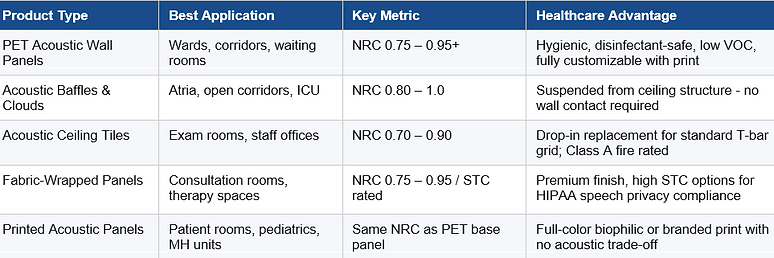
The Five Main Healthcare Acoustic Panel Types
Each product type addresses a different space and a different acoustic challenge. Specifying the wrong type for a space wastes budget and produces no clinical benefit.
What Genuinely Makes a Panel Healthcare-Grade: The Five Non-Negotiables
Every property below must be present. A single absence disqualifies a panel from clinical use in a US healthcare facility.
-
Fire Classification. Class A under ASTM E84 (flame spread index 0–25, smoke developed index 0–450). Third-party laboratory certificates must be provided. Manufacturer self-certification is not acceptable on healthcare projects.
-
Clinical Hygiene Compatibility. The surface must withstand daily cleaning with IPA wipes, chlorine-based disinfectants (sodium hypochlorite), and sporicidal agents without delaminating, discoloring, or physically degrading.
-
Low or Zero VOC Emissions. Required in enclosed clinical spaces housing immunocompromised, post-surgical, or respiratory-sensitive patients. Must meet LEED v4 low-emitting materials criteria as a minimum.
-
Anti-Microbial Properties. Inherent anti-microbial properties - built into the base material - are preferable to applied surface coatings, which weaken with every cleaning cycle over the life of the installation.
-
Independent NRC/STC Test Data. Performance figures must come from third-party laboratory testing to ASTM C423 (US). Marketing-estimated or range-average NRC figures are not sufficient for clinical project specifications.
Why Standard Commercial Acoustic Panels Fail in US Clinical Environments
Generic acoustic panels are available through dozens of commercial suppliers, interior retailers, and online platforms. Many perform adequately in offices, restaurants, and open-plan workspaces. The question of why they cannot be installed in a hospital corridor or clinic exam room is legitimate - and the answer involves three categories of failure that consistently occur in clinical settings.
Understanding what makes specialist acoustic treatment different from a standard commercial tile installation is fundamental to making the right specification decision for a healthcare environment.
The Three Failure Points of Generic Panels in Clinical Settings
-
Hygiene Breakdown
-
Standard acoustic foam, untreated mineral wool, and open-weave fabric panels absorb moisture, airborne particles, and biological contamination alongside sound.
-
In clinical environments cleaned daily with hospital-grade disinfectants, panels that cannot withstand those agents will crack, delaminate, or fragment over time.
-
In infection-sensitive areas - oncology, post-surgical recovery, ICU - a panel that cannot be properly disinfected is a direct infection control liability.
-
The correct specification requires written hygiene compatibility documentation for every disinfectant agent used in the facility, provided before the panels are installed.
-
-
Fire Code Non-Compliance
-
NFPA 101 (Life Safety Code) and local fire codes require wall and ceiling materials in healthcare occupancies to meet specific flame spread and smoke development ratings.
-
Many generic acoustic panels manufactured for studio, home, or office use carry only Class B or Class C fire ratings - not acceptable in a healthcare occupancy under NFPA standards.
-
Once a non-compliant material is installed and signed off, the fire code liability rests with the healthcare facility management team - not the panel supplier.
-
-
Unverified Acoustic Performance
-
Generic panels are commonly sold with NRC ratings stated as approximate marketing figures, not independently verified laboratory results.
-
The difference between NRC 0.60 and NRC 0.85 is clinically significant - the difference between a panel that genuinely reduces ambient noise and one that produces no measurable acoustic improvement.
-
For a patient ward attempting to approach WHO noise recommendations, an underperforming panel is budget spent to zero clinical effect.
-
US healthcare procurement must require third-party tested NRC/STC performance data - documented to ASTM C423 - as a non-negotiable specification item before any purchase order is placed.
-
Key Benefits of Healthcare Acoustic Panels for Medical Environments
Healthcare acoustic panels deliver five measurable categories of benefit - across patient outcomes, regulatory compliance, staff performance, and patient experience. Each is supported by peer-reviewed research or official US regulatory guidance.
1. Faster Patient Recovery and Improved Clinical Outcomes
Sleep is not a comfort metric in clinical settings - it is a primary recovery variable. Research published in Building and Environment (ScienceDirect, 2023) measuring general hospital wards found that acoustic treatment of ceilings and walls reduced reverberation time by 13 to 53 percent, with patients reporting measurably improved sleep quality, reduced emotional distress, and better verbal communication.
The physiological mechanism connecting noise to impaired recovery is well established:
-
Noise triggers cortisol release, suppressing immune response and raising blood pressure.
-
Elevated cortisol increases pain sensitivity, leading to higher analgesic demand on nursing staff.
-
Fragmented sleep delays tissue repair, weakens infection resistance, and extends hospital stays.
-
A 10 dB reduction in perceived noise represents a halving of loudness - a clinically significant change that well-specified acoustic wall panels can realistically achieve in ward environments.
2. HIPAA Speech Privacy Compliance
The US Department of Health and Human Services explicitly identifies acoustic panels and specialty ceiling tiles as recognized physical safeguards under the HIPAA Privacy Rule. Consultation rooms, exam rooms, and therapy spaces where protected health information (PHI) is discussed are required to have reasonable safeguards in place - and acoustic treatment is specifically named as a qualifying measure.
Three compliance points every US healthcare facility needs to understand:
-
The relevant metric for HIPAA speech privacy is STC - not NRC. NRC reduces reverberation inside the room; STC prevents conversations from being overheard in adjacent spaces.
-
Target STC 45 or above for consultation rooms, exam rooms, and any clinical space where PHI is regularly discussed.
-
Documented STC test certificates are required for HIPAA compliance audits. Written supplier documentation is not optional - it is the evidence of the reasonable safeguard taken.
-
For a broader overview of acoustic and soundproofing compliance considerations in commercial healthcare environments, the commercial soundproofing resources at DeWalls cover the core frameworks in plain language.
3. Hygiene, Fire Safety, and Material Compliance - Three Requirements, One Specification
Correctly specified healthcare acoustic panels consolidate three compliance requirements into a single material decision:
-
Acoustic performance - independently tested, documented NRC/STC data for the specified thickness and mounting configuration.
-
Fire code compliance - Class A per ASTM E84, with third-party certificates available for project sign-off.
-
Hygiene compliance - surface-tested in accordance with the full range of hospital disinfection protocols used at the specific facility.
PET acoustic panels manufactured from recycled polyester fiber are inherently non-toxic, mold-resistant, and low VOC. When surface-treated for clinical use, they withstand the full range of US hospital cleaning protocols. Class A fire-rated configurations are available across all primary product types.
4. Reduced Staff Cognitive Fatigue and Lower Clinical Error Risk
Research published in Buildings (MDPI, 2022) found that 43 percent of neurological ICU nurses reported that noise directly caused concentration problems. The cognitive consequences of sustained noise exposure are well established in the clinical research literature:
-
Sustained attention is impaired - nursing staff misses verbal cues and alarm signals at higher rates.
-
Short-term memory recall is degraded, increasing the likelihood of medication dosage and instruction errors.
-
Complex decision-making is slowed, particularly relevant during high-stakes clinical moments under time pressure.
-
Communication errors increase - the most common root cause of adverse patient events in US clinical settings.
Acoustic treatment of nurse stations, medication prep rooms, and staff working areas is a patient safety investment - not simply a staff wellbeing measure. The same acoustic principles that improve patient ward environments apply directly to staff-facing spaces. DeWalls' office acoustics approach translates directly to open-plan nurse stations and staff coordination areas in healthcare facilities.
5. Therapeutic Environment Design and Measurable Patient Experience Improvement
Roger Ulrich's landmark 1984 study in Science - replicated and extended across four decades of evidence-based design research - established that patients exposed to natural elements during recovery required less pain medication, had shorter post-surgical stays, and reported higher satisfaction with their care.
The practical implications for acoustic panel specification in US healthcare facilities:
-
Healthcare acoustic panels can be custom-printed with photographic-quality natural imagery - woodland, coastal, botanical, sky - with zero loss of acoustic performance.
-
This delivers clinically evidenced therapeutic benefit in spaces without windows - basement departments, imaging suites, enclosed treatment rooms, and long-stay ward environments where the visual setting is otherwise entirely artificial.
-
A single panel specification simultaneously addresses acoustic compliance, fire code, hygiene, and therapeutic design - four requirements resolved in one product decision.
-
DeWalls has delivered completed acoustic projects across multiple healthcare and commercial environments. The project portfolio includes examples of how acoustic treatment and custom design work together in real-world installations.
Where Healthcare Acoustic Panels Are Used: Six Key Clinical Zones
Different areas within a US healthcare facility present distinctly different acoustic challenges. Applying the same panel type across an entire building is a common and expensive specification mistake. The right product depends entirely on the specific acoustic problem in each zone.
Zone 1 - Patient Rooms and Hospital Wards
The Acoustic Problem
-
Vinyl flooring, drywall partitions, and minimal soft furnishings create highly reflective surfaces throughout ward environments.
-
Corridor noise, neighboring bed activity, equipment alarms, and overnight staff activity penetrate continuously.
-
Reverberation amplifies every individual noise source far beyond its actual duration and volume.
The Clinical Evidence
-
A 2023 Building and Environment study found that acoustic treatment of ward ceilings and walls reduced reverberation time by 13 to 53 percent.
-
Patients in treated wards reported measurably less negative impacts on sleep quality, emotional state, and verbal communication.
-
Between 30 and 50 percent of all hospitalized patients experience significant sleep disruption - environmental noise is the primary documented cause.
Recommended Specification
-
Wall-mounted PET acoustic panels on shared partition walls and behind-bed feature walls.
-
Acoustic ceiling tiles above bed zones to reduce overhead reflections.
-
Target NRC: 0.80 or above for standard ward environments.
Design Opportunity
-
Custom-printed PET panels with biophilic imagery - woodland, sky, coastal - above patient beds deliver therapeutic environment benefits alongside acoustic compliance.
-
Particularly effective in windowless rooms and basement-level clinical areas where no natural view is available to the patient.
Zone 2 - Waiting Areas and Reception
The Acoustic Problem
-
The acoustically most unpredictable environment in any healthcare facility - multiple simultaneous, uncontrolled noise sources.
-
Hard floors, glazed storefronts, and high ceilings create highly reflective surfaces throughout.
-
Overlapping conversations, children, check-in kiosks, and background systems all contribute simultaneously without predictable pattern.
The Patient Experience Impact
-
The waiting area is a patient's first acoustic impression of the facility - it sets emotional tone before any clinical contact begins.
-
A noisy, reverberant reception environment directly elevates pre-consultation anxiety.
-
Research consistently links elevated pre-consultation anxiety to reduced compliance with clinical advice and lower patient satisfaction scores.
Recommended Specification
-
Acoustic baffles suspended from the ceiling above high-traffic zones and seating areas.
-
Wall panels on return walls adjacent to seating and behind reception desks.
-
Acoustic ceiling clouds in double-height entrance atria and glazed lobby areas.
-
Target NRC: 0.80 or above for reverberant entrance and waiting environments.
Zone 3 - Consultation and Examination Rooms
The HIPAA Compliance Challenge
-
Sound transmission through drywall partitions and above T-bar ceiling grids makes confidential consultations audible in adjacent corridors and waiting areas.
-
This is the precise acoustic scenario that HIPAA physical safeguard requirements are specifically designed to address.
-
Door perimeters are typically the primary path of sound escape - even in rooms with otherwise adequate wall treatment.
Recommended Specification
-
High-density fabric-wrapped acoustic panels on shared partition walls between consultation and adjacent spaces.
-
Specify by STC rating - target STC 45+ - not NRC alone. NRC only reduces reverberation inside the treated room.
-
Acoustic door seals on all consultation room doors as a required complementary item.
-
Written STC test certificates must be available for HIPAA compliance documentation - not just NRC marketing data sheets.
Zone 4 - Nurse Stations and Staff Areas
The Acoustic Problem
-
Open-plan nurse stations combine overlapping conversations, equipment alarms, telephone calls, and ward activity - all without acoustic separation.
-
Staff must simultaneously perform cognitively demanding tasks including medication administration, clinical documentation, and direct patient communication.
-
This is acoustically one of the most demanding environments in any building type - with direct implications for patient safety.
The Patient Safety Connection
-
43 percent of ICU nurses report that noise causes direct concentration problems (Buildings, MDPI, 2022).
-
High background noise impairs sustained attention, short-term memory recall, and decision-making - all critical clinical functions.
-
Clinical miscommunication is the most frequently cited root cause of adverse patient events in US clinical settings.
-
Acoustic treatment of nurse stations is a documented patient safety measure - not a workplace amenity.
Recommended Specification
-
Ceiling baffles above workstation clusters - most effective approach in open-plan configurations.
-
Wall panels on adjacent walls opposite workstation rows.
-
Desktop acoustic screens between individual workstations where clinical workflow permits.
-
Target NRC: 0.80 or above to achieve a measurable reduction in reverberation time (RT60).
Zone 5 - Mental Health and Behavioral Health Units
The Clinical Acoustic Challenge
-
Unexpected or loud sounds can directly trigger distress, agitation, and clinical setbacks in patients with anxiety disorders, PTSD, or acute psychiatric presentations.
-
The acoustic environment in behavioral health settings is a clinical tool - not background context.
-
The Joint Commission's standards for behavioral health facilities address environmental safety, which includes acoustic environment considerations.
-
Ligature risk must inform every material and installation decision - no exposed fixings, no sharp panel edges, no protruding hardware.
Recommended Specification
-
Recessed or flush-fit PET panels - no exposed fixings, no sharp edges, no ligature points.
-
Muted, biophilic color palettes: soft greens, earthy neutrals, calm sky blues.
-
Ceiling clouds in communal areas, group therapy rooms, and dining spaces.
-
Avoid high-contrast graphic patterns - specify low-saturation, calming imagery throughout.
-
Target NRC: 0.80+ in communal spaces; NRC 0.75+ in individual rooms and corridors.
Zone 6 - Pediatric Wards and Children's Clinical Areas
The Acoustic Challenge
-
Pediatric areas generate high, unpredictable noise - requiring active acoustic management throughout the space.
-
Patients are frightened, in an unfamiliar environment, and frequently separated from their normal routine for the first time.
-
The acoustic environment must both manage generated noise and actively create a sensory space that is calming and reassuring for a child.
Recommended Specification
-
Custom-printed PET panels at child height with age-appropriate imagery - animals, underwater scenes, woodland environments, space themes.
-
Ceiling clouds above play areas and activity zones to control high-frequency noise generated by children's activity.
-
Target NRC: 0.80+ to manage the high-frequency noise characteristic of children's clinical areas.
-
DeWalls' acoustic treatment services include full custom print capability, allowing pediatric spaces to be genuinely child-friendly without compromising acoustic or hygiene performance.
US Healthcare Acoustic Panel Compliance: HIPAA, FGI Guidelines and Fire Code
Healthcare acoustic panels in the United States are a compliance instrument - not a discretionary design choice. The regulatory framework that governs their specification is specific, enforceable, and carries real consequences for non-compliance.
US Regulatory Framework for Healthcare Acoustic Panels
-
HIPAA Privacy Rule - Physical Safeguards. The US Department of Health and Human Services requires covered entities to implement physical safeguards that reasonably protect PHI from incidental disclosure. Acoustic wall panels and specialty ceiling tiles are explicitly named as recognized safeguards for speech privacy in clinical spaces. HIPAA compliance documentation requires evidence that reasonable acoustic measures have been implemented - not simply a statement of intent.
-
FGI Guidelines for Design and Construction of Hospitals. The Facility Guidelines Institute sets minimum NRC and STC requirements by room type for US hospital design. These guidelines are the reference framework for healthcare architects, design-build contractors, and AIA healthcare project specifications. Target minimums include STC 45+ for consultation room partitions and NRC 0.85+ for ceiling tiles in patient care areas.
-
NFPA 101 - Life Safety Code. Governs fire and life safety requirements in US healthcare occupancies. Wall and ceiling finish materials must meet Class A surface burning characteristics per ASTM E84 in most healthcare applications. This requirement applies to acoustic panels installed on walls or ceilings in patient care and common areas of licensed healthcare facilities.
-
ASTM E84 - Surface Burning Characteristics of Building Materials. The US standard for fire classification of wall and ceiling materials. Class A compliance requires a flame spread index of 0–25 and a smoke developed index of 0–450. Third-party laboratory test certificates to ASTM E84 are required - manufacturer self-declaration is insufficient for healthcare facility compliance documentation.
-
ASTM C423 - Standard Test Method for Sound Absorption and Sound Absorption Coefficients. The US standard for measuring NRC performance. All acoustic performance claims for US healthcare projects should be supported by ASTM C423 test results from an accredited laboratory. Unverified manufacturer estimates do not satisfy FGI specification requirements.
-
OSHA Noise Exposure Standards. While primarily applicable to industrial noise environments, OSHA's guidelines on workplace noise and its links to reduced cognitive performance and communication error provide the regulatory backdrop for staff-facing acoustic specifications in open clinical working environments, including nurse stations and medication preparation areas.
-
The Joint Commission Environment of Care Standards. The Joint Commission's accreditation standards for US hospitals include Environment of Care requirements that address noise management, patient room acoustic conditions, and speech privacy in clinical spaces. Acoustic panel installation supports compliance with these standards as part of a comprehensive Environment of Care program.
Key US Compliance Principle
Healthcare acoustic panels in the United States are a risk management tool. Specifying without documented ASTM E84 fire classifications, independently tested ASTM C423 NRC/STC performance data, and written hygiene compatibility certification creates measurable regulatory exposure - under HIPAA audit, Joint Commission review, and state healthcare facility fire code inspection.
DeWalls supplies full US compliance documentation - ASTM E84 fire test certificates, ASTM C423 acoustic data sheets, hygiene compatibility statements, and LEED VOC certifications - as standard with every healthcare project.
Healthcare Acoustic Panel Specification Checklist: 10 Points to Verify Before You Buy
Use this as a due diligence framework before committing to any acoustic panel specification for a US hospital, clinic, outpatient center, or care facility. Every item here reflects a real specification failure that has occurred in clinical settings - all preventable with the right documentation before installation.
For questions about how these specification criteria apply to your specific healthcare project, the DeWalls FAQ page covers common acoustic specification questions, or you can contact the DeWalls team directly for a project-specific consultation.
Beyond Performance: Biophilic Design and Custom Healthcare Acoustic Panels
The conversation about healthcare acoustic panels almost always starts and ends with compliance and technical specifications. That is appropriate - but it leaves unexplored one of the most compelling dimensions of what modern acoustic wall panels for hospitals now make possible: the convergence of acoustic compliance and evidence-based therapeutic design.
The Evidence Base: Why the Designed Environment Directly Affects Patient Outcomes
In 1984, environmental psychologist Roger Ulrich published a study in Science comparing recovery outcomes in post-surgical patients whose rooms overlooked either a natural landscape or a plain brick wall. The findings were statistically significant and have been replicated across decades of subsequent research:
-
Patients with the natural view had shorter post-surgical hospital stays.
-
They required measurably less analgesic pain medication.
-
They made fewer negative comments to nursing staff during their stay.
-
They experienced fewer minor post-surgical complications.
This research now underpins the evidence-based design movement in US healthcare architecture and is referenced in The Center for Health Design's Pebble Project framework, used by major US health systems including Kaiser Permanente, Cleveland Clinic, and the Department of Veterans Affairs in their facility design standards.
The implication for acoustic panel specification is direct. A panel custom-printed with photographic-quality natural imagery does not merely look appealing - it delivers a clinically evidenced proportion of the therapeutic benefit of the natural environment it represents. This is particularly valuable in:
-
Windowless patient rooms and basement-level clinical areas with no natural view.
-
Imaging suites, infusion centers, and enclosed treatment rooms where the visual environment is entirely artificial.
-
Long-stay ward environments where sustained institutional visual surroundings contribute to patient anxiety.
-
Pediatric units where distraction imagery and familiar natural themes actively support clinical care and reduce procedural anxiety.
DeWalls Custom Design Capabilities for US Healthcare Environments
DeWalls' approach to healthcare acoustic panel design goes beyond a standard color chart. Every design element is fully specifiable to the project brief - whether it is a single-room installation in a Dallas outpatient clinic or a multi-floor acoustic program in a large acute care hospital. The completed projects in the DeWalls portfolio demonstrate how acoustic performance and custom design combine in real-world healthcare and commercial applications.
-
Full-Color Digital Print on PET Acoustic Panels. Photographic-quality imagery at any scale, printed directly onto the acoustic surface. Woodland canopies, coastal horizons, sky photography, botanical close-ups - any image that serves the therapeutic brief of the space. The print is fade-resistant and surface-sealed for clinical cleaning compatibility. Acoustic performance is unchanged by the print process.
-
Custom Color Matching. Panels can be color-matched to facility brand standards or healthcare system design guidelines. Essential for brand-integrated acoustic installations and wayfinding color systems, where panels serve a departmental navigation function as well as an acoustic one.
-
Bespoke Sizing and Custom Shaping. No dependency on standard panel dimensions. Panels are manufactured to exact specification, allowing clean architectural integration into curved walls, recessed bays, geometric ceiling features, and non-standard floor plans without visible joins or sizing compromises.
-
Brand Integration for Multi-Site Healthcare Groups. Healthcare groups and clinic chains maintaining brand consistency across multiple locations can specify panels incorporating their visual identity - color palette, graphic language, photography style - ensuring acoustic treatment reinforces rather than contradicts the designed environment.
-
Wayfinding and Departmental Navigation. Acoustic panels can serve as a primary wayfinding system - color-coded by department or floor level, with graphic elements aiding navigation for patients, visitors, and staff. Acoustic function and user experience delivered through a single wall surface.
Frequently Asked Questions
Do acoustic panels actually reduce noise in hospitals?
Yes - when correctly specified. A 2023 study in Building and Environment found that acoustic treatment of hospital ward ceilings and walls reduced reverberation time by 13 to 53 percent, with patients reporting measurably better sleep quality and emotional state following installation. Key findings:
-
Reverberation time (RT60) fell in every treated room and corridor in the study.
-
Patients reported improved sleep quality and reduced anxiety in acoustic-treated areas.
-
A 10 dB reduction in perceived noise represents a halving of loudness - a clinically significant acoustic change.
What is the difference between acoustic panels and soundproofing?
These terms describe different acoustic objectives and are commonly confused in healthcare specifications:
-
Acoustic panels (NRC-rated): Absorb sound within a room, reducing echo, reverberation, and ambient noise levels in the treated space.
-
Soundproofing (STC-rated): Blocks sound from traveling between rooms through walls, floors, and ceilings.
-
For most US healthcare applications, both are needed: NRC-rated panels for wards, waiting rooms, and nurse stations; and STC-rated solutions for consultation rooms and exam spaces that require HIPAA speech privacy compliance.
-
DeWalls' noise control services encompass both acoustic absorption and sound-isolation approaches for healthcare environments.
What type of acoustic panels are best for hospitals?
The best product type depends on the specific space and acoustic objective:
-
PET acoustic wall panels: Most versatile for general hospital use - hygienic, Class A fire-rated, low VOC, disinfectant-safe, and fully customizable with print or color matching.
-
Fabric-wrapped panels: Best STC performance for HIPAA-compliant consultation rooms, exam rooms, and private clinical spaces.
-
Acoustic baffles and clouds: Most effective in large-volume spaces such as hospital atria, open ICU corridors, and waiting halls, where wall panels alone cannot fully address the acoustic volume.
-
Printed acoustic panels: Ideal for patient rooms, pediatric units, and behavioral health spaces where biophilic or therapeutic imagery serves a direct clinical function alongside acoustic performance.
The DeWalls blog post on best acoustic panels for soundproofing explores product selection criteria in practical detail across multiple facility types.
Are acoustic panels safe to use in US healthcare settings?
Healthcare-grade acoustic panels are specifically manufactured to be safe across all clinical environments. They must meet all of the following criteria to be appropriate for a US healthcare facility:
-
Class A fire rating: ASTM E84 compliance with third-party laboratory test certificates.
-
Low or zero VOC: Non-toxic, meeting LEED v4 low-emitting materials criteria.
-
Mold and anti-microbial resistant: PET panels carry no hazardous material classifications and are inherently mold-resistant.
-
Disinfectant-compatible: Surface-tested for compatibility with hospital cleaning agents used at the specific facility.
Always request written safety documentation - ASTM E84 fire test certificates, VOC compliance statements, and hygiene compatibility reports - before specifying any panel for a clinical environment.
What NRC rating do I need for a hospital or clinic?
NRC requirements vary by clinical area. As a practical guide for US healthcare environments:
-
General patient rooms and wards: NRC 0.75 minimum.
-
Waiting areas, corridors, and reception: NRC 0.80 or above.
-
High-noise zones - ICU, open-plan nurse stations: NRC 0.85 or above. FGI Guidelines specify NRC 0.85+ for ceiling tiles in patient care areas.
-
Consultation rooms requiring HIPAA speech privacy: Specify by STC 45+ rather than NRC alone.
Panel thickness is the primary NRC variable. A 24mm PET panel consistently delivers a higher NRC than a 9mm PET panel. Always request the NRC figure for the exact thickness and mounting configuration being specified.
Do acoustic panels help with HIPAA compliance?
Yes - in a specific and documented way. Three points every US healthcare compliance officer needs to understand:
-
The US Department of Health and Human Services explicitly identifies acoustic panels and ceiling tiles as recognized physical safeguards under the HIPAA Privacy Rule.
-
The relevant metric for HIPAA speech privacy is STC - not NRC. NRC reduces reverberation inside a room; STC prevents PHI from being overheard through walls in adjacent spaces.
-
Target STC 45 or above for all consultation rooms, exam rooms, and clinical spaces where PHI is regularly discussed. Written STC test certificates must be on file for HIPAA compliance audits.
Can acoustic panels be cleaned with hospital disinfectants?
Healthcare-specified acoustic panels are surface-tested for clinical cleaning compatibility - but this must be documented, not assumed:
-
Confirm compatibility with IPA (isopropyl alcohol) wipes - the most widely used disinfectant across US healthcare settings.
-
Confirm compatibility with chlorine-based disinfectants (sodium hypochlorite solutions) and sporicidal agents.
-
Request the specific agents tested, the concentration used in testing, and the cleaning frequency tested against.
-
Applied surface coatings degrade over repeated clinical cleaning. Panels with inherent material-level anti-microbial properties are more durable for long-term clinical use.
What fire rating do acoustic panels need in US healthcare buildings?
US healthcare facilities require acoustic panels on walls and ceilings to meet Class A under ASTM E84. Key requirements:
-
Class A means: flame spread index 0–25 and smoke developed index 0–450 in laboratory testing.
-
This is required under NFPA 101 (Life Safety Code) for healthcare occupancies and is enforced through the state healthcare facility licensing and fire inspection process.
-
Third-party ASTM E84 laboratory test certificates must be provided - manufacturer self-declaration does not meet healthcare facility compliance requirements.
How long do healthcare acoustic panels last?
Quality PET acoustic panels for clinical use are built for long-term durability:
-
Minimum 10-year performance warranty as standard on healthcare-grade PET panels.
-
The material does not absorb moisture, lose acoustic performance over time, or discolor under standard clinical conditions.
-
Individual panels within a modular installation can be replaced on a like-for-like basis - including color and print-matched replacements.
-
Modular replacement does not require removal of the surrounding installed panels - a significant long-term facilities management advantage.
How are acoustic panels installed in an operational US hospital?
Installation in active clinical environments follows a structured infection control and facilities management process:
-
Panels are fixed using low or zero-VOC adhesives and mechanical fixings appropriate to the wall substrate.
-
Installation is scheduled out of clinical hours or carried out in phased sections to avoid disruption to ward or clinic operations.
-
Dust, debris, and VOC off-gassing risks are mitigated through controlled installation methods throughout.
-
Installation teams working in patient-proximate areas meet applicable background check and credentialing requirements for each facility.
-
An infection control work plan is provided as standard project documentation before work begins.
For complex phased installations across operational US healthcare environments, contact DeWalls directly to discuss a project-specific installation program and timeline.



Why Choose Us?
Premium Quality Materials
Our soundproofing materials are crafted from high-quality, durable materials that effectively block out unwanted noise, ensuring maximum sound reduction.
Expert Installation Services
Leave the installation process to our team of experienced professionals. We ensure that your soundproofing solution is installed seamlessly and efficiently, minimizing disruption to your daily routine.
Customized Solutions
Every space is unique, and we understand that one size does not fit all. That's why we offer customized soundproofing solutions tailored to your specific needs and requirements.
Enhanced Comfort and Privacy
Every space is unique, and we understand that one size does not fit all. That's why we offer customized soundproofing solutions tailored to your specific needs and requirements.

Get Started Today
Transform your living or working space into a peaceful sanctuary with De-Walls Acoustic Specialties. Say goodbye to noisy distractions and hello to uninterrupted tranquility. Contact us today to schedule a consultation with one of our soundproofing experts and take the first step towards a quieter environment. Experience the De-Walls difference today!