


Texas Commercial Building Acoustic Code Requirements Explained

Updated: Jun 24
Texas commercial acoustic code requirements are primarily governed by the International Building Code (IBC) Section 1206, which mandates a minimum Sound Transmission Class (STC) of 50 for airborne noise between adjacent dwelling/sleeping units and public spaces. While enforced statewide, developers and local municipalities often implement stricter sound limits.

When a Texas Building Passes Code and Still Fails Its Tenants
A mixed-use development opens in Dallas. Within 30 days, the leasing office is fielding noise complaints - not about construction activity or a broken HVAC unit. Third-floor tenants can hear conversations happening in the apartment next door. The developer pulls the inspection records. The building passed. Wall assemblies were lab-tested and correctly specified. The permit was issued without a single red mark.
So what actually went wrong?
This scenario is not hypothetical. It plays out on Texas commercial projects every single year, and it exposes the gap that most developers, architects, and general contractors never plan for: acoustic code compliance and acoustic performance are two entirely different things. In Texas's high-growth, high-competition commercial real estate market, that gap is costing landlords tenants, lease renewals, and in serious cases, civil liability.
When a Texas building fails its tenants acoustically, the typical consequences are:
Noise complaints begin within 30 to 60 days of occupancy.
Negative online reviews appear on Google, Yelp, and apartment listing sites.
Lease renewal rates drop, increasing vacancy costs significantly.
Remediation after construction costs 5 to 10 times more than prevention.
Legal claims emerge under the implied covenant of quiet enjoyment.
This guide exists to prevent all of those outcomes - with specific, field-tested, Texas-specific answers.
What Governs Texas Commercial Building Acoustic Code Requirements?
Texas commercial acoustic requirements are governed by the International Building Code (IBC), adopted statewide through TDLR. Because Texas has no single overarching state noise statute, acoustic compliance operates across three simultaneous layers of authority - the IBC governs construction performance, city ordinances govern operational sound levels, and Texas lease law governs the implied covenant of quiet enjoyment. Satisfying one layer without the other two creates documented legal and financial risk.
How Texas Adopts the IBC - And Why the Current Edition Directly Affects Your Project
The Texas Industrialized Building Code Council approved the 2021 International Building Code at its November 2023 meeting. The Texas Commission of Licensing and Regulation formally adopted those rules in May 2024, with a statewide effective date of July 1, 2024. Every commercial project breaking ground after that date must comply with the 2021 IBC as amended in Texas administrative rules published by TDLR.
Before design development begins on any Texas commercial project, take these three mandatory steps:
Confirm the enforced IBC edition with the local Authority Having Jurisdiction (AHJ) - do not assume the city is current with the 2021 edition.
Request a complete list of local amendments the city has adopted beyond the state-adopted edition.
Verify whether the project triggers special zoning or overlay requirements - this is especially critical in Austin and San Antonio.
Why the edition matters in practical terms:
Before July 2024, some Texas projects were permitted under the 2015 or 2012 IBC editions depending on the jurisdiction.
Larger cities like Houston and Dallas moved quickly to the 2021 standards. Smaller municipalities lagged by one or two code cycles.
Specification data from a project completed in 2022 may reference code sections or assembly requirements that no longer apply.
A single plan review correction caused by the wrong IBC edition can delay a permit by weeks and add direct cost.
What TDLR governs and what it does not:
TDLR sets the state-level regulatory framework for commercial construction.
Cities and counties retain authority to implement local amendments beyond the state-adopted edition.
Houston has adopted flood-resistance provisions that exceed base IBC requirements.
Dallas has high-rise safety and soil-specific structural modifications.
San Antonio has military noise overlay requirements found nowhere else in Texas.
This decentralized structure means there is no single "Texas acoustic code." There is a state-adopted baseline and a city-by-city layer of requirements that sits on top of it - which is exactly why this guide covers both.

The Three-Layer Acoustic Authority Model in Texas
Most resources on Texas acoustic code stop at the IBC. That is like describing a building's structural requirements while ignoring electrical and plumbing codes - technically incomplete in a way that creates real project risk.
Texas commercial acoustic compliance operates across three distinct and simultaneous layers of authority. A project satisfying only one or two of these layers remains legally and operationally exposed.
Layer 1 - The IBC: How the Building Must Be Constructed
Governs the physical performance of walls, floors, and ceilings separating occupied spaces.
Specifies minimum STC and IIC ratings for assemblies separating dwelling units.
Compliance is verified during plan review and building inspection.
This is the layer that determines whether your permit is issued and your certificate of occupancy is granted.
Enforcement: Local building official and Authority Having Jurisdiction (AHJ).
Layer 2 - City Noise Ordinances: How the Building May Legally Operate
Governs decibel levels a building generates once it opens for business.
Covers amplified sound, HVAC rooftop equipment, loading docks, and outdoor entertainment.
Limits are measured in dB(A) at property lines or at the complainant's location.
These limits apply from the very first day of business operation.
A developer can pass every IBC inspection and still violate city noise code on opening night.
Enforcement: City code enforcement department; complaint-driven or proactive depending on the city.
Layer 3 - Texas Lease Law: The Implied Covenant of Quiet Enjoyment
Every Texas residential and commercial lease carries this legally binding right.
Tenants have the right to peaceful occupation without substantial noise interference.
Even when a building is fully IBC-compliant and operates within city ordinance limits, tenants with recurring noise interference have legal recourse.
This right is enforced not by inspectors - but by Texas courts.
Enforcement: Texas civil courts; tenant-initiated legal action.
Which Texas Commercial Buildings Must Comply With IBC Acoustic Code?
IBC Chapter 12 applies specifically to buildings containing Group R occupancies and to assemblies separating those occupancies from adjacent spaces. Not every commercial building triggers these requirements.
Building Type | IBC Acoustic Code Applies? | Primary Standard |
Multi-family residential (5+ units) | Yes | IBC §1206, §1207 |
Mixed-use (residential over commercial) | Yes | IBC §1206, §1207 + Local Ordinance |
Hotels and motels | Yes | IBC §1206, §1207 |
Schools and universities | Yes | IBC + ANSI S12.60 |
Healthcare and medical office | Yes | IBC + FGI Guidelines |
Standalone retail or office (no residential) | Limited | Local ordinance only |
Single-tenant warehouse or industrial | Generally No | Local ordinance only |
Key practical distinctions for mixed-use projects:
The partition wall between two retail tenants on the ground floor has no IBC acoustic rating requirement.
The floor-ceiling assembly between that retail floor and the residential units directly above it must meet STC 50 and IIC 50 minimums under the 2021 IBC.
The commercial tenant's operations are also subject to the city operational noise ordinance from day one of business.
STC and IIC Ratings - The Two Numbers Every Texas Developer Must Know
STC (Sound Transmission Class) measures how well a wall or floor-ceiling assembly blocks airborne sounds - speech, music, television. IIC (Impact Insulation Class) measures how well a floor-ceiling assembly blocks structure-borne impact sounds - footsteps, dropped objects, furniture movement. Texas requires a minimum STC of 50 and IIC of 50 for assemblies separating dwelling units under IBC §1206 and §1207. Both are laboratory measurements. Real-world field performance typically runs 3 to 7 points lower for STC and 5 to 8 points lower for IIC - which is the most consequential and least discussed compliance risk on Texas commercial projects.
Understanding STC (Sound Transmission Class) in Texas Commercial Construction
STC is a single-number rating that quantifies how much airborne sound a wall, floor, ceiling, or door assembly reduces across a standard frequency range of 125 Hz to 4,000 Hz.
Key facts about STC ratings every Texas developer should know:
Tested in laboratory conditions under ASTM E90 and rated under ASTM E413.
Represents the assembly's overall weighted sound reduction - not a flat decibel figure.
A wall rated STC 50 does not reduce every sound by exactly 50 decibels - it reduces some frequencies more and others less.
The single number reflects the weighted average across the tested frequency range.
Higher STC numbers always mean better sound isolation performance.
What tenants actually hear at each STC rating band:
STC Rating | What a Tenant Hears Through the Assembly |
25 | Normal speech clearly heard and intelligible. |
35 | Loud speech audible and reasonably intelligible. |
45 | Loud speech audible but not clearly intelligible - registers as a murmur. |
50 | Texas code minimum - loud speech audible but unintelligible; music registers as faint, low-frequency thumping. |
55 | Loud speech barely audible; Class A multifamily market standard. |
60+ | Most sounds inaudible; premium and luxury property standard. |
ICC Acoustic Guideline designations to know:
STC 55 = "Acceptable" or "Grade B" performance (ICC G2-2010).
STC 60 = "Preferred" or "Grade A" performance (ICC G2-2010).
STC 50 = Legal code minimum - not a comfort or quality target.

Understanding IIC (Impact Insulation Class) in Texas Commercial Construction
IIC measures a floor-ceiling assembly's resistance to impact-generated sound. The test uses a calibrated tapping machine that pounds the floor with steel hammers at defined intervals under ASTM E492, measuring how much energy transmits into the space below.
Key facts about IIC ratings in Texas construction:
IIC is most consequential in wood-frame multifamily construction - the dominant structural system in Texas.
Without concrete mass, impact energy travels freely through joists and into ceilings of units below.
The widespread adoption of LVP flooring across Texas has made IIC compliance significantly harder over the past five years.
Flooring type - particularly LVP versus carpet - has a dramatic impact on IIC performance.
What the tenant below experiences at each IIC rating:
IIC Rating | Tenant Experience in the Unit Below |
Below 45 | Footsteps clearly audible and jarring; every impact disruptive. |
45–49 | Footsteps consistently heard; impacts muffled but present. |
50 | Texas code minimum - footsteps noticeable; light impacts such as chair scraping and dropped objects still audible. |
55–59 | Class A standard - most normal walking activity not clearly heard below. |
60+ | Premium standard - near-silent impact transmission; typically requires concrete slab construction. |

The Lab-to-Field Performance Gap - The Most Ignored Risk in Texas Commercial Construction
This is where most Texas commercial projects get into trouble, and it is precisely why code-compliant buildings generate tenant noise complaints within months of occupancy.
Lab-rated assemblies are tested in conditions that real buildings never match:
No flanking paths exist in the test chamber.
No penetrations, gaps, or conduit runs pass through the assembly.
No installation variability is present - perfect workmanship in every test.
No workmanship errors occur during the controlled testing process.
The predictable and well-documented field performance gap:
Field STC (FSTC), measured under ASTM E336, typically runs 3 to 7 points below the laboratory STC rating.
Field IIC (FIIC), measured under ASTM E1007, typically runs 5 to 8 points below the laboratory IIC rating.
The IBC itself acknowledges this gap - it allows a field measurement of 3 to 5 points below the minimum lab rating and still considers the assembly code-compliant.
What this gap means in practice on a Texas project:
A wall specified at lab STC 50 can legally pass field inspection at FSTC 45 to 47.
At FSTC 45, loud speech is audible through the party wall - intelligible enough to be distracting.
The building is code-compliant on paper. The tenant experience is unacceptable.
Complaints begin. Reviews get posted. Lease renewals decline.
The correct specification approach is straightforward:
Design to a lab rating of STC 55 to 57 to reliably achieve STC 50 or higher in the field. Experienced Texas acoustic contractors build to this standard as a matter of project quality, not as a premium upgrade.
Delta IIC (ΔIIC) - The Right Metric for Evaluating Texas Flooring Systems
Delta IIC (ΔIIC) measures the improvement in IIC performance that a floor covering or underlayment system adds to a base structural assembly. It is the correct specification metric for comparing underlayment products because it isolates the flooring system's contribution from the structural floor below.
How ΔIIC works in a Texas multifamily project:
An underlayment rated ΔIIC 22 adds exactly 22 IIC points to whatever base assembly it is installed on.
A concrete slab testing at IIC 32 bare will test at approximately IIC 54 with ΔIIC 22 underlayment installed.
Selecting underlayment by brand name or thickness alone - rather than tested ΔIIC - is one of the most consistent specification errors on Texas multifamily projects.
LVP flooring is hard and acoustically reflective; without high-ΔIIC underlayment, it routinely causes IIC failures on wood-frame floors.
Texas Statewide Minimum Acoustic Requirements Under the IBC
Under the IBC 2021 Edition, effective in Texas from July 1, 2024, walls and floor-ceiling assemblies separating multi-family dwelling units must achieve a minimum lab-rated STC of 50 for airborne sound (IBC §1206.2) and a minimum IIC of 50 for impact sound (IBC §1207). These requirements apply to R-1 occupancies (hotels, motels) and R-2 occupancies (apartments, condominiums), as well as mixed-use buildings with residential components. A field measurement of 3 to 5 points below the lab rating is acceptable for code compliance.
Texas IBC Acoustic Minimums - Quick Reference Card
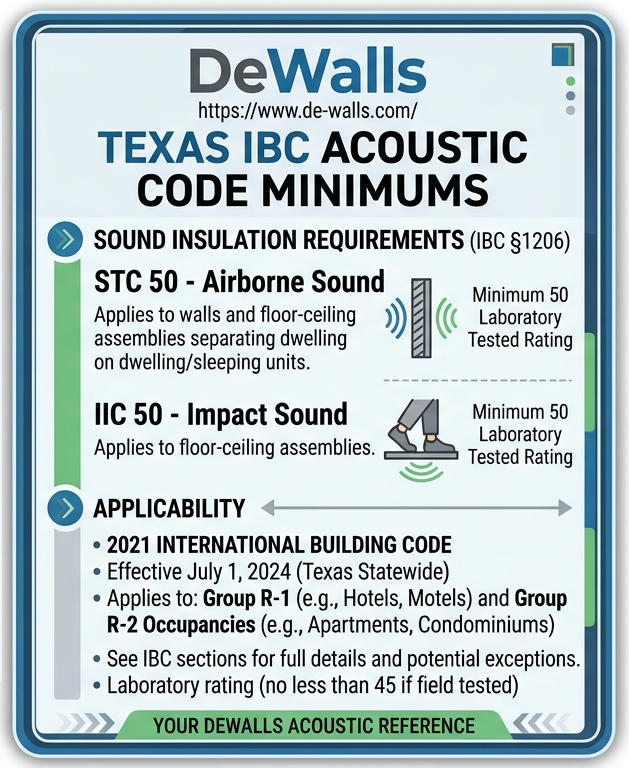
Airborne Sound: STC 50 minimum for walls and floor-ceiling assemblies between dwelling units (IBC §1206.2).
Impact Sound: IIC 50 minimum for floor-ceiling assemblies between dwelling units (IBC §1207).
Field Measurement Allowance: 3 to 5 points below lab rating is acceptable for code compliance.
Occupancy Groups Covered: R-1 (hotels, motels) and R-2 (apartments, condominiums), including mixed-use with residential.
Code Basis: IBC 2021 Edition - effective in Texas from July 1, 2024 through TDLR adoption.
Lab Testing Standard: ASTM E90 for STC; ASTM E492 for IIC.
Field Verification Standard: ASTM E336 for Field STC (FSTC); ASTM E1007 for Field IIC (FIIC).
IBC Chapter 12 - The Texas Acoustic Compliance Roadmap
Chapter 12 of the IBC - Interior Environment - is the primary location for acoustic requirements in Texas commercial construction.
IBC §1206 - Airborne Sound Control:
Requires a minimum lab-rated STC of 50 for all assemblies separating dwelling units from each other.
Covers walls between adjacent apartments, floor-ceiling assemblies between stacked units.
Also covers walls between a dwelling unit and a public corridor.
Also covers walls between a dwelling unit and building service spaces (mechanical rooms, laundry).
IBC §1207 - Structure-Borne Sound Control:
Requires a minimum lab-rated IIC of 50 for floor-ceiling assemblies between separate dwelling units.
Governs impact noise specifically - footsteps, furniture movement, dropped objects.
Applies wherever one residential unit is stacked above another.
Assemblies That Must and Must Not Be Acoustically Rated
Assemblies that MUST meet minimum STC and/or IIC ratings under Texas IBC:
Demising walls between all adjacent dwelling units.
Floor-ceiling assemblies between all vertically stacked dwelling units.
Walls between any dwelling unit and a public corridor.
Walls between any dwelling unit and mechanical rooms or building service areas.
Floor-ceiling assemblies between commercial and residential floors in all mixed-use buildings.
Assemblies that are NOT covered by IBC Chapter 12 acoustic requirements:
Walls between commercial tenant spaces in buildings with no residential component.
Interior partitions within a single dwelling unit.
Exterior wall assemblies - these are governed by energy code, not acoustic code.
Mechanical system noise within dwelling units - governed by mechanical code and market standards.
Practical implication for Texas developers:
A ground-floor coffee shop and an adjacent retail tenant share a party wall with no IBC acoustic rating requirement.
The floor-ceiling assembly between that same coffee shop and the residential units directly above it must meet both STC 50 and IIC 50.
The commercial tenant's opening-day operations are subject to the city noise ordinance regardless of IBC compliance status.
City-by-City Local Noise Ordinance Requirements Across Texas
Because Texas has no single statewide commercial noise statute, local ordinances govern how commercial buildings operate - entirely separate from how they are built. Houston, Dallas, Austin, and San Antonio each enforce distinct operational decibel limits with separate daytime and nighttime thresholds measured in dB(A). These apply to amplified sound, mechanical equipment, outdoor activity, and any operational noise crossing a property line. Developers must satisfy both IBC construction requirements and city operational noise ordinances simultaneously.
Why Local Ordinances Create a Parallel and Separate Layer of Compliance
The IBC tells you how to build the building. Local noise ordinances tell you what sound levels are permissible once it opens for business. These are two separate obligations requiring two entirely different mitigation strategies.
IBC compliance is addressed through:
Building assembly design and wall type selection.
Floor system and underlayment specification.
Door STC ratings and acoustic sealing.
Penetration management and flanking path elimination.
Operational noise compliance is addressed through:
Site planning and buffer zone analysis.
Speaker and sound system placement.
Façade orientation relative to residential adjacency.
Mechanical equipment screening and vibration isolation.
Operating hour restrictions imposed as permit conditions.
A restaurant with a rooftop bar, a fitness studio with a sound system, a hotel with outdoor entertainment, or a bar with live music - all can be fully IBC-compliant and still violate city noise code on opening night. Both layers must be planned from the earliest design phase. One cannot substitute for the other.

Houston - Chapter 30 and the 300-Foot Residential Buffer Rule
Houston's noise ordinance is codified in Chapter 30 of the City of Houston Code of Ordinances, significantly amended on May 4, 2022, with amendments effective September 6, 2022.
The core rule for Houston commercial developers:
Any commercial establishment within 300 feet of a residence that plays amplified sound - indoors, outdoors, on a patio, or in a parking area - must hold a Commercial Establishment Permit before operating.
Without a valid permit, maximum permissible sound levels are:
58 dB(A) measured at a residential receiving property.
68 dB(A) measured at a commercial receiving property.
All measurements are taken at the receiving property - not at the sound source.
With a valid Commercial Establishment Permit, the rules change to:
Amplified sound permitted up to 75 dB(A).
Permitted hours: Sunday through Thursday, 8:00 a.m. to 10:00 p.m.
Permitted hours: Friday and Saturday, 8:00 a.m. to 11:00 p.m.
Criminal violations carry fines of up to $2,000 per incident.
Citations may be written for vibration or resonance causing unreasonable disturbance even without exceeding the measurable dB(A) limit.
What Houston commercial developers must act on during design:
Identify during site planning whether the project site falls within 300 feet of any existing or planned residence.
Determine the permit requirement and acoustic mitigation strategy before buildout begins.
Understand that acoustic isolation of the building envelope does not resolve outdoor entertainment compliance.
Treat speaker placement, directional orientation, and façade orientation as acoustic design variables.
Confirm whether the project site falls within any Houston Entertainment District with additional overlay restrictions.
For commercial soundproofing in Houston, both the IBC assembly performance layer and the Chapter 30 operational layer represent distinct design considerations requiring coordinated planning from schematic design onward.
Dallas - Zoning District dBA Limits and Variance Requirements
Dallas ties permissible noise levels to the receiving land use - the limit is based on the type of property that hears the noise, not the type of property generating it.
Key characteristics of Dallas noise regulation:
Commercial operations adjacent to residential zoning districts face tighter decibel limits than the same operations in fully commercial corridors.
Entertainment districts including Uptown and Deep Ellum operate under additional noise management requirements.
Enforcement is both complaint-driven and proactively exercised in higher-density urban areas.
Dallas's noise regulations are codified in Sections 51-6.102 and 51A-6.102 of the Dallas Development Code.
For Dallas commercial developers seeking variance from standard noise limits, the three required steps are:
Submit a formal variance application to Dallas Development Services.
Include an acoustic impact study documenting projected sound levels at property lines during peak operating conditions.
Accept that approval may be conditioned on operational hour restrictions or specific acoustic mitigation measures.
Always verify current applicable limits directly with Dallas Development Services before submitting permits for any Dallas project with sound-generating uses.
Austin - Sound Assessment Requirements, Music Venue Protection, and the Residential Tension
Austin actively protects the noise sources as well as the noise receivers - a regulatory characteristic unique among major Texas cities. The city's live music scene is a defined part of its economic identity, and legal frameworks prevent new residential development from forcing established music venues to close.
The September 2024 Sound Assessment Ordinance - what it requires:
Under a sound assessment ordinance approved by Austin City Council on September 12, 2024, new residential and hotel developments must conduct a formal sound assessment if the project site is located:
Within 600 feet of an establishment holding an active Outdoor Music Venue (OMV) permit.
Within 300 feet of any performance venue.
The sound assessment is a design requirement, not a disclosure formality:
Developers must document the existing ambient sound environment in the area.
Building envelope acoustic specifications must be designed accordingly.
Austin's interactive mapping tool shows proximity of all development sites to active OMV permit holders.
For Austin commercial establishments using outdoor amplified sound, the requirements are:
An Outdoor Music Venue (OMV) Permit is required for any sound equipment used outside a fully enclosed space.
Governing code: Title 9, Chapter 9-2 of the Austin Code of Ordinances.
Maximum permitted sound level for music venues: 85 dBA.
Maximum permitted sound level for restaurant uses: 70 dBA.
Permits may not be issued for outdoor sound equipment within 100 feet of property zoned and occupied as residential.
Permitted operating hours near residential zones (within 600 feet):
Sunday through Thursday: 10:00 a.m. to 8:00 p.m.
Friday and Saturday: 10:00 a.m. to 10:00 p.m.
Extensions of up to two additional hours may be granted with documented support from neighbors and neighborhood organizations.
San Antonio - Military Noise Zones and the AICUZ Overlay
San Antonio's acoustic planning environment includes a requirement found nowhere else in Texas: proximity to Joint Base San Antonio (JBSA), which encompasses Lackland AFB, Randolph AFB, and Fort Sam Houston.
How the AICUZ program affects San Antonio commercial development:
Military aircraft operations are federally exempt from city noise ordinances.
Properties in JBSA flight paths cannot regulate the noise source - only mitigate its impact through building design.
The U.S. DOD AICUZ program maps noise contour zones using Day-Night Average Sound Level (DNL) metrics.
San Antonio incorporated these contours into the UDC through the Military Sound Attenuation Overlay District (MSAO) at UDC §35-339.05.
Within designated MSAO areas, commercial construction must meet these additional requirements:
Higher STC specifications for exterior walls and roof-ceiling assemblies than the base IBC requires.
Acoustically rated windows and glazing systems achieving required interior noise reduction targets.
Designed HVAC upducts in ceilings allowing air circulation while windows remain closed.
Signed MSAO compliance certification submitted to Planning and Development Services before final inspection or certificate of occupancy issuance.
General San Antonio noise ordinance limits (outside MSAO zones):
Daytime limit: 70 dB(A) at the nearest residential property line.
Nighttime limit: 60 dB(A) at the nearest residential property line.
Enforcement is more proactively exercised than Houston's complaint-driven approach.
Work near San Antonio military installations frequently requires vibration and industrial acoustic assessment alongside standard building code review - particularly for commercial buildings in DNL 65+ noise contour zones.
Texas Major Cities - Operational Noise Comparison Table
City | Daytime Limit | Nighttime Limit | Measurement Point | Key Provision | Enforcement |
Houston | 68 dB(A) unpermitted / 75 dB(A) permitted | 58 dB(A) residential | Complainant location | 300-ft buffer; Commercial Permit required; fines up to $2,000. | Complaint-driven. |
Dallas | Varies by zoning district | Varies by zoning district | Property line | Zoning overlays; variance requires acoustic impact study. | Complaint + proactive. |
Austin | Up to 85 dB(A) permit-specific | Up to 85 dB(A) permit-specific | Permit-specified | OMV permit required; 600-ft and 300-ft assessment trigger zones. | Complaint-driven. |
San Antonio | 70 dB(A) | 60 dB(A) | Nearest residential property line | AICUZ military overlay; MSAO under UDC §35-339.05. | Proactive. |
Important: Decibel limits shown reflect verified ordinance data at publication date. Texas city ordinances are updated periodically. Always confirm current limits directly with the applicable city development or code enforcement office before permit submission.
Above-Code Acoustic Targets for Class A Texas Commercial Projects
Direct Answer: The IBC minimum of STC 50 and IIC 50 consistently falls short of Class A tenant expectations in Texas's competitive urban markets. The ICC designates STC 55 as "Acceptable" (Grade B) and STC 60 as "Preferred" (Grade A) performance. Most Class A Texas developers target STC 55 to 58 and IIC 55 to 60 - not as luxury upgrades, but as risk management strategies against tenant noise complaints, non-renewals, and legal exposure under the implied covenant of quiet enjoyment.
Why Code Minimum Is No Longer Market Minimum in Texas
Texas's population growth is concentrating in high-density urban cores. The Austin Domain, Dallas's Uptown, Houston's Midtown, and San Antonio's Pearl District are delivering new multifamily and mixed-use inventory into markets where tenants have real choices and where online reviews spread fast.
Three forces driving above-code acoustic demand across Texas commercial development:
Remote work has made acoustic privacy a productivity requirement. A tenant who works from home needs walls that provide genuine speech privacy - not walls that pass inspection. The audible difference between STC 50 (neighbor's phone call as unintelligible murmur) and STC 55 (neighbor's phone call completely inaudible) is the difference between a lease renewal and a move-out notice. For the growing share of Texas multifamily tenants working remotely, acoustic performance is a daily work productivity issue.
Premium rent competition demands measurable quality differentiators. In Class A Texas multifamily markets, tenants pay significant premiums and make deliberate property comparisons. Acoustic comfort is consistently cited as one of the top drivers of both negative online reviews and non-renewals. Properties with documented noise issues lose tenants and receive the reviews that prevent replacement leases.
Social media complaint velocity has permanently changed the stakes. A single acoustic failure generating a three-star Google review or a Reddit thread about thin walls can undermine months of lease-up marketing. Unlike a plumbing repair that gets fixed and forgotten, ongoing noise problems generate ongoing negative reviews - because tenants live with the problem every single day until they move out.

The Implied Covenant of Quiet Enjoyment - The Legal Risk That STC 50 Does Not Eliminate
Under Texas law, the implied covenant of quiet enjoyment is legally binding in every residential lease - confirmed through established case law documented by the Texas State Law Library. Tenants have the right to peaceful occupation without substantial noise interference, whether or not the lease explicitly states this right.
What tenants can legally pursue when this covenant is substantially breached:
Withhold rent payments until the issue is meaningfully addressed.
Terminate the lease agreement on grounds of constructive eviction.
File a civil lawsuit for breach of contract and seek monetary damages.
Continue occupying the property while simultaneously maintaining an active lawsuit.
Critical point for Texas developers and property managers:
Code compliance does not shield a landlord from covenant of quiet enjoyment claims. A building with field STC 44 walls - legally code-compliant within the allowable field tolerance - may still breach this covenant if tenants experience substantial, recurring noise interference that the landlord fails to address after being notified.
The most effective protection is building to a standard that prevents the problem from arising in the first place.
Class A Wall Assembly Targets - Achieving STC 55 and Above
Moving from IBC minimum to Class A performance requires deliberate decisions made during assembly specification. These upgrades deliver the most meaningful impact on final lab and field performance:
Upgrade From Code-Minimum Specification | Approximate STC Gain |
Acoustic mineral wool cavity fill instead of standard fiberglass batt. | +2 to 3 STC points. |
Resilient isolation clips (RSIC-1 or equivalent) replacing standard resilient channel. | +2 to 4 STC points. |
Second layer of 5/8" gypsum with staggered joints on both sides of the assembly. | +2 to 3 STC points. |
Acoustic sealant at all penetrations - outlets, pipes, conduit, and perimeter gaps. | Protects 3 to 5 STC points by eliminating flanking losses. |
Double-stud wall with 1-inch air gap (premium builds). | +6 to 10 STC points above the single-stud baseline. |
How these upgrades compound:
A single-stud assembly starting at STC 48 baseline.
With mineral wool + resilient clips + two gypsum layers + acoustic sealant: reaches STC 60 to 65 in the laboratory.
Expected field performance with those upgrades: STC 55 to 58.
That is a Class A result that protects lease renewals and legal standing.
Class A Floor Targets - Achieving IIC 55 and Above With LVP Flooring
LVP is now in the majority of new Texas multifamily units - durable, waterproof, and tenant-preferred. But its hard, rigid surface transmits impact energy efficiently into the subfloor below, creating an IIC compliance challenge that did not exist at the same scale five years ago.
Selecting underlayment by tested ΔIIC - not thickness or brand - is the correct approach:
Flooring Type | Target ΔIIC for Reliable IIC 55 Field Result | Recommended Specification |
Luxury Vinyl Plank (LVP) | ΔIIC 22 or higher. | 6mm+ dense closed-cell foam or cork composite. |
Hardwood (solid or engineered) | ΔIIC 18 or higher. | 3mm+ acoustic felt or rubber underlayment. |
Tile or stone | ΔIIC 25 or higher. | Uncoupling membrane with acoustic mat layer. |
Carpet over pad | ΔIIC 10 or higher. | Standard acoustic pad generally sufficient. |
The critical design rule that prevents LVP IIC failures:
Underlayment adds ΔIIC points to the base assembly - it does not replace a deficient structural assembly.
A structural floor-ceiling system testing at IIC 30 bare, plus ΔIIC 22 underlayment, yields approximately IIC 52 lab and IIC 45 to 47 field.
That field result is below code minimum - regardless of how high the underlayment's ΔIIC rating is.
Design the structural assembly and flooring system together as a coordinated unit from the start.
Mechanical System Acoustic Targets - The Gap Most Texas Projects Miss
IBC STC and IIC requirements do not cover HVAC duct-borne noise or mechanical equipment vibration. Yet these are consistently among the top three acoustic complaints in Texas commercial buildings. Hitting meaningful mechanical noise targets requires setting Noise Criterion (NC) targets during mechanical design.
Recommended NC targets by space type for Texas commercial projects:
Space Type | Recommended NC Target |
Private offices | NC-30 to NC-35. |
NC-35 to NC-40. | |
Hotel guest rooms | NC-30. |
Residential bedrooms | NC-25 to NC-30. |
Corridors and lobbies | NC-35 to NC-40. |
NC-40 to NC-45. |
Achieving these targets requires these coordinated mechanical design decisions:
Size ducts for lower air velocities to reduce duct-generated noise at registers.
Apply acoustic lining to supply and return duct runs through or adjacent to occupied spaces.
Install flexible duct connectors at unit transitions to interrupt vibration transmission.
Mount all major equipment on vibration isolation pads or spring mounts.
Design return air paths to avoid creating acoustic bypass between adjacent spaces.
For Texas commercial projects with complex mechanical systems, professional noise control and vibration solutions address HVAC-related acoustic concerns as part of a coordinated design process - not as afterthoughts added during construction.
Wall and Floor Assembly Options That Meet Texas Acoustic Code
Direct Answer: Three wall assembly types are widely used in Texas commercial construction to meet or exceed IBC STC 50: single-stud with resilient channel (budget-tier, with significant field performance risk), staggered stud (reliable mid-tier for most multifamily applications), and double-stud with air gap (premium, standard for Class A performance). For floor-ceiling assemblies, concrete slab systems most reliably meet IIC 50 and above. Wood-frame assemblies require carefully selected ceiling decoupling and floor underlayment systems - especially when luxury vinyl plank is the specified finish floor.

Texas Commercial Wall Assembly Performance Comparison
Understanding the real-world field performance of each assembly type - not just the laboratory number on a data sheet - is what separates Texas buildings that work from those that generate complaints.
Assembly Type | Construction Summary | Lab STC | Expected Field STC | Code Compliant? | Risk Level |
Single stud + resilient channel | 3-5/8" metal studs, RC-1 channel one side, 5/8" Type X gypsum both sides, mineral wool. | 50–52 | 44–48 | Borderline - frequently falls below STC 50 in field. | High - RC short-circuit risk. |
Staggered stud | Staggered 2x4 studs on 2x6 plate, fiberglass batt woven through, two layers 5/8" gypsum each side. | 54–56 | 49–52 | Yes - reliable when properly inspected. | Moderate. |
Double stud + air gap | Two independent 2x4 walls, 1" air gap, acoustic mineral wool, two gypsum layers each side. | 60–65 | 55–60 | Yes - exceeds code; Class A standard. | Low. |
CMU / concrete masonry | 8" CMU, painted both sides, all penetrations and joints fully sealed. | 48–52 | 46–50 | Yes - when all penetrations sealed. | Low when correctly detailed. |
If the single-stud resilient channel assembly is specified, take these minimum protective steps:
Specify acoustic mineral wool fill instead of standard fiberglass batt.
Require verified pre-drywall inspection of all resilient channel installations before any board is applied.
Confirm fastener length verification against channel depth specifications is documented in writing.
Conduct field acoustic testing before final drywall finishing so failures can be identified and corrected before permanent closure.
Texas Commercial Floor-Ceiling Assembly Performance Comparison
Assembly Type | Construction Summary | Lab IIC | Expected Field IIC | Best Application |
Concrete slab (bare) | 6-inch normal-weight concrete, no finish flooring. | 42–48 | 40–46 | Requires flooring overlay - not independently code-compliant. |
Concrete slab + 6mm foam underlayment + LVP | 6" slab, 6mm dense acoustic closed-cell foam, LVP topping. | 52–58 | 49–54 | Standard Texas multifamily with LVP - borderline in field. |
Concrete slab + cork composite + LVP | 6" slab, 8mm cork composite underlayment, LVP topping. | 56–62 | 51–57 | Class A multifamily - better low-frequency performance. |
Wood frame + mineral wool + RC ceiling + gypsum | 2x10 joists, mineral wool, resilient channel ceiling, 5/8" Type X gypsum. | 48–54 | 43–49 | Borderline - requires flooring upgrade for reliable IIC 50 field. |
Wood frame + floating floor + acoustic underlayment + LVP | Above with floating floor decoupler, 8mm+ underlayment, LVP topping. | 56–62 | 51–57 | Class A wood-frame - highest-performing option. |
Flanking Paths - Where Compliant Texas Assemblies Silently Fail
Flanking transmission is the phenomenon where sound bypasses a rated assembly entirely through structural connections, unsealed gaps, or penetrations in the building fabric. It is responsible for a substantial portion of field STC failures on Texas commercial projects - and it is completely invisible once walls are closed.

The six most common flanking paths found in Texas commercial buildings:
Back-to-back electrical outlets on opposite sides of a demising wall - sharing a hollow cavity that acoustically connects both sides of the assembly.
HVAC ductwork running through shared wall cavities without acoustic lining - creating a direct sound transmission path between adjacent spaces.
Unsealed perimeter gaps at wall-to-floor intersections - particularly where bottom plates meet concrete slabs without acoustic caulk applied to the perimeter.
Recessed lighting fixtures in ceiling assemblies below upper-floor units - installed without sealed acoustic housings, creating direct penetrations through the rated assembly.
Continuous drywall planes running past wall terminations - transmitting vibration around the end of an otherwise compliant assembly through the structure.
Undersized corridor doors adjacent to rated demising walls - a STC 50 party wall paired with a standard hollow-core corridor door effectively performs at STC 20 to 26 at the door location.
Addressing flanking paths requires specification-level attention - not field discretion:
Acoustic sealant at all penetrations must be written as a mandatory requirement in Division 09 specifications.
Putty pads on back-to-back outlet boxes must appear on the drawings - not left to installer choice.
Sealed recessed light housings must be specified in the reflected ceiling plan.
Corridor door STC ratings must be selected to match the demising wall performance.
For projects where acoustic doors are specified - particularly in healthcare, conference room, hotel, or recording studio applications - the door STC rating must be selected to match or exceed the adjacent wall assembly's performance, not selected independently based on price.
The Most Costly Acoustic Compliance Mistakes on Texas Commercial Projects
The most consequential acoustic compliance failures on Texas commercial projects are installation errors - not specification errors. Resilient channel short-circuited to the stud, unsealed penetrations, LVP installed over insufficient underlayment, undersized corridor doors, and referencing the wrong IBC edition account for the majority of field STC and IIC failures. These mistakes consistently cost 5 to 10 times more to fix after construction than to prevent during it.

Mistake No. 1 - The Short Circuit: Resilient Channel Screwed Through to the Stud
This is the single most consequential installation error in Texas commercial acoustic construction - and it occurs with greater frequency than most project teams acknowledge.
How the short circuit happens:
Resilient channel creates a mechanical decoupling break between drywall and stud framing.
When a drywall crew member drives a screw through the RC channel into the stud below, the decoupling is permanently destroyed at that location.
The channel and stud become rigidly connected.
The entire isolation benefit of the system collapses at that point.
This happens when fasteners are even slightly too long - a common occurrence under schedule pressure.
How severe the performance loss actually is:
Weyerhaeuser research documents that short-circuit connections can decrease STC rating by up to 20 percent.
ABD Engineering studies show RC sandwiched between layers produces performance equivalent to no resilient channel at all - dropping 15 to 20 STC points below specification.
Combined risk factors (upside-down installation, weight-induced short circuits, post-construction damage from tenant fixture mounting) create documented failure rates approaching 90 percent on standard RC installations.
Four steps that prevent this mistake on every Texas commercial project:
Specify resilient isolation clips (RSIC-1 or equivalent) instead of standard resilient channel on all Class A performance projects - they are mechanically harder to accidentally short-circuit.
Require pre-drywall inspection of all RC installations by the superintendent or project acoustician before any board is applied.
Document fastener length verification as a written requirement in the construction specifications - not a verbal site instruction.
Conduct field acoustic testing before ceiling and wall finishing permanently conceal the assemblies.
Mistake No. 2 - Skipping Acoustic Sealant at All Penetrations
Every electrical outlet box, pipe penetration, conduit run, and structural gap through a rated assembly creates a potential acoustic flanking path. Unsealed penetrations are among the most consistent sources of field STC degradation on Texas commercial projects.
The performance impact of unsealed penetrations:
A single unsealed penetration through a STC 50 wall can reduce acoustic performance to STC 30 or below at that location.
Assemblies perform at the level of their weakest point - not their strongest.
Once drywall finishing is complete, these failures are completely invisible.
Detection requires destructive investigation or formal field testing.
The specification approach that prevents it:
Write acoustic sealant requirements into Division 09 project specifications as mandatory items - not optional best practices.
Specify non-hardening acoustic caulk at the perimeter of every wall and ceiling penetration.
Require acoustic putty pads on all back-to-back electrical outlet boxes in demising walls.
Specify backer rod and acoustic sealant at all oversized gaps around pipes and conduit runs.
Mistake No. 3 - Using Floor Covering to Compensate for a Deficient Structural Assembly
The reasoning sounds plausible: premium underlayment is specified under the LVP - that should close the IIC gap. The problem is that underlayment adds ΔIIC improvement to the base assembly, but cannot compensate for a structurally inadequate floor-ceiling system.
The math that reveals the problem:
Wood-frame floor-ceiling assembly: tests at IIC 30 bare.
With ΔIIC 22 underlayment added: approximately IIC 52 in the lab.
Expected field IIC: 45 to 47 - below code minimum.
This fails code regardless of the underlayment's ΔIIC rating.
The correct design sequence to prevent this mistake:
Design the structural floor-ceiling assembly to achieve the highest IIC the structure and budget can support.
Calculate the remaining gap between the structural assembly's expected field IIC and the project target.
Select underlayment with tested ΔIIC sufficient to close that gap - with margin for field variability.
Never treat underlayment as a structural correction - treat it as the final performance layer in a coordinated system.
Mistake No. 4 - Ignoring Corridor Door STC Ratings
In the majority of Texas multifamily and hotel floor plans, sound travels through the weakest element in the wall plane - which is frequently the corridor door, not the demising wall.
The corridor door performance gap in Texas construction:
IBC minimum for corridor doors in residential occupancies: STC 32.
Standard hollow-core interior doors: STC 20 to 26.
A STC 50 demising wall with a STC 23 hollow-core corridor door performs at STC 23 at the door location.
The entire wall's acoustic performance is governed by the weakest element.
Corridor door specifications by project tier:
IBC minimum compliance: STC 32.
Mid-tier multifamily market standard: STC 35 to 38.
Class A multifamily and hotel standard: STC 42 to 45.
Premium builds adjacent to high-traffic corridors or mechanical spaces: STC 45 and above.
Investing in properly rated acoustic doors - selected for tested STC performance, not just door construction type - is one of the highest-return acoustic decisions on Texas hotel and multifamily projects.
Mistake No. 5 - Referencing the Wrong IBC Edition
Texas's decentralized code adoption structure means different jurisdictions may enforce different IBC editions. Specifications correct under the 2021 IBC may differ from 2015 requirements in ways that create plan review corrections or costly field changes.
The prevention process is a single simple step:
Confirm the enforced IBC edition with the local AHJ before beginning design development on every Texas commercial project.
Document the confirmed edition and all local amendments in the project specifications.
If working across multiple Texas jurisdictions simultaneously, confirm each city's edition separately - never assume all cities are on the same code cycle.
How to Document and Verify Acoustic Compliance in Texas
Direct Answer: Acoustic compliance in Texas is documented through manufacturer-tested assembly data submitted during plan review, and verified through post-construction field testing under ASTM E336 (airborne sound) and ASTM E1007 (impact sound). Field testing is not universally required by Texas AHJs but is strongly recommended on all projects where acoustic performance is a defined quality standard. Acoustic remediation after construction completion consistently costs 5 to 10 times more than correct design and installation during the original build.

Step 1 - Pre-Construction: Specification and Plan Review Documentation
Getting acoustic compliance documented correctly during plan review prevents delays, corrections, and the significantly more expensive problem of discovering a performance gap after construction is complete.
The pre-construction documentation process - four required actions:
Identify all assemblies requiring acoustic ratings. The partition schedule and reflected ceiling plan on the architectural drawings should explicitly identify every assembly required to meet minimum STC or IIC standards, with the required rating stated alongside each assembly type.
Select tested assemblies from manufacturer data libraries. Major gypsum manufacturers including USG, CertainTeed, and National Gypsum maintain libraries of ASTM E90 and E492 tested assemblies with documented test report numbers. Specify by test report number - not by general description. "Staggered stud with two layers of gypsum" is not a specification.
Reference ASTM test report numbers in project specifications. Division 09 of the project specifications should include references to specific tested assemblies with ASTM report numbers and explicit minimum STC and IIC performance requirements stated for each assembly type.
Submit complete acoustic documentation with the building permit application. The local AHJ reviews acoustic assembly specifications as part of plan review. Complete, properly referenced documentation accelerates the review process and significantly reduces the likelihood of corrections that delay permit issuance.
Step 2 - During Construction: Pre-Drywall Inspection Checklist
Post-construction field testing confirms performance. Pre-drywall inspection prevents failures before they are permanently concealed. Both steps are necessary.
The critical pre-drywall inspection checkpoints - verify each before board application:
Resilient channel orientation: Leg must face down; verify spacing and fastener lengths before any board is applied.
Outlet box treatment: Confirm all back-to-back electrical outlet boxes have been fitted with acoustic putty pads.
Penetration sealing: Verify all pipe and conduit penetrations through rated assemblies are sealed with acoustic caulk and backer rod.
Recessed lighting housings: Check that all recessed light fixtures in rated ceiling assemblies are installed in sealed acoustic housings.
HVAC duct penetrations: Confirm all HVAC duct penetrations through rated assemblies are acoustically lined at the penetration point.
Perimeter gaps: Verify acoustic sealant has been applied at all wall-to-floor and wall-to-ceiling intersections.
Step 3 - Post-Construction: Field Testing Standards and Application
Test Standard | What It Measures | When to Apply |
ASTM E336 | Field Sound Transmission Class (FSTC) - airborne noise between spaces. | Recommended for all projects; required by some lenders and Class A building programs. |
ASTM E1007 | Field Impact Insulation Class (FIIC) - impact noise between floor levels. | Essential for wood-frame multifamily; recommended wherever IIC is a defined performance standard. |
ASTM E966 | Exterior wall sound attenuation - traffic and exterior noise. | Projects in highway or airport adjacency; Austin developments within OMV sound assessment zone. |
When to schedule field testing for best results:
After construction is complete but before furniture and finish materials are installed in the receiving space.
Empty-room conditions produce consistent, reproducible measurements.
Results can be directly compared to laboratory ratings without adjustment for furnishings.
Step 4 - When a Field Test Fails: Remediation Cost Hierarchy
Remediation options ordered from least to most expensive:
Add a gypsum layer over existing drywall (approximately $3 to $6 per square foot): A second layer of 5/8" gypsum with staggered joints and perimeter acoustic sealant can add 3 to 5 STC points. Most effective when the base assembly is close to target and the failure is mass-related.
Add resilient channel and a new gypsum layer (approximately $8 to $14 per square foot): Furring existing drywall with resilient channel or isolation clips plus a new gypsum layer can add 5 to 10 STC points. More invasive but effective when decoupling deficiency is the root cause.
Open walls and correct the source failure (approximately $20 to $40 per square foot or more): When field testing identifies a short-circuit or flanking path that cannot be addressed from the surface, opening the wall and correcting the root cause is the only reliable option. This requires coordinating with trades whose work is already complete behind the wall.
The ratio that defines the investment case: Acoustic remediation after construction completion consistently costs 5 to 10 times more than correct design and installation during the original build. Pre-drywall inspection and post-construction field testing are modest investments that prevent the most expensive outcomes.
Texas Commercial Acoustic Requirements by Building Type
Acoustic requirements in Texas vary significantly by building type. Multi-family and hotel properties must meet IBC STC 50 and IIC 50 minimums, with Class A market practice pushing to STC 55+ and IIC 55+. Mixed-use buildings must satisfy both IBC construction standards and city operational noise ordinances simultaneously. Schools must meet ANSI S12.60 alongside IBC requirements. Medical office buildings have no IBC mandate for commercial-to-commercial assemblies but face HIPAA speech privacy requirements translating to practical STC targets of 48 to 52 between clinical spaces.

Multi-Family Residential Buildings (R-2 Occupancy) in Texas
Multi-family residential is where Texas commercial building acoustic code requirements are most actively enforced, most consequential to project outcomes, and most frequently the source of tenant complaints and legal disputes.
The specific acoustic challenges Texas multifamily developers face today:
LVP flooring adoption across the majority of new builds. LVP is tenant-preferred and operationally durable - but without underlayment specified by tested ΔIIC, LVP assemblies on wood-frame structures routinely fall below IIC 50 in field conditions.
Shared amenity spaces adjacent to or above dwelling units. Fitness centers, yoga studios, rooftop terraces, and co-working lounges generate substantial impact and airborne noise. When positioned directly above or below residential units, these spaces require impact isolation systems well beyond standard IIC 50 requirements.
Student housing near Texas university campuses. These building types experience above-average noise generation. STC 55 for demising walls is increasingly standard on student housing projects near UT Austin, A&M, TCU, SMU, and Rice.
Remote work tenants with heightened sensitivity. The growing share of tenants working from home means acoustic performance affects daily productivity - not just nighttime comfort.
What Class A Texas multifamily developers specify:
Demising walls at lab STC 55 to 58 targeting field STC 50 to 54.
Floor-ceiling assemblies at lab IIC 55 to 62 targeting field IIC 50 to 57.
LVP underlayment selected by tested ΔIIC - minimum ΔIIC 22.
Corridor doors at STC 38 to 42.
All penetrations sealed with acoustic caulk and putty pads.
For commercial soundproofing in Texas multifamily projects, the coordinated system approach - walls, floors, doors, and mechanical - consistently outperforms individual component selections made independently.
Hotels and Extended-Stay Properties (R-1 Occupancy)
Hotels carry the same IBC STC 50 and IIC 50 requirements as multifamily residential between guest rooms. The market standard is meaningfully higher - particularly in branded properties subject to franchise acoustic requirements.
Key acoustic considerations specific to Texas hotel projects:
Brand standard requirements. Major hospitality brands - Marriott, Hilton, IHG, and sub-brands - typically require STC 52 to 58 between guest rooms as a condition of brand approval at three-star and above. These are franchise agreement conditions, not aspirational guidelines.
Corridor acoustic door performance. IBC minimum for R-1 corridor doors is STC 32. Standard hollow-core interior doors achieve STC 20 to 26. The gap is audible every time a guest walks the hallway during quiet hours. Market standard for Texas hotel corridor doors is STC 38 minimum; premium properties specify STC 42 to 45.
Mechanical room placement. A mechanical room adjacent to guest rooms without proper vibration isolation at equipment mounts and adequate STC at the separating wall is among the most common sources of recurring hotel noise complaints in Texas. This is a schematic design decision - not a field correction.
Adaptive reuse and hotel conversions. Texas's commercial real estate market includes significant office-to-hotel and commercial-to-extended-stay conversions. Acoustic retrofitting in occupied buildings requires professional soundproofing services that minimize operational disruption while achieving the required performance.
Mixed-Use Buildings (Commercial Below Residential)
Mixed-use buildings are the most acoustically complex commercial building type in Texas. They require simultaneous compliance with two regulatory frameworks while managing physics that is genuinely difficult - commercial uses generate more impulsive noise and more low-frequency energy than residential neighbors.
Critical design decisions for Texas mixed-use projects:
Structural slab specification. An 8-inch or thicker concrete structural slab between commercial and residential floors is the most reliable path to achieving IIC 50 and meaningful low-frequency isolation. Wood-frame construction between commercial and residential uses requires exceptional detailing to achieve reliable field performance.
Commercial kitchen equipment vibration isolation. Walk-in cooler compressors, commercial dishwashers, exhaust fans, and ice machines must be mounted on vibration-isolating pads or spring isolators - specified in the mechanical coordination documents, not left to field decisions.
Operational noise compliance from day one. The city noise ordinance applies to the commercial tenant from the first day of business. IBC compliance (construction) and city ordinance compliance (operations) must both be planned during design.
Low-frequency sound attenuation. STC ratings attenuate mid-frequency speech effectively but provide limited reduction of bass-frequency sound from music systems. Mixed-use buildings housing entertainment or food and beverage tenants may require STC 60 or higher at commercial-to-residential separating assemblies.
For restaurant acoustic solutions within mixed-use buildings, both internal reverberation control and sound transmission isolation to residential units above require separate but coordinated acoustic design strategies.
Office Buildings and Commercial Tenants
Standard Texas office buildings without residential components have no IBC STC mandate for partitions between commercial tenant spaces. However, office acoustic design and conference room soundproofing are increasingly incorporated into lease negotiations and Class A office specifications.
Office space types requiring acoustic attention in Texas:
Private offices and executive suites: STC 45 to 50 between offices ensures speech privacy for sensitive conversations.
Conference rooms and boardrooms: STC 50 to 55 required for confidential meetings; soundproof conference rooms require both wall STC and door STC to be coordinated.
Open plan offices: Noise control through acoustic treatment - panels, baffles, sound masking - rather than isolation walls.
Healthcare administrative offices: HIPAA implications apply beyond clinical spaces when patient information is discussed.
For reducing noise in open plan offices across Texas's growing corporate campuses in Dallas-Fort Worth, Austin, and Houston, the combination of acoustic panels, sound masking systems, and strategic layout design addresses the unique challenges of modern open office environments.
Healthcare and Medical Office Buildings
Medical office buildings in Texas have no IBC acoustic mandate for assemblies between commercial tenant spaces. However, HIPAA's physical safeguard requirements create a practical acoustic standard that frequently exceeds what developers initially plan for.

HIPAA creates these practical acoustic requirements for Texas medical office projects:
HIPAA requires covered entities to implement reasonable physical safeguards for protected health information.
Patient conversations in clinical spaces must not be overheard in adjacent waiting areas, corridors, or other exam rooms.
These requirements are enforced by HHS - not by building inspectors - and carry material compliance consequences.
Practical STC targets for Texas medical office projects by adjacency:
Space Adjacency | Practical STC Target |
Exam room to public corridor. | STC 45 to 48. |
Exam room to adjacent exam room. | STC 48 to 52. |
Counseling or behavioral health room to any adjacent space. | STC 52 to 55. |
Waiting area to reception desk. | STC 40 to 45. |
For healthcare-specific acoustic design in Texas, acoustic solutions for healthcare facilities address both HIPAA speech privacy compliance and the broader patient comfort considerations that affect clinical outcomes, satisfaction scores, and regulatory compliance simultaneously.
Fitness Centers and Gyms Within Texas Commercial Buildings
For fitness centers within mixed-use commercial buildings, the acoustic challenges are two distinct problems requiring two separate solutions:
Problem 1 - Impact noise from fitness activity:
Dropped weights and equipment impacts generate low-frequency structure-borne noise.
IIC requirements for floor-ceiling assemblies between fitness floors and any use above or below are among the most demanding in the building.
Floating floor systems, thick rubber underlayment mats, and spring-isolated equipment platforms are required - not optional.
Problem 2 - Airborne noise from music and equipment:
Sound systems in fitness spaces generate significant airborne sound transmission to adjacent tenants.
STC 55 to 60 is commonly required for walls separating fitness spaces from occupied offices or residential units.
For complete fitness center soundproofing solutions in Texas commercial buildings, both problems require coordinated design - and addressing them separately in sequence consistently produces inferior results compared to solving them together from the design development phase.
Schools and Educational Facilities in Texas
Texas public school projects are governed by both the IBC and ANSI S12.60 - Acoustical Performance Criteria, Design Requirements, and Guidelines for Schools.
ANSI S12.60 requirements most critical for Texas schools:
Background noise in classrooms from mechanical systems must not exceed NC-35 in an unoccupied room.
Achieving NC-35 requires deliberate duct sizing, acoustic duct lining, diffuser selection, and mechanical equipment isolation.
Standard commercial HVAC design does not achieve NC-35 without specific acoustic coordination.
STC targets by space adjacency in Texas school construction:
Standard classroom to classroom: STC 50.
Classroom adjacent to music or band room: STC 55 minimum.
Classroom adjacent to gymnasium or cafeteria: STC 55 to 58.
Administrative office to public corridor: STC 45.
For industrial noise control in Texas educational facilities - including cafeterias, gymnasiums, and mechanical plant rooms - the industrial-grade noise control solutions developed for Texas manufacturing environments often apply directly to the high-noise spaces within educational buildings.
Frequently Asked Questions
What STC rating is required for commercial buildings in Texas?
Under the IBC 2021 Edition (effective in Texas from July 1, 2024), the minimum STC is 50 for walls and floor-ceiling assemblies separating dwelling units in multi-family and mixed-use commercial buildings. This applies to R-1 (hotels, motels) and R-2 (apartments, condominiums) occupancies. Standalone commercial buildings with no residential component have no IBC STC minimum, though local city noise ordinances may apply.
What is the IBC requirement for sound transmission in Texas?
IBC Chapter 12, Sections 1206 and 1207 require a minimum STC of 50 for airborne sound and a minimum IIC of 50 for impact sound between dwelling units. The 2021 IBC is currently in force in Texas as of July 1, 2024, adopted through TDLR. A field measurement of 3 to 5 points below the lab minimum is acceptable for code compliance purposes.
What IBC edition does Texas currently follow?
Texas adopted the 2021 IBC, effective July 1, 2024, through TDLR. Projects permitted before that date may have used the 2015 IBC depending on the jurisdiction. Always confirm the enforced edition with your local AHJ before permit submission.
What is the difference between STC and field STC (FSTC)?
STC is the laboratory-rated performance under ASTM E90. FSTC is the actual field-measured performance under ASTM E336 in the completed building. FSTC typically runs 3 to 7 points below the lab STC due to flanking paths, penetrations, and installation variability. The IBC allows a field result 3 to 5 points below the lab minimum while still meeting code.
Does Texas have a statewide noise ordinance for commercial buildings?
No. Texas has no single statewide statute governing commercial operational noise. State law grants cities the authority to create and enforce local noise ordinances - which is why Houston, Dallas, Austin, and San Antonio each have substantially different requirements. Compliance requires a jurisdiction-specific review for every Texas city where you build or operate.
Is STC 50 enough for a Class A apartment building in Texas?
Not typically. STC 50 is the legal minimum. The ICC designates STC 55 as "Acceptable" (Grade B) and STC 60 as "Preferred" (Grade A). Most Class A Texas multifamily developers specify STC 55 to 58 in the lab to achieve field performance of STC 50 to 54 and to reduce exposure under the implied covenant of quiet enjoyment.
What are Houston's commercial noise ordinance rules?
Under Houston Chapter 30, commercial establishments within 300 feet of a residence using amplified sound must hold a Commercial Establishment Permit. Without a permit, sound at residential properties must not exceed 58 dB(A). With a permit, amplified sound up to 75 dB(A) is allowed during permitted hours. Violations carry fines of up to $2,000 per incident. The ordinance was significantly amended in September 2022.
What is the minimum IIC rating for Texas commercial buildings?
Under IBC §1207 (2021 Edition, effective July 1, 2024), the minimum IIC is 50 for floor-ceiling assemblies between separate dwelling units in multi-family and mixed-use commercial buildings. A field measurement of 3 to 5 points below the lab minimum is acceptable for compliance purposes.
Can a code-compliant Texas building still violate quiet enjoyment rights?
Yes. The implied covenant of quiet enjoyment is legally binding in every Texas residential lease - confirmed through Texas case law by the Texas State Law Library. Tenants experiencing substantial, recurring noise interference may pursue rent withholding, lease termination, or civil damages even when the building passed all IBC inspections.
When should I hire an acoustic consultant for a Texas commercial project?
Acoustic consulting delivers maximum value during design development - before schematic design is finalized. Consultation is most strongly recommended for:
Any mixed-use project with entertainment, food and beverage, or amplified sound.
Residential development within Houston's 300-foot buffer zone or Austin's 600-foot OMV assessment zone.
Commercial construction within San Antonio's AICUZ military noise overlay zones.
Hotel projects requiring brand approval with STC ratings above IBC minimums.
Any project explicitly targeting Class A acoustic performance at STC 55+ and IIC 55+.
For Texas-specific acoustic consulting across all commercial project types, the DeWalls FAQ page covers the most common questions about project scoping, service process, and what to expect from a professional acoustic assessment.
Conclusion - Texas Acoustic Code Is the Floor, Not the Finish Line

Texas commercial building acoustic code requirements form a compliance baseline - not a performance target. STC 50 and IIC 50 are where code compliance begins, not where tenant satisfaction is achieved or where legal risk is eliminated.
The consistent pattern across Texas commercial construction is:
Lab ratings overstate field performance by 3 to 7 STC points and 5 to 8 IIC points.
Flanking paths silently destroy the performance of correctly specified assemblies.
Installation errors convert compliant specifications into non-compliant buildings before the first tenant signs a lease.
Remediation after occupancy costs 5 to 10 times more than prevention during construction.
The three things every Texas commercial developer, architect, and contractor should take from this guide:
Code compliance and acoustic performance are not the same thing. Design to lab STC 55 to 57 if you want field STC 50 to 54. Build to the standard that tenants actually experience - not the standard that passes inspection.
Installation quality governs field performance more than specification. The best specification delivers nothing without verified installation. Pre-drywall inspection is not a quality luxury - it is the only point at which failures can be corrected at reasonable cost.
The earliest acoustic decision is always the most cost-effective. Specification changes during design development cost nothing beyond the time to make them. Pre-drywall corrections are inexpensive. Post-occupancy remediation costs 5 to 10 times more - and happens while tenants are living in the building and generating the reviews and legal correspondence that follow from inadequate performance.
The bottom line for Texas commercial real estate:
Developers who build to code minimum in Texas's competitive urban markets - Austin, Dallas, Houston, San Antonio - are building to the edge of adequacy. Field conditions push many of them over that edge before the first lease is renewed. The developers who consistently protect their asset value, lease income, and legal standing are the ones who treat acoustic performance as a design quality standard from the first design meeting - not a compliance checkbox at permit submission.


Comments