


RT60 Explained: What Reverberation Time Your Room Needs

Updated: Nov 9

By the DeWalls Acoustic Specialties team, McKinney, TX. Project figures come from DeWalls project records. Last updated November 2026.
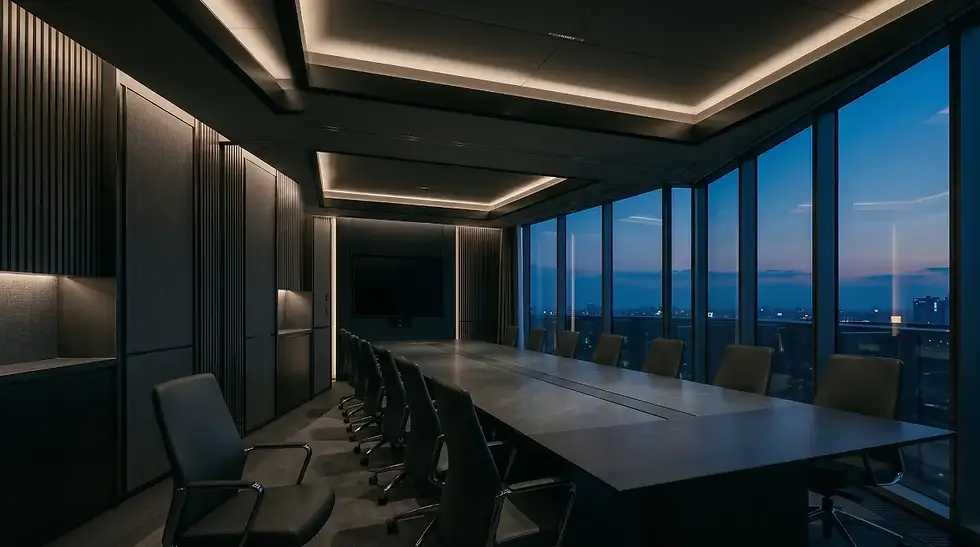
Short answer: RT60 is how many seconds it takes sound to fade by 60 decibels after the source stops. Offices and conference rooms usually want about 0.4 to 0.6 seconds. Classrooms need 0.6 to 0.7 seconds or less. If your room is well above its target, speech turns to mush and people talk louder, which makes the room louder still.
What RT60 means
Clap in an empty gym and you hear the sound hang in the air. That hang time is reverberation. RT60 puts a number on it. In the field, background noise usually hides the full 60 dB drop, so the decay is measured over the first 20 or 30 dB and extended to 60.
Three things get mixed up all the time:
Reverberation: many reflections blending into a wash of sound.
Echo: one clear, delayed repeat, usually from a hard wall far from the source. If this is your problem, see our echo reduction page.
Background noise: HVAC, traffic, neighbors. Acoustic panels do not fix this. That is a soundproofing or mechanical noise problem. HVAC noise is judged with NC ratings, not RT60.
RT60 targets by room type
These are common design targets, not code for every project. Your architect, the owner's standards or a specific code may set a different number. The classroom limits come from ANSI/ASA S12.60, summarized in Larson Davis's guide to the classroom acoustics standard.
Room type | Typical RT60 target |
Private office, conference room | 0.4 to 0.6 s |
Open-plan office | 0.4 to 0.8 s |
Classroom under 10,000 cu ft | 0.6 s or less (ANSI/ASA S12.60) |
Classroom 10,000 to 20,000 cu ft | 0.7 s or less (ANSI/ASA S12.60) |
Restaurant, cafeteria | 0.6 to 1.0 s |
Worship space, speech focus | 1.0 to 1.5 s |
Worship space, music focus | 2.0 s or more |
Auditorium, speech | 0.8 to 1.2 s |
Auditorium, music | 1.5 to 2.2 s |
Recording control room, home theater | 0.2 to 0.5 s |
What drives RT60

Room volume: bigger rooms hold sound longer.
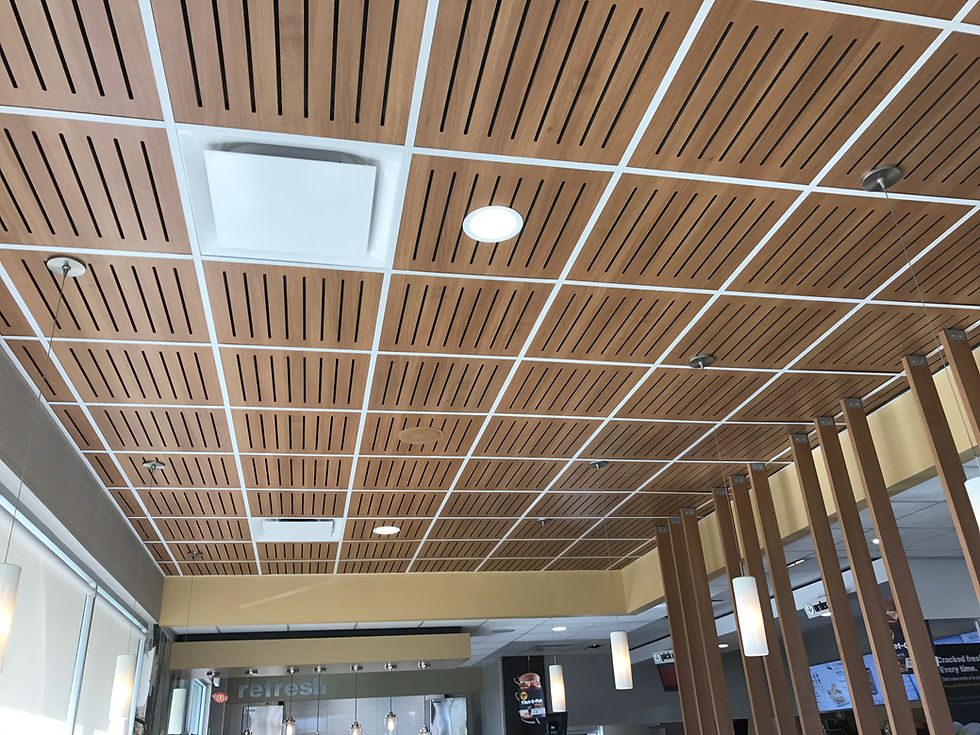
Surfaces: glass, concrete, drywall and metal decks reflect. Carpet, ceiling tile and acoustic panels absorb. See our guide to commercial acoustic ceiling tiles.
Occupancy and furniture: people and soft furnishings absorb sound, so an empty room measures longer than a full one.
Frequency: low frequencies decay slower than speech frequencies. A room can pass at 1 kHz and still sound boomy.
How to estimate RT60 with Sabine's formula
For a quick estimate in imperial units:
RT60 = 0.049 x V / A
V is room volume in cubic feet. A is total absorption in sabins (each surface's area times its absorption coefficient, added up).
Example (hypothetical room, for illustration only): a conference room 30 ft x 20 ft x 9 ft is 5,400 cu ft. Say its existing surfaces add up to 300 sabins.
Before: 0.049 x 5,400 / 300 = 0.88 s. Too long for a conference room.
Add 250 sabins of ceiling and wall absorption, so A becomes 550.
After: 0.049 x 5,400 / 550 = 0.48 s. Inside the 0.4 to 0.6 s target.
Sabine works best in fairly diffuse rooms. Long corridors, atriums and rooms with one very absorbent surface need a modeled or measured answer.
What this looks like on real Texas projects
A formula tells you what should happen. We install the treatment and see what actually changes. Two government projects show the difference between a noise problem and a reverberation problem, and why the fix is not the same.
TxDOT main offices, Mesquite, TX (2022 to 2024)
Two rooms where talking is the whole job: a conference room for 40 people and an executive office for 10. The rooms had two separate problems. Outside noise was coming in through the glass, and sound was hanging in the room after every sentence.
Windows: Noise Shields, a second acoustic window that sits over the existing one, to cut the noise coming in.
Walls: Acoustic Stretch Systems to absorb sound inside the room.
Result: noise down 20 dB and reverberation down 2 seconds.
Every 10 dB drop sounds about half as loud to most people, so 20 dB is roughly a quarter as loud. The window fix handled the noise. The wall fix handled the RT60. Doing only one would have left the room half fixed.
North Texas Municipal Water District main offices, Wylie, TX (2023)
A 40-seat conference room, a directors' office and a meeting room. The complaint was noise from outside, so the job was windows only. We fitted Noise Shields to the windows in all three rooms.
Result: noise down 12 dB in all three rooms.
No wall or ceiling work was part of this job, and the project record has no reverberation figure for it. That is the point. Not every noisy room has an RT60 problem. If the sound is coming in from outside, panels on the wall will not fix it, and the first step is finding out which problem you have. That is what a noise assessment is for.
Other measured reductions in reverberation
Project | Space | Treatment | Reverberation reduced by |
City of Wylie municipal offices, Wylie, TX (2025) | Offices | Acoustic panels on ceilings and walls | 2.9 s (background noise also down 9 dB) |
Republic Services Training Center, Grand Prairie, TX (2023 to 2026) | 8 training rooms, 20 to 60 people each | Acoustic walls | 5 s |
Denton Bible Church, Denton, TX (2025) | 4,000-seat worship space | Acoustic stretch walls on ceilings and walls | 6.2 s |
Planning a worship space? See our church acoustic panels page.
What these numbers tell you
These are reductions, not final RT60 values. Our reading: if a room lost 5 seconds of reverberation, it was holding sound for at least 5 seconds before. Compare that with the 0.4 to 0.6 second target for a conference room and you can see why people in those rooms struggled to follow each other. Three things we take from this work:
Diagnose first. Outside noise and room echo are different problems. Treating the wrong one wastes the budget.
Treat the surfaces that reflect most. In large rooms that is the ceiling and the long walls.
Do it room by room when the building stays in use. Training centers, government offices and churches keep running, so the schedule is part of the design.
How to bring RT60 down

Find the strongest reflections first. Ceilings and the walls facing each other usually matter most.
Add absorption where it is hit hardest. Fabric-wrapped or fiberglass wall panels, ceiling clouds and baffles, and acoustic ceiling tile all work. Placement matters more than quantity. Our acoustic panel installation page shows how we handle it.
Expect diminishing returns. The first panels help a lot. Each extra one helps less.
Do not overshoot. A room that is too dead feels strange to talk in, and it hurts spaces used for music.
Measure after install. Calculations predict. A measurement confirms.
Absorption improves sound inside a room. It does not stop sound moving between rooms. If the complaint is that people hear the neighbor's meeting, that is a commercial soundproofing job, not an RT60 job. To pick the right wall rating, read our guide to STC ratings for commercial buildings. For the difference between panels that absorb and panels that block, see best acoustic panels for soundproofing.
How RT60 is measured
Professionals measure with a calibrated source and microphone and follow a method such as ISO 3382-2, the international standard for reverberation time in ordinary rooms. They report RT60 by frequency band, not one number, because the 125 Hz result and the 2 kHz result can be far apart. A phone app can show you a rough trend. It is not a substitute for a measurement you would put in a spec or closeout report.
FAQ
What is a good RT60 for an office?
About 0.4 to 0.6 seconds for private offices and conference rooms, and 0.4 to 0.8 seconds for open-plan space.
Is a lower RT60 always better?
No. Speech rooms want it short. Music spaces and worship spaces want it longer. Too short and a room feels dead.
Does RT60 change when a room is full of people?
Yes. People absorb sound, so an occupied room measures shorter than an empty one. State which condition a number was measured in.
Can acoustic panels fix echo?
Usually, if the echo comes from a hard, flat surface. The fix is to absorb or break up that reflection. Placement decides how well it works.
Do acoustic panels stop noise from the next room?
No. They reduce reverberation inside the room. Blocking sound between rooms takes mass, sealing and decoupling.
Why did the TxDOT rooms need windows and walls treated?
Windows control the noise that comes in from outside. Walls control the reverberation inside. They are different problems, so we used two products.
Next step
Send us the room size, use and a photo of the ceiling. We will tell you whether treatment is likely to get you to target. Call 888-539-7217, email info@de-walls.com or contact us here.

Comments