


Restaurant Soundproofing in DFW: What the Data Says and How Acoustic Treatment Fixes It

A case study for restaurant owners, general contractors, architects and facility managers in Dallas-Fort Worth.
Summary
Most diners dislike loud restaurants and many say they avoid them, and the same noise puts kitchen and floor staff nearer to recommended exposure limits. The fix is well understood: measure the room, cover the largest hard surfaces with sound absorbing material, move noisy equipment away from dining areas, and measure again. For a DFW restaurant, the order of work matters more than the product, because treating the ceiling and walls first is the control the CDC authors say works best on patrons' voice levels.
The problem: guests avoid loud restaurants
In a 2021 national survey of 4,085 US adults, analyzed by CDC and NIOSH researchers and published in The Hearing Journal in January 2022, loud restaurant noise was a clear turn-off.
Finding | Result |
Adults who find a loud dining experience annoying | 68.0% |
Adults somewhat or very likely to avoid a noisy restaurant | 64.8% |
Adults who say restaurants are too loud at least some of the time | 77.6% (23.3% half the time or more, 54.3% some of the time) |
Adults aged 49 to 62 vs ages 18 to 32, likelihood of avoiding a noisy restaurant | 2.1 times the odds |
Adults aged 63 and older vs ages 18 to 32, likelihood of avoiding a noisy restaurant | 2.7 times the odds |
The survey's South region, which includes Texas, was also more likely than the Northeast to report restaurants as too loud at least some of the time (odds ratio 1.4). The authors note two limits: answers are self-reported, and the survey did not separate fast casual from full service.
Measured sound levels back up the complaints. A study of 30 casual and quick service restaurants in Orlando found levels between 58.1 and 97.5 dBA, and only 23% were quiet enough (about 60 dBA) to talk without raising your voice. Crowd-sourced readings from 1,788 New York City restaurants showed 25% above 81 dBA. A peer-reviewed survey of Hong Kong restaurants measured 66.7 to 82.6 dBA and found that occupancy density was the main driver of background level. A UK survey of 1,200 people for Action on Hearing Loss in 2017 found 91% would not return to a noisy venue and 79% had left a restaurant early because of noise (UK data).
The staff side
OSHA's noise standard (29 CFR 1910.95) sets a permissible exposure limit of 90 dBA as an 8-hour average and an action level of 85 dBA that triggers a hearing conservation program. A University of Iowa study took 180 full-shift measurements at six locally owned restaurants. None exceeded the OSHA limit, the average worker exposure under the NIOSH method was 80 dBA, and 7.8% of shifts went over the NIOSH 85 dBA recommendation.
Exposure was highest for cooks and in full-service restaurants. A separate New York pilot measured 59 loud restaurants, bars, clubs and lounges and found that a single visit exceeded the daily NIOSH dose in 49% of them. Restaurants are not routinely over the OSHA limit, but a share of shifts sit above the stricter recommendation, and treatment lowers that risk.
Why it matters in Texas right now
The Texas Restaurant Association reports 56,739 restaurant locations, $106.8 billion in annual sales and about 1.46 million restaurant and foodservice jobs (2023 data), and 91% of restaurants have fewer than 50 employees. Margins are thin: the Dallas Express, citing National Restaurant Association figures, reports that 42% of operators said they were not profitable in 2025 and that 1,039 Texas restaurants closed in the first half of 2026. We did not find a study that measures lost revenue from noise in Texas restaurants, so the link between noise, repeat visits and margin is an inference from the avoidance data above, not a measured result.
What treatment changes
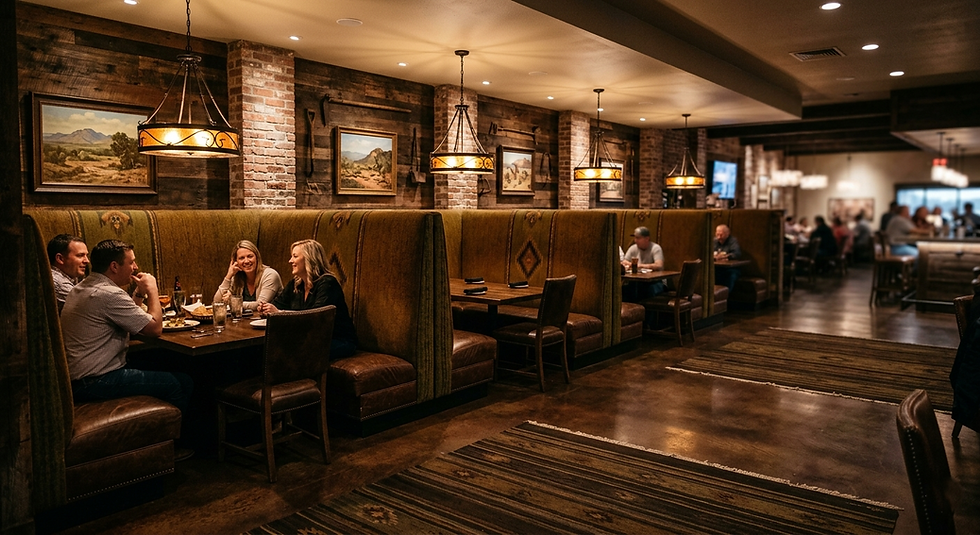
The CDC authors list the available controls: treat walls and ceilings with sound absorbing material, move sound-producing equipment such as ice and beverage dispensers away from dining areas, and lower music levels. They add that room treatment is more effective on patrons' voice levels than on other sources. They also name the features that raise levels: open kitchens, hard surfaces, and the absence of upholstered chairs, tablecloths, carpet, draperies, plants or absorbent paneling. Guests also raise their voices to be heard over each other, which pushes the level up further (the Lombard effect).
One published example of the starting condition is Restaurant Point de Chute in Paris, an 80 square meter dining room where reverberation measured over 2 seconds in some zones before an acoustic ceiling and a sound-insulating lining were installed. The manufacturer's case study reports better speech clarity and calmer service but gives no before and after decibel figures, which is typical of vendor case studies.
The DeWalls approach for a dining room
Assess: measure sound levels at peak service and note the room's hard surfaces, ceiling height, open kitchen or bar, and any adjoining tenant spaces.
Design: decide how much absorption the room needs and where. The ceiling is usually the largest uncovered surface, so it comes first, then wall zones near booths and the bar.
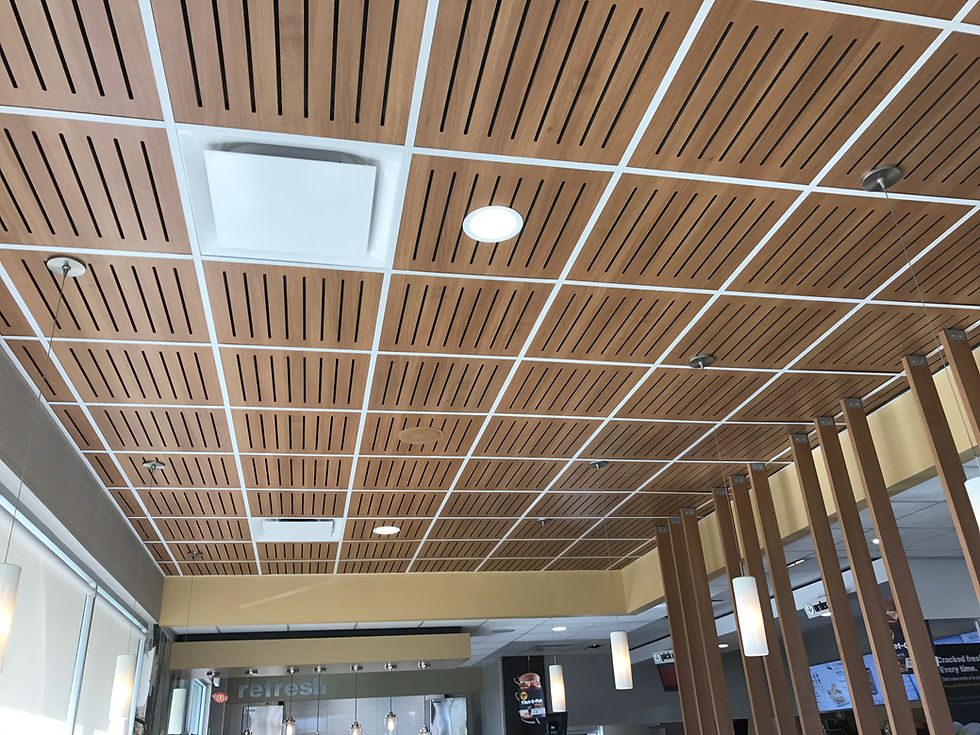
Treat: restaurant and hospitality spaces typically use Ceiling Baffle Solutions, U-FormaFelt Ceiling Design Clouds, Fabric Wrapped Panels and Acoustic Slat Panels, chosen to match the interior design. Fabric Wrapped Panels are rated NRC 0.75 to 1.00 and Cloud Acoustic Boards NRC 0.96.
Verify: measure again under the same conditions and compare.
Questions to ask before you hire
Will the contractor measure sound levels before and after, and share the numbers?
Do the products carry a tested NRC rating, and where will they be mounted?
Does the plan cover the ceiling, the biggest surface, before the walls?
How is installation scheduled around service hours?
Who coordinates with the architect or general contractor on finishes, fire rating and access?


Comments