


Acoustic Wall Panels: How They Work, Where to Use Them & How to Choose the Right Solution

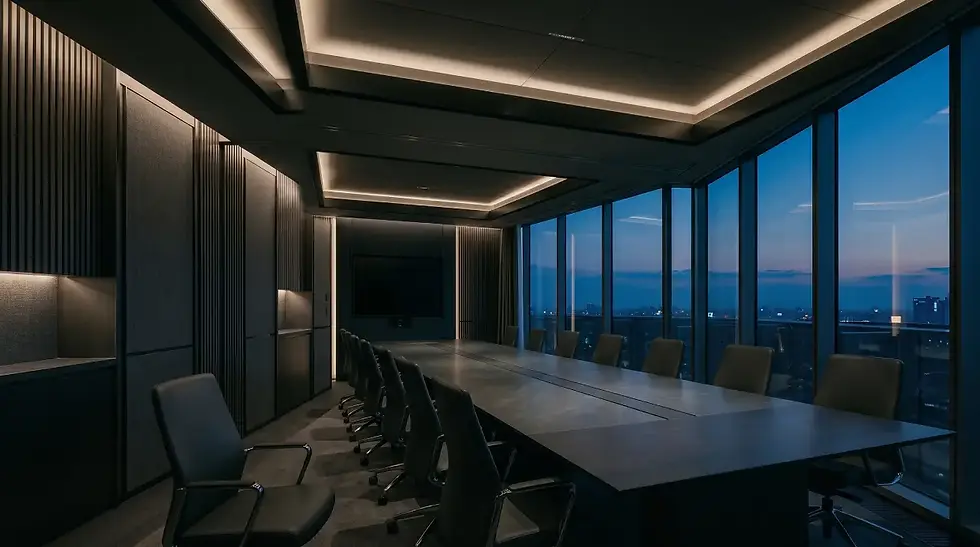
Acoustic wall panels are one of the most common acoustic products in offices, restaurants, schools, and worship spaces, and one of the most misunderstood. They can make a loud, echoey room much easier to be in. They won't stop the office next door, a neighbor, or the HVAC system from being heard.
This guide explains how acoustic wall panels work, where they make sense, how to read an NRC rating, and when the real answer is something other than panels. If you're comparing acoustic panels for walls in a commercial space, it should help you decide whether panels are the right tool or whether the problem needs a broader look.
The short version:
Acoustic wall panels absorb sound reflections inside a room. They reduce echo and improve speech clarity.
They are not soundproofing. They don't reliably stop sound from passing between rooms.
NRC measures absorption. STC measures sound transmission. They are different ratings.
How many panels you need, and where they go, depends on the room.
What Are Acoustic Wall Panels?
Acoustic wall panels are designed to absorb sound reflections within a room, helping reduce reverberation and improve speech clarity.
Sound travels outward from its source and bounces off whatever it hits. Hard surfaces such as drywall, glass, concrete, and tile reflect most of it, so the same sound reaches your ear several times, slightly delayed. That's reverberation, and it's what makes a room sound echoey and speech harder to follow.
Wall acoustic panels, also called sound absorbing wall panels or acoustic treatment panels, are typically built from a porous or fibrous core, such as fiberglass, mineral fiber, foam, or felt, with a fabric or decorative face. Sound enters the material and loses energy instead of bouncing back. With less reflected sound, speech is clearer and the room feels calmer.
What Do Acoustic Wall Panels Actually Do?

Acoustic wall panels reduce excessive reflections inside a room. In practice, that can mean:
Less reverberation: a boardroom with glass and drywall stops sounding like a hallway.
Better speech intelligibility: people repeat themselves less, and voices come through more clearly on video calls.
Easier conversation: in a restaurant, guests don't have to raise their voices to compete with the room.
Better listening conditions: presentations and instruction are easier to follow in a classroom or sanctuary.
More acoustic comfort: overall room sound is calmer and less tiring.
Put simply, they help reduce noise in a room by absorbing the reflections that make it loud. They don't change how much sound passes through the wall itself.
Acoustic Panels vs. Soundproofing: What's the Difference?

Acoustic panels control how sound behaves inside a room. Soundproofing reduces sound transmission between spaces. They solve different problems, which is why the acoustic panels vs. soundproofing question matters before you buy anything.
Approach | What it addresses | Typical example |
Sound inside the room: echo, reverberation, speech clarity | Acoustic wall treatment panels, ceiling treatments | |
Soundproofing / sound isolation | Sound transmission between spaces | Wall, door, ceiling, and window assemblies |
Mechanical equipment, vibration, and other noise sources | Equipment isolation, HVAC noise treatment |
Putting acoustic panels on a wall doesn't necessarily stop a neighbor, another office, an HVAC system, or traffic from being heard. Sound passes through walls when the assembly lacks mass, decoupling, and sealing, and it also travels through doors, ceilings, ductwork, and windows. Panels absorb sound in the room but add little of what blocks sound transmission.
Some products are sold as soundproof wall panels or soundproofing panels. Whether they reduce sound transmission depends on how they're built and installed, so check what a product is designed to do and don't assume the name tells you. Real commercial soundproofing is about the whole assembly, not a single layer on the wall.
Where Should Acoustic Wall Panels Be Used?
Wherever hard surfaces make a room reverberant and speech harder to understand.
Offices
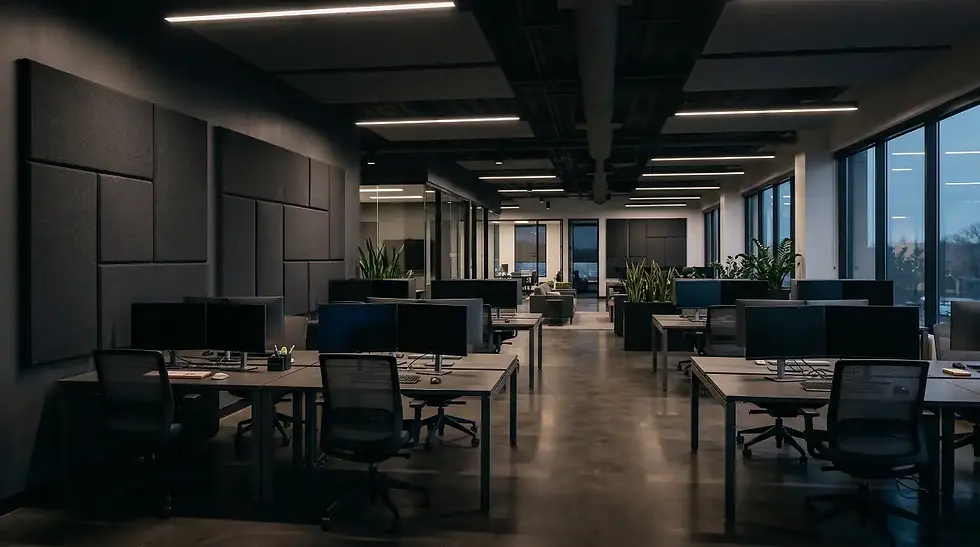
Open-plan offices often combine hard ceilings, glass, and constant overlapping conversation. Acoustic panels for offices reduce reverberation so speech is easier to understand and a noisy office is less tiring. They improve how the space sounds and ease general workplace noise; they don't create privacy between desks on their own. Office acoustic treatment usually combines wall panels with ceiling treatments, depending on the space.
Conference Rooms
Conference room echo and poor speech intelligibility are the usual complaints, along with video calls where microphones pick up reflections. Acoustic panels for conference rooms and acoustic panels for meeting rooms help with all three. Privacy from the hallway is a separate question, covered below.
Restaurants
Hard architectural surfaces and full tables make dining rooms loud, and reverberation makes people talk louder, which raises the level further. Acoustic panels for restaurants absorb reflections so conversation takes less effort, often without changing the look of the room.
Schools
In classrooms, reverberation makes it harder for students to understand the teacher. Acoustic panels for schools improve speech clarity and support learning, particularly in rooms with hard walls and ceilings.
Churches and Worship Spaces
Worship spaces are often large, hard-surfaced rooms where both speech and music suffer from reverberation. Acoustic panels for churches can improve speech intelligibility, though the right balance depends on how much liveliness the music program needs.
Auditoriums
Large rooms create long reflection paths, and reflections from rear and side walls can muddy speech. Acoustic panels for auditoriums are usually part of a broader acoustic design that considers the whole room.
Recording Studios and Media Rooms
Studios and media rooms need controlled reflections so what you hear is what was recorded or played. Acoustic panels for studios, and acoustic panels for home theaters and media rooms, shape how sound behaves inside the room. Keeping sound from reaching other rooms is a separate soundproofing question.
Other Commercial Spaces
Lobbies, gyms, healthcare waiting areas, and retail spaces face the same issue. Acoustic panels for commercial spaces can help where reverberation is the problem, and results depend on the room.
Types of Acoustic Wall Panels
Sound absorption panels come in several forms, and the differences are mostly material, finish, and construction:

Fabric-wrapped acoustic panels: an absorptive core wrapped in fabric, common in offices, lobbies, and libraries.
Felt acoustic panels: dense felt in a range of colors and shapes, often chosen for design-forward interiors.
Decorative acoustic panels: absorption combined with visual design, such as slats, patterns, and textured finishes.
Custom acoustic wall panels: made to specific sizes, shapes, and finishes for a project.
Printed acoustic panels: graphics or images on an acoustic face.
Architectural acoustic panels: integrated into walls or ceilings as part of the building design.
Specialty solutions: for unusual rooms or requirements.
Appearance, thickness, material, mounting, and acoustic performance vary between products. Compare performance using the manufacturer's tested specifications rather than looks, and don't assume two panels that look alike absorb alike.
What Is an NRC Rating?
NRC, or Noise Reduction Coefficient, is a single-number rating of how much sound a material absorbs, on a scale from 0 to 1.
It averages the material's absorption across several mid-range frequencies, so a higher NRC means more absorption. The underlying measure, the sound absorption coefficient, describes how much sound a material absorbs at a specific frequency. When comparing NRC acoustic panels, the rating is one way to see how absorptive each material is.
Rating | What it relates to |
NRC | Sound absorption inside a room |
STC | Sound transmission through building assemblies |
NRC should not be confused with STC. A high acoustic panel NRC rating says the material absorbs sound well. It doesn't say the wall behind it blocks sound. And an NRC rating describes the tested material, not the acoustic performance of an entire room, which also depends on its size, surfaces, and where the panels go. Our STC vs. NRC guide covers the difference in more detail.
How Many Acoustic Wall Panels Does a Room Need?
There's no universal number. The right amount depends on:
Room size and ceiling height
How much of the room is hard surface, and existing finishes
How the room is used
The acoustic performance you're aiming for
Panel type, thickness, and placement
How much reverberation the room has now
Covering every available wall isn't always the right approach. Treating the walls when the ceiling is the biggest reflective surface, or concentrating panels in one spot, can leave a room sounding much the same.
Where Should Acoustic Panels Be Installed?
Placement matters as much as quantity. Wall mounted acoustic panels work best where they intercept reflections:
Reflection points and large reflective wall surfaces, especially opposite walls that bounce sound back and forth
Areas around speaking and listening zones
Conference rooms: walls and ceiling around the table and the display
Open offices: ceilings and walls near work areas
Auditoriums: rear and side walls where reflections build up
Acoustic design should consider the entire room rather than adding panels wherever there's empty wall space.
Do Acoustic Wall Panels Reduce Outside Noise?
Not on their own. Acoustic panels primarily address sound inside the room by absorbing reflections. If the problem is any of the following, a different sound isolation or noise control strategy may be necessary:
Traffic noise
Neighboring offices
Music from another room
Mechanical equipment or HVAC noise
Sound entering through doors, walls, ceilings, or windows
Can Acoustic Wall Panels Help With Conference Room Noise?
Often, yes, for the right problem. Common conference room complaints include echo, reverberation, poor speech clarity, video-call microphone issues, hard reflective surfaces, and background noise. Conference room acoustic treatment addresses the reflections behind most of these.
If people outside the room can hear the meeting, that's sound transmission, and panels alone won't fix it. Speech privacy usually means looking at the wall, door, ceiling, and glass as a system. Many conference rooms need both. See our guide to conference room acoustics and soundproofing for the full breakdown.
Acoustic Wall Panels for Commercial Spaces
Commercial projects rarely come down to a product choice. The right solution depends on:
Room function and existing construction
Sound paths into and out of the room
Acoustic treatment and sound isolation needs
Doors, glass, and ceilings
HVAC and mechanical noise
Product selection and installation
DeWalls is an acoustic specialist, not just a product seller. We provide acoustic solutions across Texas, with a focus on the Dallas-Fort Worth area, from commercial acoustic panels to full acoustic treatment in Dallas offices and venues. We start by working out what's causing the problem, then determine whether panels, sound isolation, noise control, or a combination makes sense. That's what commercial acoustic solutions, including commercial noise control, look like in practice.
Should You Buy Acoustic Panels or Work With an Acoustic Specialist?
A simple product purchase may be appropriate for relatively straightforward problems:
Excessive echo
A hard, reflective room
Basic acoustic improvement
A broader assessment is usually more useful when the problem involves:
Sound traveling between rooms
Speech privacy
Mechanical or industrial noise
Noise entering from outside
Complex commercial spaces or large auditoriums
New construction or design projects
How DeWalls Approaches Acoustic Wall Panel Projects
DeWalls provides acoustic consulting and acoustic engineering, product expertise, and professional installation. We don't promise a specific result before we understand the project. The process:
Identify the problem
Understand the room and sound conditions
Determine whether the issue is absorption, sound isolation, noise, or vibration
Develop the appropriate acoustic approach
Select the appropriate products or system
Install the solution properly
Acoustic Wall Panels FAQ
What are acoustic wall panels?
Acoustic wall panels absorb sound reflections within a room, reducing reverberation and improving speech clarity.
Do acoustic wall panels reduce noise?
They reduce reverberation and room noise inside the space. They generally don't block sound coming from outside or from another room.
Do acoustic panels soundproof a room?
No, not by themselves. Panels absorb sound inside the room. Soundproofing requires addressing how sound travels through walls, doors, ceilings, and windows.
What is the difference between acoustic panels and soundproofing?
Acoustic panels control sound inside a room. Soundproofing, or sound isolation, reduces sound transmission between spaces.
Where should acoustic wall panels be installed?
At reflection points and on large reflective surfaces, near speaking and listening areas. Placement depends on the whole room, not just available wall space.
How many acoustic panels do I need?
It depends on room size, hard surfaces, use, panel type, and your goals. There's no universal number.
What is an NRC rating?
NRC, or Noise Reduction Coefficient, rates how much sound a material absorbs on a scale from 0 to 1. It relates to absorption, not sound blocking.
Are acoustic panels good for conference rooms?
Yes, for echo and speech clarity. They won't prevent people outside from hearing the meeting, which takes sound isolation.
What type of acoustic panels are best for offices?
It depends on the space, the look you want, and performance needs. Fabric-wrapped, felt, and decorative panels are all common. Compare tested specifications, not just appearance.
Can acoustic panels reduce echo?
Yes. Absorbing reflections is what they do, and echo is a reverberation problem.
Can acoustic panels stop sound from entering a room?
Generally no. Stopping sound from entering takes sound isolation or noise control, depending on the source.
How much do acoustic wall panels cost?
It varies with panel type, size, materials, finish, quantity, and installation. A specific quote requires knowing the room and goals.
Are decorative acoustic panels effective?
They can be, if the material absorbs sound. A decorative finish alone doesn't make a panel acoustic, so check the specifications.
When should I hire an acoustic consultant?
When sound travels between rooms, privacy matters, mechanical or outside noise is involved, or the project is large or new construction. An acoustic contractor in Dallas or elsewhere in DFW can assess the space before you commit to a product.
The Bottom Line on Acoustic Wall Panels
Acoustic wall panels are a good answer to a specific problem: too much reflected sound inside a room. They're not an answer to sound traveling between spaces, and they work best when the amount and placement are matched to the room.
If you're not sure which problem you have, the first question isn't which panel to buy. It's what is actually causing the noise. DeWalls can help assess your space and determine whether you need acoustic wall panels, sound isolation, noise control, or a combination.


Comments