


How DeWalls Helped a Houston Office Reduce Noise by 60% - A Real Case Study


A Houston corporate office reduced its ambient noise levels by 60% - a verified, post-installation measurement, not a marketing estimate. The project used a four-layer acoustic strategy that addressed every source of noise in the building simultaneously.
Before the project, the office had three measurable problems:
The open floor plan registered 55–58 dB of ambient noise - the level of a restaurant at lunch, sustained all day.
Private offices and the HR suite had an estimated STC rating of 33–35 - meaning confidential conversations were clearly audible next door.
The boardroom had a constant 48 dB of HVAC background noise before a single person walked through the door.
After four weeks of targeted acoustic work, post-installation measurement confirmed:
Ambient noise reduced to approximately 42 dB - a 60% reduction in perceived loudness.
Reverberation time dropped from 1.4 seconds to 0.55 seconds - within the ideal office range.
Private offices and the HR suite achieved STC 52 - clearing the HIPAA-adjacent speech privacy threshold.
Boardroom HVAC background noise fell below 38 dB - a 10+ dB verified reduction.
Employees stopped reaching for noise-cancelling earbuds. HR conversations stayed private. The boardroom stopped echoing on client calls. The office passed its internal compliance review for the first time since it was built.
This is the complete story of how that happened - and what any Houston office manager can take from it.
Project Snapshot
Detail | Information |
Client Type | Multi-department corporate office - HR, executive leadership, and legal |
Location | Houston, Texas |
Space Size | ~10,000 sq ft open floor plan + private suites and boardroom |
Core Problems | Reverberation, flanking noise, HVAC mechanical hum, zero speech privacy |
Pre-Treatment Noise | 55–58 dB ambient / RT60: 1.4 seconds |
Solutions Installed | MLV walls, QuietRock drywall, acoustic ceiling clouds, sound masking, solid-core acoustic doors, HVAC duct liner |
Post-Treatment Noise | ~42 dB ambient / RT60: 0.55 seconds |
STC Rating Achieved | STC 52 - private offices and HR suite |
Compliance Outcome | HIPAA-adjacent speech privacy confirmed |
Project Duration | 4 weeks - site assessment through post-installation verification |
Verified Result | 60% reduction in perceived loudness |
Why Houston Offices Struggle With Noise More Than Most Cities
Before looking at how this office solved its noise problem, it helps to understand why Houston offices develop these problems in the first place. Three factors drive acoustic failures in this city specifically - and they work together.
1. The Open-Plan Architecture Trap
Houston's commercial real estate boom produced a very specific type of office across the city. Walk into almost any building completed in the last fifteen years and you will find:
Glass partition walls that bounce sound horizontally across the open floor.
Polished concrete or tile floors that reflect sound straight back upward.
High ceilings with exposed ductwork and little to no acoustic material overhead.
Open floor plans with no interior walls separating departments or functional zones.
Minimal soft furnishings - no carpet, no curtains, nothing to absorb what the hard surfaces reflect.
These design choices look sharp and modern. From an acoustic standpoint, every single one of them reflects sound rather than absorbing it.
When sound keeps bouncing off hard surfaces without being caught, the result is reverberation - overlapping sound waves that stack on each other and turn a normal conversation into an exhausting acoustic fog that nobody can fully tune out.
What is RT60 - and why does it matter for your office?
RT60 is the standard acoustic measure of reverberation time: the number of seconds it takes for a sound to decay by 60 decibels after the source stops. Industry-accepted targets by space type:
Space Type | Target RT60 Range |
Open-plan office | 0.6 – 0.8 seconds |
Private office | 0.4 – 0.6 seconds |
Conference room | 0.4 – 0.6 seconds |
This Houston office (pre-treatment) | 1.4 seconds |
At 1.4 seconds, one person finishing a sentence and another starting theirs are acoustically overlapping. The office was not just noisy. It was cognitively damaging to work in.
2. What Office Noise Actually Does to the People Inside
The research on workplace noise and human performance is clear, consistent, and significant:
63% of knowledge workers struggle to concentrate because of workplace noise - Jabra, Global Workplace Survey, 2024, 2,000 professionals across the US, UK, Germany, and France.
7 in 10 employees experience regular disruption from conversations and ambient noise in open-plan offices - Gensler, Global Workplace Survey, 2024.
Workers in noisy environments lose up to 66% of their cognitive performance on complex tasks from a single nearby intelligible conversation.
After a noise interruption, it takes an average of 23 minutes to fully regain deep concentration.
A study of 50,000 workers across 351 buildings found that lack of speech privacy ranked as the single greatest source of workplace dissatisfaction - above temperature, lighting, and air quality.
The total US productivity cost of workplace distraction - with noise as the primary driver - is estimated at approximately $650 billion annually.

3. Houston's HVAC Noise Problem Is Worse Than in Most American Cities
This is an acoustic challenge specific to Houston that almost never appears in generic soundproofing content - and it matters considerably.
Why Houston HVAC systems generate more noise:
Houston summer temperatures regularly exceed 90°F with humidity above 70%.
These extreme conditions persist for approximately seven months per year.
Commercial HVAC systems in Houston run longer, harder, and cycle more frequently than systems in milder climates - producing more mechanical vibration, more duct airflow turbulence, and more low-frequency hum year-round.
Unlined metal ductwork amplifies and carries that noise directly into every room it serves.
Most facility managers never connect their HVAC system to their noise complaints, because the hum is constant and easy to unconsciously adapt to. The measurement, however, does not adapt. In this project, the boardroom registered a steady 48 dB of HVAC background noise with nobody in the room. The recommended maximum for a conference room where speech clarity is required is below 38 dB - a 10 dB gap that made every meeting harder than it needed to be.
4. The Compliance Problem Houston's Industries Cannot Afford to Overlook
Houston is a major hub for sectors where verbal confidentiality carries legal and regulatory weight. For offices in these industries, acoustic privacy is not a preference - it is a professional and compliance requirement:
Healthcare and health administration - HIPAA Privacy Rule requirements for protecting verbal disclosures of patient information.
Energy, oil, and gas - proprietary project discussions, contract negotiations, and sensitive operational conversations.
Legal services - attorney-client privilege and case strategy conversations.
Financial advisory and banking - client position discussions and compliance-sensitive conversations.
Corporate HR functions - performance management, disciplinary matters, and personal employee information.
The industry-accepted minimum STC rating for confidential speech privacy in HR suites, legal offices, and executive rooms is STC 50 - the threshold at which normal conversation through a wall becomes unintelligible rather than merely muffled. This office's private walls were estimated at STC 32–35. Every HR conversation was, in functional terms, a semi-public one.
Understanding the STC Rating Scale - What the Numbers Mean in Practice
STC Rating | Real-World Meaning in an Office |
STC 25 | Normal conversation is clearly understood through the wall. |
STC 35 | Normal conversation is clearly audible - words and intent are discernible. |
STC 40 | Minimum standard for a basic private office. Raised voices are audible. |
STC 45 | GSA minimum for conference rooms requiring confidential speech privacy. |
STC 50 | Industry standard for HR suites, legal offices, and executive spaces. Normal speech unintelligible. |
STC 52+ | Confirmed confidential privacy - content and intent cannot be determined through the wall. |
This office started at STC 33–35 and finished at STC 52. That gap is not a minor improvement. It is the difference between a room that leaks every sensitive conversation and one that meets the professional standard for speech privacy.
The Acoustic Diagnosis: What Was Found Before Any Work Began
Before a single product was specified, a formal site acoustic assessment was carried out across the entire building. This is a structured, measurement-driven process - not a sales visit with a product catalogue.
The five-step professional assessment process:
Calibrated ambient noise level measurement - across every zone: open floor, private offices, and meeting rooms.
RT60 reverberation time testing - establishing how long sound decays in each space before and after treatment.
Flanking path analysis - tracing where sound travels between rooms through shared plenums, gaps, and penetrations.
HVAC noise contribution testing - isolating mechanical noise from conversational noise in each zone.
STC estimation of existing partitions - evaluating real-world performance, not the manufacturer's laboratory figure.
Businesses that engage a specialist in noise control and vibration assessment for Texas commercial spaces before specifying any solution consistently achieve more accurate results - because the treatment addresses the actual failure, not the most visible surface.
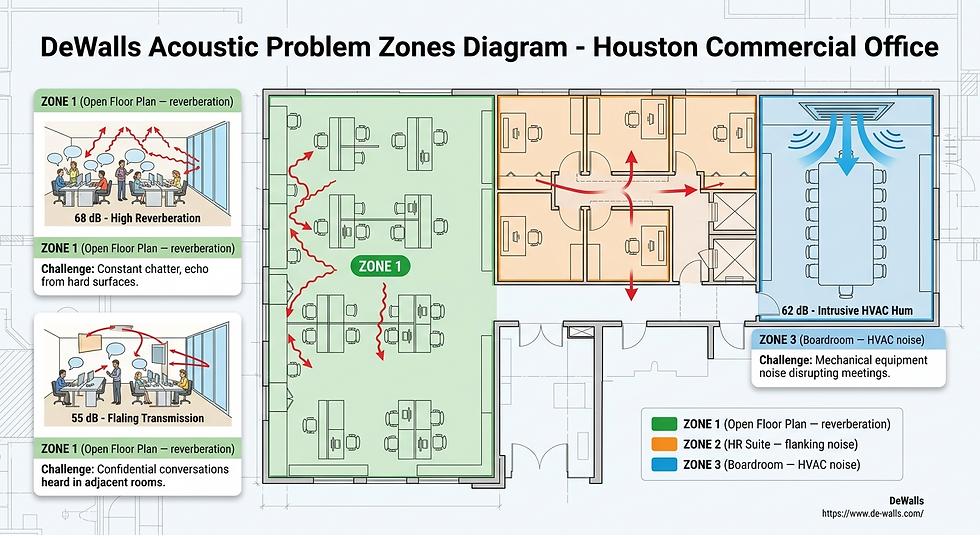
The assessment identified three distinct problem zones, each with a different acoustic failure mode.
Zone 1 - The Open Floor Plan: Reverberation and Excessive Ambient Noise

Measured pre-treatment conditions:
Ambient noise across the open workspace: 55–58 dB throughout the working day.
RT60 reverberation time: 1.4 seconds - nearly double the recommended range.
Industry-recommended ambient level for focused office work: 40–45 dB.
Observable sign: Every employee on the floor wore noise-cancelling earbuds as a daily working condition, not by choice.
At 55–58 dB, the office was sitting at the noise level of a casual restaurant at lunchtime. At 1.4 seconds of reverberation, conversations from one side of the floor were clearly audible forty feet away.
Earbuds worn universally across an open office floor are one of the most reliable indicators that the acoustic environment has failed. When the entire workforce individually manages a building failure with personal hardware, the building is long overdue for a professional solution.
Zone 2 - Private Offices and the HR Suite: Flanking Noise Over Every Partition
Measured pre-treatment conditions:
Existing walls: standard stud-and-drywall construction terminating at the drop ceiling tile.
Above those walls: an open, shared ceiling plenum accessible from every private office on the floor.
Estimated effective STC of existing partitions: 32–35, accounting for the flanking path through the plenum.
Sound path observed: conversations in the HR suite were clearly audible in the adjacent manager office with the door closed.
Why this is the most commonly misunderstood failure in commercial office acoustics:
A wall that stops at a drop ceiling does not separate two rooms acoustically. Sound travels upward, crosses the open plenum freely, and descends into the adjacent space with almost no energy loss. The drop ceiling tile absorbs a fraction of that energy but blocks essentially none of it.
Critical compliance finding: The HR suite was operating at an estimated STC 33 - seventeen points below the STC 50 minimum for confidential speech privacy. Every sensitive conversation in that space - performance reviews, disciplinary discussions, personal employee matters - was effectively being shared with the adjacent offices. That is not a facilities inconvenience. It is a documented professional liability.
Zone 3 - The Boardroom and Conference Rooms: HVAC Mechanical Noise

Measured pre-treatment conditions:
Constant HVAC background noise in the boardroom: 48 dB - present before any meeting began.
Source: unlined metal supply ductwork feeding directly into the room without any acoustic treatment.
Recommended maximum background noise for a conference room: below 38 dB.
Observable impact: client calls consistently disrupted by background hum; teams spoke louder to compensate; the noise had become an unacknowledged constant.
The HVAC issue had been present since the building was first occupied. Nobody had identified it as a discrete, measurable, addressable problem - it was simply the background condition everyone had adapted to unconsciously, by speaking louder, repeating themselves on calls, and occasionally apologising to clients for the background noise.
How This Houston Office Reduced Noise - The Four-Layer Acoustic Strategy
One of the most common reasons office acoustic projects underperform is that a single solution is applied to a problem that requires multiple layers working together.
A new ceiling panel does not fix a flanking wall. A masking system does not fix a reverberation problem. A wall upgrade does not fix a hollow-core door.
Effective office noise reduction requires four layers, applied simultaneously:
Layer | Function | Key Tool |
1. Mass | Blocks sound transmission between enclosed spaces | MLV + QuietRock drywall |
2. Absorption | Reduces echo and reverberation within spaces | Acoustic ceiling clouds |
3. Masking | Creates speech unintelligibility in open areas | Sound masking system |
4. Sealing | Eliminates flanking paths that defeat every other layer | Acoustic doors, sealant, duct liner |
Addressing any one layer in isolation produces partial improvement. Addressing all four together produced a verified 60% reduction in perceived loudness in this Houston office.
Layer 1 - Wall and Partition Upgrades: Blocking Airborne Noise Transmission
What was installed:
Mass-Loaded Vinyl (MLV) applied within the stud wall assemblies across the private office zone.
QuietRock soundproof drywall as the finish layer over the MLV - constrained-layer damping that converts sound energy into trace heat.
Full-height wall extensions built from the drop ceiling up to the structural concrete slab above, closing the shared plenum flanking path entirely.
Acoustic putty pads around every electrical box, pipe penetration, and switch plate in every upgraded wall.
Acoustical caulk at all wall perimeter joints and seam transitions.
How Mass-Loaded Vinyl works - the mass law explained:
MLV works on the mass law of acoustics: the denser a barrier, the harder it is for sound waves to set it in motion, and the less energy transfers through.
MLV performance by assembly type:
Assembly | Approximate STC |
Standalone 1 lb/sq ft MLV sheet only | STC 26 |
Standard stud wall with MLV added | STC mid-40s |
Stud wall with MLV + QuietRock drywall | STC 48–50 |
Full assembly + slab-height extension | STC 48–52 |
Why the slab-height wall extension was the single most important decision in this project:
A wall assembly rated STC 50 that stops at a drop ceiling achieves a real-world effective STC of approximately 33 - because sound passes freely through the shared plenum.
Extending the wall to the structural slab above converts an open acoustic space into a genuinely separated one.
Without this step, every other wall investment operates at a fraction of its rated performance.
Result from Layer 1: Private office partitions moved from an effective STC of approximately 33 to approximately 48 - a fundamental change in actual speech privacy before any ceiling or door work began.
Layer 2 - Acoustic Ceiling Treatment: Eliminating Echo at Its Source

What was installed:
Suspended acoustic ceiling clouds positioned directly above high-density work clusters in the open floor plan.
Foam core acoustic absorption panels installed overhead in the boardroom.
Strategic placement by occupancy mapping - clouds placed above where people actually sit and generate sound, not distributed uniformly across the ceiling.
Why the ceiling must be treated first in open-plan spaces:
In an open-plan office, the ceiling is the largest unbroken reflective surface. Sound from human speech travels upward, strikes the ceiling, and returns amplified and scattered across the entire floor. Treating walls without treating the ceiling misses the primary reflection cycle.
Understanding the NRC rating:
Surface | NRC Rating | Absorption Performance |
Untreated concrete ceiling | 0.02 | 98% of sound reflected back |
Standard acoustic ceiling tile | 0.55 | 55% absorbed, 45% reflected |
Acoustic ceiling clouds (this project) | 0.85+ | 85%+ absorbed, less than 15% reflected |
That 0.30 difference in absorption coefficient, applied across the primary reflective surface of a 10,000 sq ft floor, produces a dramatic reduction in reverberation time.
Why strategic placement outperforms uniform coverage:
People cluster predictably - at desks, in collaboration zones, along walkways. Clouds positioned directly above those clusters intercept sound at its point of origin, at the moment of first reflection, before it has the opportunity to bounce across the full length of the floor.
Result from Layer 2: RT60 dropped from 1.4 seconds to approximately 0.7 seconds from ceiling treatment alone - before masking was added.
Layer 3 - Sound Masking System: The Privacy Layer Open Offices Cannot Skip
What was installed:
Distributed ambient sound masking system - small emitters mounted throughout the ceiling grid across the full open-plan floor.
Signal spectrally shaped to the human speech frequency range (approximately 500 Hz to 4,000 Hz).
System calibrated to a consistent background of 45–48 dB across the open workspace.
The single most important clarification about sound masking:
Sound masking does not make an office quieter. It makes nearby speech unintelligible. These are fundamentally different outcomes, and understanding the difference explains everything about when masking works and when it does not.
How the intelligibility principle works:
The human brain cannot voluntarily filter out a nearby conversation it can understand - it processes intelligible speech automatically, consuming cognitive resources regardless of conscious intent.
When the ambient background is raised to 45–48 dB using a spectrally shaped masking signal, nearby conversations lose their intelligibility. Words become indistinct even though the volume level is similar.
The brain stops processing background speech it cannot decode. The distraction disappears at the intelligibility threshold, not the volume threshold.
Why sound masking is not optional in open offices:
No partition, ceiling cloud, or absorption panel gives an open workstation area confidential speech privacy.
Sound from any open desk radiates in all directions to every nearby ear, regardless of what is on the walls.
Research confirms masking systems reduce speech intelligibility at adjacent workstations from over 80% to below 20% - the threshold at which nearby conversation stops being a distraction and a privacy exposure simultaneously.
People do not notice sound masking is running. They notice immediately when it is switched off - the office suddenly feels exposed and uncomfortably quiet.
Layer 4 - Door, Seal, and HVAC Upgrades: Closing Every Gap the Other Layers Cannot Reach

What was installed:
Solid-core acoustic doors replacing hollow-core interior doors throughout the private office zone.
Perimeter compression seals on all four sides of every upgraded door frame.
Automatic door bottoms deploying a sweep against the threshold when the door closes, retracting when it opens.
Flexible acoustic duct liner installed inside the HVAC supply ductwork serving the boardroom and both conference rooms.
Acoustic putty pads and backer rod applied to every mechanical penetration, electrical outlet, and switch plate in every upgraded wall assembly.
Acoustical caulk at all perimeter transitions between walls, floors, and ceiling.
Why the hollow-core door problem destroys acoustic wall investments:
The STC performance of any partition system is set by its weakest component. This is not a guideline. It is physics.
Door STC performance comparison:
Door Type | Approximate STC | Impact on a 50-Rated Wall |
Hollow-core, no seal | STC 26 | Reduces effective system to STC ~26 |
Solid-core wood, no seal | STC 28–32 | Significant performance limitation |
Solid-core with full perimeter seal | STC 38–42 | System approaches wall rating |
Acoustic solid-core with full seal package | STC 45–52 | Door within range of surrounding wall |
Every acoustic project that retains hollow-core interior doors is investing in wall performance it will never be able to measure - because the door cancels it before it can be verified.
The HVAC duct liner solution:
The boardroom's 48 dB HVAC background noise required a separate solution from the wall and ceiling work. The noise originated inside the duct system - not at the room boundary.
How acoustic duct liner works:
Flexible fiberglass or mineral wool composite liner is installed inside existing metal supply ductwork.
The liner absorbs sound energy within the duct before it reaches the room diffuser.
It also damps the vibration of the duct walls themselves, eliminating the secondary transmission path through the ceiling structure.
No new ductwork is required. No mechanical system performance is affected.
Result from HVAC liner alone: Boardroom background noise fell from 48 dB to below 38 dB - a 10+ dB reduction, making the room feel approximately half as loud from the HVAC contribution before any human activity began.
The gap-sealing principle - why 1 inch of unsealed gap matters more than 100 sq ft of panel:
Gap Scenario | Impact on Wall STC |
1-inch unsealed gap in an STC 50 wall | Effective STC drops to approximately 33 |
1 sq in opening in a 100 sq ft STC 45 wall | Effective STC drops by approximately 15 points |
Fully sealed wall with every penetration treated | Rated STC holds in practice |
This is why every electrical outlet, cable run, pipe penetration, and perimeter joint in this project received acoustic sealant treatment. It is the least visible part of the work. It is not the least important.
For a full overview of how these solutions combine in practice, the complete commercial soundproofing services offered across Texas detail both the materials and the installation process for commercial retrofits.
Before and After - The Verified Results

Full Measurement Comparison
Metric | Before Treatment | After Treatment | Change |
Ambient noise - open floor plan | 55–58 dB | ~42 dB | 60% reduction in perceived loudness |
Reverberation time (RT60) | 1.4 seconds | 0.55 seconds | Within ideal range of 0.6–0.8 seconds |
STC - private offices and HR suite | ~33–35 | 52 | HIPAA-adjacent speech privacy confirmed |
HVAC background noise - boardroom | 48 dB | Below 38 dB | 10+ dB verified reduction |
Compliance status | Non-compliant | Compliant - STC 52 | Passed internal facilities compliance review |
Why "60% Quieter" Is the Scientifically Accurate Way to Describe a 13 dB Drop
Most people assume decibels work like percentages - that a 10 dB drop is 10% quieter. It is not. Decibels operate on a logarithmic scale, which means each step represents a multiplicative change in perceived loudness, not an additive one.
The established psychoacoustic principle:
Every 10 dB decrease in sound level corresponds to approximately half the perceived loudness to the human ear.
Working through the maths for this project:
Noise reduced from approximately 55 dB to approximately 42 dB = a 13 dB reduction.
A 10 dB reduction = approximately 50% less perceived loudness.
A 13 dB reduction exceeds that threshold = approximately 60% less perceived loudness.
This is the scientifically accurate application of psychoacoustic measurement to a verified post-installation result. The 60% figure is what the measurement confirms - not a marketing interpretation.
What Actually Changed for the People Working There
Within the first week after project completion:
Employees stopped wearing noise-cancelling earbuds at their desks - without being asked, without prompting, and without any change in office policy.
The HR team confirmed that confidential conversations could happen in their suite without lowering voices, finding alternative rooms, or waiting for the floor to clear.
The boardroom was used for client video calls without any mention of background noise - the first time this had been a non-issue since the office was built.
Open-plan employees reported measurably improved ability to sustain focus on complex tasks.
On the compliance and documentation side:
The office passed its internal facilities compliance review with no acoustic deficiencies noted - the first time since the building was originally occupied.
The STC 52 performance of the HR suite was formally documented as part of the organisation's internal data privacy records.
These outcomes are not incidental. They are the reason the acoustic work was worth doing.
Five Things Every Houston Office Manager Should Know About Workplace Noise Reduction
This project is specific to one building. The lessons it produced apply to nearly every modern open-plan commercial office in Houston, TX - and to any facility manager responsible for a space where people need to work, focus, and keep conversations private.
Lesson 1: Treating One Surface Will Never Fix a Systemic Noise Problem
The instinct when an office becomes too noisy is to treat the most visible or most complained-about symptom. That instinct consistently underdelivers.
Sound does not respect the single surface that was treated. It finds every path simultaneously:
Up and over partitions that stop at a drop ceiling.
Through hollow-core doors that defeat the walls surrounding them.
Across shared ceiling plenums that connect every private office on the floor.
Off every untreated hard surface, returning into the space amplified.
The only acoustic strategy that delivers verified results:
Address mass - block sound transmission between rooms.
Address absorption - control echo within rooms.
Address masking - achieve speech unintelligibility in open areas.
Address sealing - close every flanking path the other layers cannot reach.
A partial approach to a systemic problem produces a partial result. There is no shortcut to a verified outcome.
Lesson 2: Drop Ceilings Are Not Acoustic Barriers - They Are Acoustic Liabilities
The most expensive single mistake in commercial acoustic retrofit projects is treating the drop ceiling as a wall. It is not.
What the drop ceiling actually is:
A suspended tile hung from the structural floor or ceiling above.
Separated from the slab by an open, shared ceiling plenum that connects every office on the floor.
Rated for sound absorption (NRC) - not sound blocking (STC). It absorbs some energy. It blocks almost none.
What this means for your office:
An STC 50 wall that stops at the drop ceiling has an effective real-world STC of approximately 33.
Every dollar invested in high-performance wall assemblies that do not reach the slab is buying rated performance that the plenum silently cancels.
The slab-height wall extension is the single highest-return acoustic intervention available in a commercial retrofit - and it is frequently the first item cut from a value-engineered proposal.
If your private offices have walls that stop at a dropped ceiling, the privacy those walls appear to provide is largely illusory.
Lesson 3: Sound Masking Is Not Optional in Open-Plan Houston Offices
Walls and ceilings control what leaves a room and how long sound bounces within it. Sound masking controls what can be understood across an open floor. These are different problems requiring different tools.
Why there is no architectural substitute for masking in open environments:
No partition, ceiling cloud, or absorption treatment gives an open workstation confidential speech privacy.
Sound from any unenclosed desk radiates in every direction to every nearby ear, regardless of what is on the walls.
Sound masking crosses the intelligibility threshold - reducing speech comprehension at adjacent workstations from over 80% to below 20%.
Both the distraction problem and the privacy exposure resolve at that threshold. Neither resolves without it.
Lesson 4: Your Interior Doors Are Probably the Weakest Link in the Entire System
In nearly every commercial office, the element that caps the performance of the entire acoustic investment is not the wall. It is the interior door.
The three-point acoustic door reality:
A hollow-core door with no perimeter seal performs at approximately STC 26.
An STC 50 wall next to that door produces a real-world system STC far closer to 26 than to 50.
A properly sealed solid-core acoustic door (STC 45–52) brings the door within range of the surrounding wall - and allows the wall investment to actually perform.
Every acoustic project that retains the original hollow-core doors is investing in wall performance it will never realise.
Lesson 5: Acoustic Privacy Is a Legal and Compliance Matter - Not a Comfort Preference
For any office handling HR discussions, legal strategy, healthcare administrative calls, or financial advisory conversations, STC 50 or better is the minimum professional standard - not a wish-list item on a renovation budget.
The compliance framework for Houston offices:
HIPAA Privacy Rule - requires "reasonable safeguards" for verbal disclosures of protected health information. The acoustics of a room are physical safeguards within this framework.
GSA Sound Matters - STC 45 minimum for conference rooms requiring confidential privacy; STC 50 for HR suites and private offices.
Professional liability - any investigation citing inadequate speech privacy as a contributing factor will examine the acoustic history of that space.
The cost of retrofitting an office to STC 50+ is a fraction of the cost of a single legal matter that references inadequate confidentiality measures. Acoustic compliance belongs in the same non-negotiable category as data security.
Does Your Houston Office Have a Noise Problem? Check This First.
Most office noise problems accumulate gradually and go unaddressed until someone formally raises them. By that point, the productivity loss and compliance exposure have been building for months or years.
Go through this six-point self-assessment:
Wall check: Can you hear a conversation in the adjacent private office through the wall - even faintly?
Conference room check: Does your conference room produce audible echo during video calls?
Employee behaviour check: Do staff routinely wear noise-cancelling earbuds at their desks during the working day?
Privacy check: Has anyone in HR, legal, or management raised a concern about conversation privacy?
HVAC check: Can you clearly hear the HVAC system when you step into a meeting room with nobody speaking?
Privacy behaviour check: Do employees leave their offices to take sensitive phone calls rather than speaking at their own desk?
If any answer is yes, your office has a measurable acoustic problem. These are not ambiguous signs. They are building conditions that a formal site assessment can quantify, document, and resolve - typically without shutting down business operations.
The difference between a vague noise complaint and a solvable problem is a calibrated measurement. Businesses looking at commercial soundproofing options across Texas consistently find that the assessment itself - not the materials - is the most valuable first step.
Frequently Asked Questions
How do you reduce noise in an office?
The most effective method combines four layers working together:
Mass - MLV and soundproof drywall added to walls to block sound transmission.
Absorption - acoustic ceiling clouds and panels to reduce echo and reverberation.
Masking - a sound masking system to make speech unintelligible in open areas.
Sealing - acoustic door seals, putty pads, and sealant to eliminate flanking paths.
Each layer addresses a different failure mode. Treating only one consistently underperforms. For commercial offices in Houston, TX, a professional acoustic site assessment establishes which layers are needed and in what order.
Does soundproofing an office actually work?
Yes - when it is correctly diagnosed, specified, and installed. Properly designed commercial soundproofing projects routinely achieve 50–70% reductions in perceived loudness, verified by post-installation acoustic measurement. The most common reason projects underperform is that a single solution is applied to a problem that requires multiple layers. A wall upgrade without sealing, or a ceiling panel without masking, consistently leaves the client half-solved.
What is the best soundproofing material for office walls?
For commercial retrofit projects, Mass-Loaded Vinyl (MLV) combined with constrained-layer damping drywall (such as QuietRock) delivers the highest STC improvement within an existing wall cavity without requiring demolition. Together they can push a standard stud wall from approximately STC 33 to STC 48–50. Full-height extension of those walls to the structural slab is required for the rating to hold in practice - without it, the open plenum above the drop ceiling cancels most of the wall's performance.
What STC rating do I need for a private office or conference room?
Minimum STC requirements by space type:
STC 40 - basic private office where normal speech should not be understood next door.
STC 45 - conference rooms requiring confidential speech privacy (GSA Sound Matters guidance).
STC 50 - HR suites, legal offices, executive spaces, and any room handling sensitive personal conversations.
STC 52+ - confirmed confidential privacy, as achieved in this Houston project.
What is sound masking and does it help in an open office?
Sound masking emits a spectrally shaped broadband signal through ceiling-mounted emitters, raising the ambient noise floor to the point where nearby speech becomes unintelligible rather than merely louder. It does not eliminate noise. It eliminates intelligibility - which is what makes nearby conversation both distracting and a privacy risk. Research confirms masking reduces speech intelligibility at adjacent workstations from over 80% to below 20%. For open-plan Houston offices, it is the only tool that provides speech privacy at scale without physical enclosures around every desk.
How much does commercial soundproofing cost in Texas?
Cost depends on four variables:
The total square footage being treated.
The number of acoustic zones requiring different solutions.
The scope of structural work - particularly slab-height partition extensions.
The specific solutions needed - ceiling-only projects cost less than full wall, door, and HVAC combinations.
The correct starting point is a professional acoustic site assessment - not a per-square-foot estimate based on assumptions. A scoped assessment from a Texas commercial soundproofing specialist produces an accurate figure based on what your specific building actually needs.
Can you soundproof an existing office without major demolition?
Yes. Most elements of a commercial acoustic retrofit do not require demolition:
MLV applies directly over existing stud frames.
Acoustic ceiling clouds suspend below the existing ceiling without disturbing it.
Sound masking emitters install in the ceiling grid.
Door upgrades require only hardware and frame work - not structural modification.
Slab-height wall extensions require construction work - but can be phased around business hours with minimal operational disruption.
Most commercial Houston office retrofits are completed without shutting down business operations.
How long does it take to soundproof a commercial office in Houston?
A typical Houston commercial project - from initial site assessment through final post-installation verification measurement - takes three to six weeks, depending on scope:
Faster projects (ceiling treatment and sound masking only): two to three weeks.
Full-scope projects (wall reconstruction, HVAC duct lining, door replacements, multiple zones): four to six weeks.
Post-installation acoustic measurement is non-negotiable - it is how the work is verified, not assumed to have worked.
Ready to Reduce Noise in Your Houston Office?

The 60% noise reduction documented here is a verified result from a real building in this city. It was not achieved by buying a single product. It was achieved by:
Diagnosing the actual acoustic failures across three distinct zones.
Specifying a four-layer treatment plan matched to the actual measurements.
Installing each layer in the correct sequence with the correct materials.
Verifying the outcome with post-installation calibrated acoustic measurement.
The right first step for any office dealing with noise is a professional acoustic site assessment - calibrated measurement of what is actually happening in your space, identification of every problem zone, and a treatment specification based on data rather than assumptions.
If the six-point checklist above produced any yes answers, your office has a solvable problem. Every month that passes without addressing it is another month of measurable productivity loss, employee dissatisfaction, and compliance exposure.
→ Book Your Free Acoustic Assessment and get a calibrated measurement of your Houston office - not an estimate, not a ballpark, and not a product recommendation built around what happens to be in stock.


Comments