


Top 10 Commercial Soundproofing Methods for Texas Office Buildings

Updated: Jun 26

Double-layer drywall with acoustic damping compound is the most effective commercial soundproofing method for Texas office buildings due to its high Sound Transmission Class (STC) rating and cost-efficiency. Commercial properties in major Texas metros like Houston, Austin, and Dallas must balance structural heat resistance with acoustic privacy to handle open-concept disruptions and loud HVAC systems.
What Actually Works for Commercial Soundproofing in Texas Offices
The most effective commercial soundproofing methods for Texas office buildings address two distinct noise categories at the same time:
Airborne noise - speech, phone calls, music, and general conversation.
Structure-borne vibration - footsteps, HVAC systems, and rolling chairs on hard floors.
No single product handles both categories. A complete, field-proven acoustic strategy for Texas commercial spaces layers three core actions together:
Seal every gap - acoustic caulk, door sweeps, perimeter sealants, and outlet putty pads.
Decouple surfaces from the building structure - resilient channels, isolation clips, and mass-loaded vinyl barriers.
Absorb residual sound energy within the room - acoustic wall panels, ceiling clouds, and high-CAC ceiling tiles.
Texas adds one layer of complexity that no other state demands at the same intensity: extreme heat, Gulf Coast humidity cycling, and seasonal thermal expansion that destroys standard silicone sealants within two to three years. Material selection must account for the Texas climate - not just the acoustic requirement on paper.
The 10 methods below are ranked by how often Texas office projects actually require them - not by price point or marketing popularity.
Why Texas Office Buildings Have a Noise Problem Unlike Any Other State
Picture an open-plan office in Austin's downtown corridor on a Tuesday morning. I-35 construction punches through the glass facade. HVAC systems battle 95-degree heat, generating duct vibration that resonates through the ceiling plenum. Keyboard clatter bounces off polished concrete floors. Three simultaneous phone conversations blend into an unintelligible wall of sound.
That scenario repeats itself in `, Dallas, San Antonio, and Fort Worth every single working day.
The financial cost is real and well-documented:
The Gensler Research Institute's Global Workplace Survey reports that 7 in 10 employees in open-plan offices experience regular noise-related disruption.
Technology researcher Jonathan Spira estimates the total cost of workplace distraction - noise being the primary driver - at approximately $650 billion annually across U.S. businesses.
European occupational health studies show that severe acoustic conditions can reduce individual worker productivity by as much as 66%.
Texas commercial buildings face three noise challenges that other states rarely encounter at the same scale:

1. Highway and Urban Construction Noise
Austin's I-35 expansion, Houston's inner loop system, the Dallas North Tollway, and San Antonio's downtown tourist corridor all produce sustained broadband traffic noise that standard commercial glazing cannot stop.
Texas is among the fastest-growing states in the nation - active construction amplifies noise problems in every major metro, year after year.
Street-level offices in Dallas's Uptown, Austin's 2nd Street District, and Houston's Midtown district report this as their single most-complained-about noise source.
2. Year-Round HVAC System Noise
Texas commercial buildings run air conditioning for 9 to 10 months of the year - significantly longer than any northern-climate state.
The mechanical load required to cool a large office building in July - especially in West Texas or along the Houston Medical Center corridor - creates duct vibration and air handler noise.
That mechanical noise leaks through ceiling plenums and wall penetrations at intensity levels simply not present in buildings that run HVAC seasonally.
3. Thermal Expansion and Sealant Failure
Texas temperatures swing from near-freezing winter northers to 110°F summer afternoons - an 80°F to 100°F annual differential.
That cycling causes standard silicone caulk to crack and fail, opening flanking gaps that would hold indefinitely in a climate-stable state like Oregon.
Most Texas building managers do not recognize sealant failure as an acoustic maintenance issue until formal noise complaints arrive.
Understanding these three Texas-specific drivers shapes every material decision in the methods below.
Understanding the Three Acoustic Ratings Before You Spend a Dollar
Texas office managers consistently make expensive mistakes by misunderstanding what acoustic ratings actually measure. Here is a plain-language breakdown of the three ratings that govern every product and assembly decision in commercial office soundproofing.

STC - Sound Transmission Class
STC measures how well a wall, door, window, or floor assembly blocks airborne sound from passing into an adjacent space. Higher numbers mean better sound blocking.
STC Rating | What You Actually Hear Through the Assembly |
STC 25 | Normal conversational speech is fully and clearly audible. |
STC 33 | Normal speech is intelligible with little effort. |
STC 42 | Loud speech is audible but difficult to follow. |
STC 50 | Loud speech is barely detectable. |
STC 60 | Only shouting is faintly audible. |
The International Building Code 2021 (IBC 2021), adopted statewide in Texas, sets STC 50 as the minimum for walls separating commercial occupancies from each other.
IIC - Impact Insulation Class
IIC measures how well a floor-ceiling assembly stops impact noise from transmitting to the space below. Common impact noise sources in Texas commercial offices include:
Footsteps from tenants on the floor above.
Rolling office chairs on luxury vinyl tile.
Dropped objects, stacked furniture, and equipment vibration.
IBC 2021 requires a minimum IIC 50 for floor-ceiling assemblies separating commercial occupancies. This is the rating most Texas office managers have never heard of - until the tenant on the floor below files a formal complaint.
NRC - Noise Reduction Coefficient
NRC measures how much sound a surface material absorbs within the room - reducing echo and reverberation rather than blocking transmission to another space.
NRC 0.0 - All sound reflects back into the room. Bare concrete is the standard example.
NRC 0.50 - Half of all sound energy striking the surface is absorbed.
NRC 1.0 - Virtually all sound energy is absorbed.
Acoustic panels, commercial carpet, and ceiling tiles are all rated by NRC. A complete acoustic solution must address all three ratings together. STC 60 walls with CAC 25 ceiling tiles still allow sound to travel freely over the wall through the open plenum above - because the ceiling attenuation path is left completely unaddressed.
Method 1: Acoustic Wall Panels and Ceiling Clouds
Best for: Open-plan Texas offices battling echo, reverberation, and zone-to-zone conversational bleed.

What Acoustic Panels Do - and What They Cannot Do
Acoustic wall panels are fabric-wrapped fiberglass or recycled PET felt boards mounted to walls and ceilings. They absorb sound energy within a room, cutting echo and reducing reverberation time. Understanding what they do - and do not do - prevents a very common and costly mistake.
What acoustic panels DO:
Reduce echo and reverberation within the treated room.
Lower RT60 (reverberation time) to make speech clearer and more comfortable.
Reduce zone-to-zone conversational bleed in open-plan layouts.
Improve the quality and clarity of sound within a space.
What acoustic panels DO NOT do:
Block sound from passing through walls into adjacent rooms.
Replace STC-rated wall assemblies for speech privacy.
Compensate for gaps, unsealed doors, or plenum flanking paths.
A conference room covered entirely in acoustic panels still has zero speech privacy if the wall assembly is STC 33. Panels make a room sound better acoustically. They do not make it more private. For a detailed breakdown of the best panel options for Texas commercial spaces, this guide to acoustic panels for office soundproofing covers the current leading products and their performance data.
Fiberglass vs. PET Felt: The Texas-Specific Material Decision
The two standard acoustic panel materials perform differently in Texas climates - and most vendors will not tell you which one is better suited for your city.
Fiberglass panels:
Typical NRC performance: 0.90 to 1.00.
Use a resin binder to hold fibers together.
That binder can degrade under sustained high humidity - a real risk in Houston, Galveston, and Corpus Christi offices where outdoor humidity regularly exceeds 80%.
Over time, fiberglass panels in poorly sealed Gulf Coast buildings can sag, develop odor, and lose acoustic performance.
Best for: West Texas, the Permian Basin, and the Panhandle - dry climates where fiberglass performs reliably throughout its service life.
PET felt panels (recycled from plastic bottles):
Typical NRC performance: 0.75 to 0.90 depending on thickness.
Dimensionally stable across wide humidity and temperature ranges - no binder degradation risk.
Longer, more consistent service life in coastal Texas environments.
Best for: Houston, Galveston, Corpus Christi, and Beaumont - any Gulf Coast Texas office where long-term stability outweighs peak NRC performance.
How Much Coverage Your Texas Office Actually Needs
The most common and most expensive acoustic panel mistake is placing panels for visual effect rather than acoustic function. A single feature wall, or a corner cluster of panels, delivers near-zero practical benefit regardless of panel quality or cost.
To meaningfully reduce RT60 - the standard measure of reverberation - follow these coverage targets:
25% to 35% of total wall surface area for standard offices with 8 to 10-foot ceilings.
Ceiling clouds (horizontal panels suspended from the ceiling) for converted warehouse offices with ceilings above 14 feet - common in Austin's East Side and Dallas's Deep Ellum. In high-ceiling spaces, sound travels predominantly vertically, making wall panels far less effective than overhead clouds.
Aim for RT60 of 0.4 to 0.6 seconds in the 500 Hz to 2,000 Hz speech frequency range. Above 0.8 seconds, the space is acoustically problematic for focused open-plan work.
Texas installation cost: $3 to $12 per square foot installed, depending on panel material, thickness, and mounting method.
Method 2: Comprehensive Door Seal Kits
Best for: Texas multi-tenant office suites where corridor noise bleeds through entry doors and between adjacent private offices.

Doors Are the Weakest Acoustic Link in Almost Every Texas Office
Invest in STC 55 walls, high-CAC ceiling tiles, and professionally sealed penetrations throughout a Texas office suite - and a single hollow-core entry door with a gap at the base will allow the phone conversation next door to carry through as clearly as if no wall existed at all.
This is not an exaggeration. The physics are clear:
A gap covering just 1% of a wall's surface area allows roughly 50% of sound energy to pass through.
The typical air gap beneath a standard commercial door exceeds that 1% threshold.
That single gap completely undermines every other acoustic investment in the room.
STC Ratings by Door Type and Seal Configuration
Door Configuration | STC Rating | Practical Result |
Hollow-core interior door, no seals | STC 20 | Normal speech fully and clearly audible. |
Solid-core door, no seals | STC 28–32 | Speech intelligible but slightly muffled. |
Solid-core door with basic weatherstripping | STC 33–37 | Speech harder to follow but still audible. |
Solid-core door with professional 4-point seal kit | STC 40–45 | Loud speech barely detectable. |
Dedicated acoustic door assembly, full seal system | STC 45–54 | Near-complete speech privacy. |
For most Texas law offices, medical suites, and executive spaces, a solid-core door upgraded with a professional seal kit delivers functional speech privacy at a fraction of the cost of a full acoustic door assembly.
The Complete 4-Point Door Seal System
Most commercial door seal guides cover three contact points. All four points are required for a seal that performs consistently in Texas:
Head seal - A continuous compression gasket along the top of the door frame, mounted to the door stop. This is the simplest point and the one most rarely missed.
Jamb seals - Compression seals on both side jambs. A simple test: if any light is visible around the edge of a fully closed door, the seal is not making complete contact and is acoustically ineffective.
Automatic door bottom sweep - The mechanism drops flush when the door closes and lifts when it opens, preventing floor drag on textured commercial flooring. An automatic sweep is strongly preferred over a fixed sweep in high-traffic Texas reception areas and corridors - fixed sweeps wear down quickly on the textured tile common throughout Texas commercial buildings.
Door sill threshold - The mating surface directly beneath the bottom sweep. Without a properly installed acoustic threshold, the sweep compresses against uneven flooring and leaves acoustic gaps on both sides. This is the most frequently skipped component, and the most common source of acoustic seal failure in older Texas commercial buildings where concrete slabs have settled unevenly.
The Texas Fire Code Detail No Contractor Volunteers
Texas commercial occupancies fall under the Texas State Fire Marshal's Office requirements, aligned with the International Fire Code. Key points every building owner should know:
Fire-rated door assemblies are required at occupancy separations, corridor walls, and stair enclosures.
A fire-rated door assembly is tested and listed as a complete unit: door, frame, hardware, and any gaskets.
Adding acoustic seals to a fire-rated door must not invalidate the listed fire rating.
An installer who does not check the fire label before adding acoustic hardware can inadvertently de-list the assembly - creating a code compliance failure and a direct liability exposure.
Always confirm the fire rating label on any commercial door before specifying acoustic hardware additions.
Texas Cost Reference
Scope | Cost Range |
DIY door seal kit (head, jamb, sweep) | $150 – $400 per door |
Professional seal kit installation with threshold | $400 – $800 per door |
Full solid-core door replacement with professional seals | $800 – $1,800 per opening |
Dedicated acoustic door assembly (STC 45+) | $2,000 – $5,000+ per opening |
Method 3: Soundproof Drywall for Texas Commercial Offices (QuietRock, SilentFX)
Best for: Private offices, boardrooms, executive suites, and medical consultation rooms across Texas commercial buildings.

How Constrained-Layer Damping Works
Standard drywall is rigid. A sound wave strikes the surface, the wall vibrates, and that vibration transfers directly through the material - re-radiating as audible sound on the other side. A standard 5/8-inch drywall partition on metal studs with cavity insulation achieves approximately STC 33 to 35.
Acoustic drywall products - QuietRock by PABCO Gypsum and CertainTeed SilentFX, the two most commonly specified products in Texas - use Constrained-Layer Damping (CLD). Here is how it works:
A viscoelastic polymer layer is bonded between two rigid gypsum faces.
When a sound wave causes the wall to vibrate, the polymer absorbs that vibrational energy.
The energy is converted into a negligible amount of heat rather than passing through to the opposite side.
The result: dramatically higher STC from a wall assembly that installs identically to standard drywall.
The performance difference from manufacturer-published ASTM E90 test data:
Product | Thickness | STC Range (Assembly-Dependent) |
Standard 5/8" Type X drywall | 5/8" | STC 33–35 |
QuietRock 510 | 1/2" | STC 47–52 |
QuietRock 530 | 5/8" | STC 52–74 |
A single layer of QuietRock 510 delivers sound damping equivalent to approximately eight layers of standard drywall - at a fraction of the thickness. For Texas boardrooms, private attorney offices, and HIPAA-sensitive medical consultation rooms, this is the most space-efficient path to STC 50+ without reducing rentable square footage.
The Texas Heat Problem With CLD Products
This is not in any manufacturer's literature - but it directly affects Texas commercial installations:
Viscoelastic damping compounds have an optimal operating temperature range.
QuietRock's data sheet notes panels should not face continuous exposure above 125°F (52°C).
In Texas, wall cavity temperatures inside west-facing exterior walls of under-insulated commercial buildings regularly reach 140°F during July afternoons in Midland, Abilene, and El Paso.
This does not destroy the product, but it can reduce damping efficiency in those specific wall locations during peak summer hours.
The fix is straightforward: Specify adequate cavity insulation in all exterior wall assemblies before installing acoustic drywall. In Texas commercial construction, treat this as a separate line item within the acoustic scope.
The Flanking Path Problem - Why Drywall Upgrades Alone Frequently Fail
This is the most expensive acoustic mistake in Texas commercial renovations, and it happens repeatedly. Addressing flanking requires these four steps, in order:
Leave a 1/4-inch gap between all drywall panels and every perimeter surface - floor, ceiling, and adjacent walls.
Fill every gap with acoustical sealant - not standard caulk - before taping and finishing.
Seal every HVAC penetration with fire-rated acoustic sealant before any drywall finishing begins.
Install acoustic putty pads behind all electrical outlets on every shared wall.
QuietRock's own installation instructions include all four of these requirements. The majority of commercial drywall contractors who are not acoustic specialists skip all four - negating a significant portion of the STC investment.
The HVAC Penetration Audit
Texas commercial buildings carry more HVAC ductwork per square foot than buildings in any moderate climate. Before any acoustic drywall installation, conduct a penetration audit:
Identify every pipe sleeve, conduit run, and duct penetration through each shared wall.
Mark each penetration for acoustic sealant treatment before drywall access is lost.
Specify fire-rated acoustic sealant for all penetrations in fire-rated assemblies.
A single unsealed 4-inch HVAC supply penetration can reduce an entire QuietRock wall assembly from STC 52 down to the mid-30s.
Method 4: Mass-Loaded Vinyl (MLV) Barriers
Best for: Texas tenants with lease restrictions preventing structural modifications; ceiling plenum flanking paths; medical office ductwork treatments.

Adding Acoustic Mass Without Adding Wall Thickness
Mass-Loaded Vinyl (MLV) is a dense, flexible barrier - typically 1 pound per square foot for standard commercial applications - that blocks sound transmission primarily through mass.
Why MLV matters specifically in Texas commercial leases:
Office rent in Austin, Dallas, and Houston is priced per square foot.
Every inch of wall depth added represents a direct dollar cost in rentable area.
An MLV layer between two standard drywall sheets adds less than 1/8 inch of total wall thickness while meaningfully increasing STC performance.
Unlike rigid products, MLV can be installed where rigid materials physically cannot fit.
Where MLV can be installed:
Between drywall layers within a wall assembly.
Draped above suspended ceiling tiles to block plenum flanking.
Wrapped around HVAC ductwork to stop airborne transmission through duct runs.
Installed beneath surface flooring in floor-ceiling assemblies.
For executive offices or medical consultation rooms with demanding privacy requirements, the MLV-plus-Green Glue combination produces some of the highest STC values achievable in a standard stud wall:
Wall Assembly Configuration | Resulting STC |
Standard stud wall, single drywall layer per side, insulation | STC 39 |
Same assembly + Green Glue between two drywall layers | STC 52–55 |
Same assembly + MLV + Green Glue between layers | STC 55–62 |
Three Specific MLV Applications in Texas Commercial Offices
Application 1 - Between Drywall Layers (Most Effective)
In new construction or gut renovation, MLV is installed against the stud face.
Drywall is then fastened over the MLV.
Combined with a damping compound on the second drywall layer, this produces the highest STC values of any standard stud wall assembly.
Application 2 - Above Suspended Ceiling Tiles (Most Common Texas Use)
In most Texas commercial buildings, the open plenum above the ceiling grid is the primary flanking path connecting adjacent suites.
Sound travels over partition wall tops through that open plenum and re-enters neighboring spaces.
A targeted MLV strip above ceiling tiles at shared wall zones blocks this path without any structural modification.
This is the most common MLV application in Texas tenant improvement projects.
Application 3 - Inside HVAC Duct Runs (Medical Offices)
Relevant for Texas medical offices where examination rooms share ductwork with waiting areas.
Lining sheet metal duct runs with MLV and acoustic duct liner blocks airborne sound transmission through the ductwork itself - a path that standard HVAC insulation does not address.
The Texas Ceiling Load Calculation Nobody Checks
Standard commercial suspended ceiling systems are engineered for specific dead loads. Here is what the numbers actually mean for Texas buildings:
A standard Texas T-bar ceiling grid supports tiles, light fixtures, sprinkler heads, and HVAC diffusers - nothing beyond its engineered design load.
Adding 1 lb/sq ft MLV across a 2,000-square-foot ceiling plenum adds 2,000 pounds of unplanned dead load to a system not rated for it.
In older Texas office parks - Houston's Energy Corridor, Dallas's Stemmons Corridor, Austin's Research Boulevard office stock - the original ceiling grid may not have the structural capacity.
The non-negotiable rule: Before installing MLV above suspended ceiling tiles across more than a few hundred square feet, have a structural engineer confirm the ceiling grid's rated capacity. A structural consultation runs $500 to $1,500. A ceiling failure costs orders of magnitude more.
MLV vs. Soundproof Drywall - Choosing the Right Product
Choose MLV When | Choose Soundproof Drywall When |
Lease restrictions prevent structural wall modifications. | You are completing a gut renovation with fresh framing. |
The ceiling plenum is the primary flanking path. | You need the highest STC from a single wall layer. |
You need to treat HVAC ductwork acoustically. | You are the owner-occupant with no modification restrictions. |
The installation must be fully reversible at lease end. | New construction where acoustic specs are set at design phase. |
Method 5: Resilient Channels and Sound Isolation Clips
Best for: Multi-story Texas commercial buildings where impact noise, HVAC vibration, or low-frequency structural transmission connects floors or adjacent suites.

The Physics of Acoustic Decoupling
In a standard stud wall, drywall screws directly to the studs. When structural vibration travels through the building - footsteps from above, HVAC motor vibration, bass noise from adjacent mechanical rooms - it travels through the studs, into the drywall, and re-radiates as sound in the adjacent space. The transmission path is completely uninterrupted.
Decoupling breaks that path physically:
Resilient channels (RC-1): Thin metal channels mount to the stud face. Drywall fastens to the channels only - never the studs. The channel's geometry partially interrupts the vibration path.
Sound masking (IsoMax, RSIC-1): Clips mount at discrete points with rubber vibration isolators. Hat channel segments span between clips. Drywall fastens to hat channels - never to the studs directly. This is the more complete and more reliable form of decoupling.
RC-1 Channels vs. Isolation Clips: What Texas Projects Should Specify
For any project where acoustic performance is the genuine priority - medical offices, law firm conference rooms, financial services floors, HR suites - isolation clips consistently outperform RC-1 channels for three specific reasons:
Clips maintain consistent performance even with minor installation deviations. RC-1 channels are highly sensitive to perimeter screw placement. A clip system tolerates real-world installation variables far better.
Clips attenuate low-frequency structural vibration more effectively. The rubber isolator performs better against the HVAC hum and mechanical vibration that RC channels struggle to address.
Clips carry a dramatically lower catastrophic failure risk - which leads to the most important warning in this entire guide.
The Short-Circuit Problem - The #1 Installation Failure in Texas
Short-circuiting is the most frequent reason resilient channel installations in Texas commercial buildings fail - and most building managers never discover it happened.
How a short circuit occurs:
A short circuit happens when any fastener - a screw at the wall perimeter, at an electrical box, or at a ceiling junction - makes contact with both the resilient channel and the structural stud behind it.
When that contact is made, the physical path between structure and drywall is fully restored.
The decoupling effect is completely lost.
The wall looks identical to a correctly installed wall. The acoustic performance is essentially the same as if no channel had been installed at all.
Where short circuits most commonly form in Texas commercial construction:
Wall perimeters - where screws are driven through the drywall and channel all the way into the stud to prevent edge movement.
Electrical boxes - which are typically fastened directly to the stud face.
Ceiling junctions - where drywall is sometimes toe-nailed directly to the top plate.
To prevent short-circuit failure, follow these three non-negotiable rules:
Use only the screw length specified for the channel - long enough to seat in the channel, short enough to stop clear of the stud behind it.
Never drive screws through the channel into the stud at perimeters. Use acoustic putty pads and acoustic caulk at all perimeter junctions instead.
Use electrical box isolators or acoustic back boxes that do not create a hard mechanical path to the stud.
High-Performance Wall Assembly Specification for Texas Multi-Story Buildings
For Texas commercial projects requiring STC 55 to 62 - medical office buildings, law firm suites, financial operations centers - this is the current field-proven specification:
Metal stud framing at 24 inches on center.
RSIC-1 isolation clips at 24 inches on center vertically, 48 inches on center horizontally.
RC-1 hat channel spanning continuously between clips.
Acoustic batt insulation filling the full stud cavity.
One layer of 5/8-inch QuietRock 530, screwed to the hat channel only - never to the studs.
Green Glue damping compound applied to the QuietRock face at the manufacturer's recommended coverage rate.
One layer of 5/8-inch standard Type X drywall over the Green Glue layer.
Acoustical sealant at all perimeter gaps before taping and finishing.
This assembly achieves tested STC values of 58 to 62 when installed without short circuits - near-complete speech privacy in a standard commercial partition.
Method 6: Sound Masking Systems for Texas Commercial Offices
Best for: HIPAA-regulated Texas medical and dental offices, law firms, open-plan corporate floors, financial services spaces, and HR departments.

What Sound Masking Actually Is - Most Guides Get This Wrong
Sound masking is not white noise. It is not noise cancellation. It does not eliminate noise from a space.
What sound masking actually does:
Emits a precisely engineered ambient sound shaped to match the frequency profile of human speech - concentrated in the 1,000 Hz to 5,000 Hz range.
Raises the ambient noise floor just enough to make distant conversations unintelligible without being intrusive.
Produces a background level of approximately 45 to 50 dB SPL - roughly equivalent to a normal ventilation system running.
Attacks speech intelligibility directly - you know someone is speaking nearby, but cannot understand a single word.
What sound masking does not do:
It does not cancel or block sound at the source.
It does not replace STC-rated wall assemblies or door seals.
It does not work as a standalone solution in spaces where structure-borne noise is the primary problem.
Why Sound Masking Is Essential for Texas Healthcare, Legal, and Financial Offices
Texas has a concentrated base of HIPAA-covered healthcare organizations, law firms, financial advisory practices, and HR departments - all handling conversations with formal legal privacy obligations.
The HIPAA connection:
The HIPAA Physical Safeguards Rule (45 CFR §164.310) requires covered entities to implement facility security plans that prevent unauthorized access to protected health information.
HHS guidance explicitly identifies the acoustic environment - workstation placement, physical partitioning, and ambient noise levels - as relevant physical safeguard implementation considerations.
Documented sound masking serves as direct evidence of reasonable physical safeguards during an HHS compliance audit.
HIPAA civil penalties range from $100 to $50,000 per violation, with an annual maximum of $1.9 million per violation category.
A professionally installed sound masking system costs $1 to $3 per square foot - negligible against a single enforcement action.
The attorney-client privilege connection:
For Texas law firms, attorney-client privilege applies to any communication made with the intent of seeking legal advice.
An overheard conversation can potentially waive privilege under certain circumstances.
Sound masking in a law firm waiting area or open-plan associate floor creates a documented acoustic privacy layer supporting privilege protection.
Sound masking is one element of a broader acoustic strategy that Texas regulated-industry offices should evaluate together. Explore the full range of commercial soundproofing services available for Texas offices to understand how masking fits alongside structural acoustic improvements.
Commercial Sound Masking System Options for Texas
LogiSon Acoustic Network:
Zone-based system with individual speaker-level control.
Allows independent masking levels in private offices, open floors, and conference rooms.
Most popular with Texas law firms and healthcare groups requiring granular zone privacy configuration.
Cambridge Sound Management Qt:
Overhead speaker array system with centralized control.
Widely installed across Texas corporate campuses and tech offices.
Strong installer networks in both Dallas and Austin.
Soft dB:
Sophisticated real-time frequency tuning.
Frequently specified for high-sensitivity Texas environments - medical facilities, research campuses, government offices.
Zone Masking Levels for Texas Office Layouts
Office Zone | Recommended Level | Primary Goal |
Open floor area | 46–48 dB, speech frequency range | Reduce intelligibility between workstations. |
Private offices | 43–46 dB, slightly lower | Walls already provide partial isolation. |
Conference rooms | 48–52 dB + door seals | Full conversation privacy from adjacent spaces. |
Reception and waiting areas | 45–47 dB, moderate | Balance privacy with a welcoming environment. |
Method 7: Acoustic Ceiling Tiles and Targeted Plenum Barriers
Best for: Texas offices with standard drop ceilings where sound travels between suites through the open plenum above the grid.

NRC vs. CAC - The Confusion That Costs Texas Offices Thousands
When Texas building managers shop for replacement ceiling tiles, they almost always evaluate NRC. Here is why that single-metric approach regularly produces expensive disappointment.
The critical difference between NRC and CAC:
NRC measures how much sound the tile absorbs within the room. It is a comfort rating.
CAC (Ceiling Attenuation Class) measures how well the tile blocks sound from traveling over the partition wall through the plenum and re-entering the adjacent space. It is a privacy rating.
The practical result of this confusion:
A tile carries NRC 0.90. A building manager installs 3,000 square feet.
Total cost: $15,000 to $20,000 including labor.
Result: conversations in one suite are still clearly audible in the neighboring suite.
The tile has excellent NRC performance but CAC 25 - the plenum flanking path is completely unaddressed.
For functional speech privacy in a Texas commercial office, ceiling tiles must achieve CAC 35 or higher. High NRC and high CAC tiles exist, but they cost more and the CAC distinction is rarely explained at the point of sale.
The Texas HVAC Plenum Conflict - A Code Issue No Other Article Addresses
The majority of Texas commercial office buildings use the ceiling plenum as a return-air pathway for the HVAC system - a practice recognized under the Texas Mechanical Code and ASHRAE 62.1.
Why this creates a conflict for acoustic contractors:
Recommending MLV across the entire ceiling plenum to block flanking restricts the return-air pathway.
Restricting that pathway raises system static pressure, reduces HVAC efficiency, and in severe cases triggers air handler faults.
This is a building code violation - not an acoustic upgrade.
The code-compliant approach:
Place a 24-inch-wide acoustic barrier strip above ceiling tiles directly at each point where a shared partition wall meets the plenum.
Run that strip the full length of the shared wall only - not across the entire ceiling area.
Leave all remaining plenum volume completely unobstructed for return-air flow.
This creates a local barrier to the flanking path without restricting the HVAC system. Any acoustic contractor proposing to cover your entire Texas ceiling plenum with MLV should be asked directly about HVAC flow restriction before any work proceeds.
Texas Commercial Ceiling Tile Recommendations
Application | Product | NRC | CAC | Notes |
Standard office, privacy secondary | Armstrong Cortega | 0.55 | 35 | Cost-effective workhorse tile for general Texas offices. |
Open-plan office, echo reduction priority | Armstrong Optima | 0.95 | 40 | Best dual-rating balance in a standard commercial format. |
Medical, legal, or HR private suite | USG Climaplus HRC | 0.70 | 44 | Highest available CAC in standard Texas commercial tile formats. |
Conference rooms | High-CAC tile + targeted plenum barrier above shared walls | - | 40+ | Combine both strategies for complete conference room privacy. |
Method 8: Acoustic Window Inserts for Texas Office Buildings
Best for: Texas offices on I-35, the Houston inner loop, Dallas highway corridors, and urban streets where full window replacement is not feasible within budget.
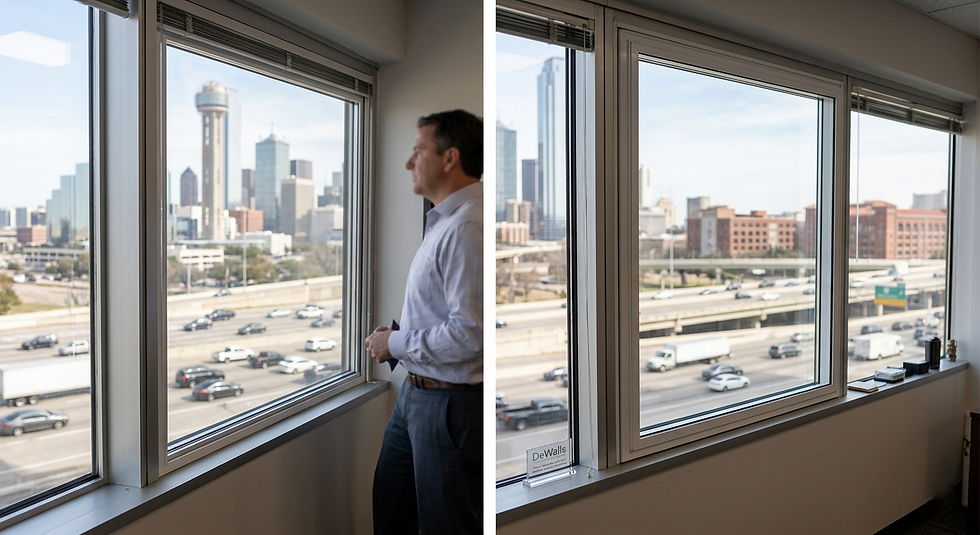
How the Dead Air Gap Principle Works
Every acoustic engineer agrees on the same fundamental point: the most effective soundproofing material is air. A properly sized air gap between two rigid surfaces dampens sound transmission more effectively than almost any solid material of equivalent thickness.
Acoustic window inserts exploit this principle directly:
A custom-cut acrylic panel snaps into the existing window frame using a compression seal.
No fasteners, no structural modification to the window, frame, or surrounding wall.
The insert creates a 2 to 4-inch air gap between itself and the existing glass pane.
That air gap does the acoustic work - not the acrylic material itself.
The STC improvement from that air gap is substantial and measurable:
Window Configuration | STC Rating |
Single-pane commercial window, no insert | STC 26 |
Single-pane window with 2-inch insert gap | STC 38 |
Single-pane window with 4-inch insert gap | STC 42 |
Existing double-pane IGU with 4-inch insert gap | STC 44–48 |
For Texas offices along I-35 in Austin and San Antonio, the I-10 Houston loop, and Dallas's Central Expressway corridor, those STC improvements represent a directly perceptible reduction in traffic, construction, and highway noise - without the $800 to $1,500 per opening cost of full commercial window replacement.
The Texas UV Acrylic Problem Most Suppliers Do Not Disclose
Standard acrylic is manufactured in two forms - and the difference matters significantly in Texas:
Extruded acrylic:
Less expensive and widely available.
Under Texas UV exposure, yellows noticeably within 5 to 7 years.
Develops surface micro-crazing, losing dimensional stability.
Compromises the compression seal - the insert becomes acoustically ineffective.
Cast acrylic:
Higher upfront cost - typically 20 to 40% premium over extruded.
Significantly better UV radiation resistance.
Maintains dimensional stability and optical clarity throughout its service life.
In a Texas UV environment, the service life difference is measured in decades, not years.
Texas averages 220 to 230 sunny days per year - with UV radiation intensity substantially exceeding that of northern states. Specifying cast acrylic for every acoustic window insert in a Texas commercial building is not optional. It is the correct specification for this climate.
Why Window Inserts Are Uniquely Suited for Texas Tenants
Acoustic window inserts offer a rare combination that no other high-performance acoustic product matches in a Texas leased commercial space:
No structural modification to the building fabric.
No landlord approval required in the vast majority of Texas commercial lease agreements.
No building permit required in virtually all Texas jurisdictions.
Fully reversible at lease termination - the insert leaves no trace of modification.
No Tenant Improvement negotiation required - inserts can be installed the same week the decision is made.
Method 9: Acoustic Caulk and Sealants - The Highest-ROI Step in Any Texas Office
Best for: Every Texas commercial office - the lowest-cost, fastest-payback intervention in the entire acoustic toolkit.

Why a $15 Tube Can Undo a $50,000 Acoustic Investment
Acoustic sealant costs $8 to $25 per tube and requires no specialized installation labor. Yet a single unsealed gap - at an electrical outlet, around a pipe sleeve, or beneath a baseboard - can reduce the effective STC of an entire professionally installed acoustic wall assembly by 10 to 15 points.
The physics are counterintuitive but documented:
A gap covering just 1% of a wall's total surface area allows approximately 50% of sound energy to pass through.
Most building managers assume a small gap causes a proportionally small acoustic problem.
It does not. Even very small gaps have a disproportionately large effect on overall wall system performance.
Sealing costs almost nothing. Skipping it defeats every other investment in the assembly.
Why Texas Offices Cannot Use Standard Silicone Caulk
In most U.S. climates, standard silicone or latex caulk performs adequately at wall perimeters and penetrations. In Texas, it is a failure waiting to appear.
The Texas thermal cycling problem:
Texas annual temperature ranges regularly span from below freezing (winter fronts affecting DFW, Austin, and San Antonio) to 100°F to 115°F in summer.
That 80°F to 100°F seasonal temperature differential causes commercial building materials to expand and contract measurably every year.
In concrete slab-on-grade buildings, the perimeter joint between the slab and the wall bottom plate moves with every seasonal cycle.
Standard silicone caulk becomes brittle and cracks under repeated thermal cycling.
When that caulk cracks, the acoustic seal is broken - the gap at the wall base becomes an open flanking path.
Acoustical sealants - specifically OSI SC-170, Tremco Acoustical Sealant, and Green Glue Sealant - maintain full elasticity from below freezing to above 130°F. Unlike silicone, they remain permanently tacky and flexible, accommodating the building movement that Texas thermal cycling produces year after year. In Texas, acoustic sealant is not an optional upgrade - it is the correct product specification.
The Texas Office Acoustic Seal Checklist
Every point on this list is a known flanking path in Texas commercial construction. Inspect and seal each location before investing in any other acoustic upgrade:
Electrical outlet backs - The gap between the electrical box and the wall cavity is a direct sound path. Acoustic putty pads seal the box from behind without affecting electrical function or fire rating.
HVAC supply and return penetrations - Every duct through a shared wall must be wrapped with acoustic sealant at the penetration point and backfilled with fire-rated acoustic sealant before finishing.
Pipe sleeves and conduit penetrations - Routinely left with foam backer rod only. Foam backer rod is a backing material, not a seal. Acoustical sealant applied over the rod provides the actual acoustic sealing performance.
Baseboard perimeter - In Texas offices with luxury vinyl tile or polished concrete, there is typically no acoustic seal between the wall base and the floor. A bead of acoustic sealant behind the baseboard during installation closes this path permanently.
Top plate junction - Where the wall top plate meets the ceiling grid above. In suspended ceiling buildings, this junction is typically left completely open - one of the most commonly missed flanking paths in Texas commercial construction.
Window frame perimeter - Critical in older Texas commercial buildings where window frames have shifted away from surrounding wall assemblies due to decades of slab movement.
Acoustic Sealant Maintenance Schedule for Texas Climates
Acoustic sealant is not a one-time installation. Texas's climate demands an ongoing maintenance schedule:
Annual visual inspection of all sealed perimeters - the minimum standard everywhere in the state.
Six-month inspection in Houston, Beaumont, Galveston, and Corpus Christi - humidity cycling accelerates sealant aging at exterior-adjacent wall perimeters.
Post-first-freeze inspection in Dallas-Fort Worth, Austin, and San Antonio - the freeze-thaw cycle is the fastest sealant degradation mechanism in North Texas. Inspect expansion joints and floor-wall junctions after each freeze event each year.
Method 10: Floor Treatments and Acoustic Underlayments
Best for: Multi-story Texas offices replacing commercial carpet with LVT; Texas tech offices with raised access flooring systems.

The Rating Nobody Checks Until It Is Too Late
When a Texas office manager replaces commercial carpet with luxury vinyl tile, three factors drive the decision:
Cost - LVT is less expensive over its life cycle than commercial carpet.
Appearance - LVT offers a modern, clean aesthetic preferred in contemporary Texas office builds.
Maintenance - LVT requires far less upkeep in a climate where spills, humidity, and heavy foot traffic are constant.
IIC (Impact Insulation Class) almost never enters the conversation - until the tenant on the floor below files a formal noise complaint.
The IIC swing from commercial carpet to bare LVT on a concrete slab is one of the most dramatic single-step acoustic performance drops available through any standard renovation:
Floor Configuration | IIC Rating |
Concrete slab with commercial carpet | IIC 65–75 |
Concrete slab with LVT, no underlayment | IIC 25–35 |
Concrete slab with LVT and quality acoustic underlayment | IIC 58–68 (product-dependent) |
A 30 to 40-point IIC drop - delivered overnight, through one renovation decision, in a multi-story building where the tenants below had no input - is what an unremediated carpet-to-LVT conversion produces. The Texas IBC minimum is IIC 50. An unremediated LVT installation on slab fails that minimum by 15 to 25 points.
Why This Is a Growing Problem in Texas Commercial Buildings
Texas is experiencing a rapid, accelerating LVT adoption wave across all commercial office markets.
In a climate where concrete slab construction is standard and wood subfloor moisture problems are well documented, LVT over slab has become the default renovation option.
The result: a rising volume of impact noise complaints in Texas multi-tenant buildings across Austin's Domain, Houston's Galleria area, and Dallas's Uptown district.
Tenants on lower floors are encountering footstep noise that simply did not exist when the tenant above had commercial carpet.
When a floor renovation drops IIC by 30 points in a building with a code-required IIC 50 minimum, it creates a building code compliance failure - and increasingly, a basis for lease dispute litigation.
Acoustic Underlayment Product Comparison for Texas LVT-over-Concrete
Product | Thickness | Tested IIC Under LVT on Slab | Notes |
PROFLEX 90 | 6mm recycled rubber | IIC 58–63 | Cost-effective standard commercial specification. |
Regupol 510 | 3mm recycled rubber | IIC 60–65 | Thinner profile - ideal where floor height transitions are constrained. |
PROFLEX 525 | 6mm composite | IIC 64–68 | Designed specifically for LVT floating floor installations. |
ACOUSTIMAT 3 | Fiberglass/foam composite | IIC 66–71 (under carpet) | Premium specification for buildings targeting IIC 65+. |
Critical installation note for floating LVT: Always verify that the specified underlayment thickness does not exceed the LVT manufacturer's maximum recommended underlayment depth. Many click-lock LVT profiles require a maximum of 3mm underlayment to maintain joint integrity. Exceeding this limit causes joint separation - both an acoustic failure and a warranty void.
The Raised Access Flooring Opportunity in Texas Tech Offices
Austin and Dallas host a large and growing concentration of technology company offices that use raised access flooring - a system of pedestals and removable panels typically 6 to 12 inches above the structural slab - to accommodate dense cabling and data infrastructure.
The unexploited acoustic opportunity:
The cavity inside a raised access floor system is an acoustic asset that virtually every installation leaves unexploited.
Filling the cavity with recycled rubber acoustic fill material or acoustic batting achieves IIC performance in the 60 to 70 range without any additional underlayment.
For Austin and Dallas tech offices completing new builds or major renovations with raised access systems, specifying acoustic cavity fill adds negligible cost to a budget line already open.
Texas-Specific Considerations: Code, Climate, Leases, and City Differences

Texas Building Code Acoustic Minimums (IBC 2021 Section 1207)
Texas has adopted IBC 2021 statewide. Section 1207 establishes the following minimum performance standards for commercial construction:
STC 50 (lab-tested) - Minimum for walls separating commercial occupancies from each other in mixed-use buildings.
IIC 50 (lab-tested) - Minimum for floor-ceiling assemblies between separate commercial occupancies.
Field-tested equivalents accepted - IBC 2021 accepts field measurements of ASTC 45 and AIIC 45 as compliant, acknowledging that field installation cannot replicate controlled lab conditions.
Important: These are code minimums, not acoustic design targets. A Texas law firm or medical practice meeting exactly the IBC minimum may still have functionally inadequate privacy for its actual operational requirements. Meeting code and achieving acoustic comfort are two separate goals that frequently require different specifications.
Local amendment notes:
Fort Worth carries additional acoustic requirements under local IBC amendments, particularly for noise-sensitive uses near transportation corridors.
Houston, Dallas, Austin, and San Antonio have each adopted IBC 2021 with varying local modifications.
Always confirm requirements with the specific jurisdiction's building department before finalizing acoustic specifications.
Texas Climate Zones and Material Selection Guide
Texas spans four distinct climate environments that directly affect acoustic material performance and service life:
Gulf Coast - Houston, Galveston, Corpus Christi, Beaumont:
High humidity, salt air, moderate but cycling temperature range.
Specify PET felt panels over fiberglass for all acoustic panel applications.
Specify cast acrylic for all window inserts.
Use acoustic sealant on a 6-month inspection schedule.
MLV ceiling applications: use galvanized or stainless steel grommets - standard steel corrodes under sustained salt-air humidity.
Central Texas - Austin, San Antonio, Waco:
Moderate humidity with significant seasonal temperature swings and active spring storm seasons.
Balanced material choices work year-round.
Prioritize thermal-resilient acoustical sealants at all expansion joints.
Window inserts carry added value during spring storm season when construction and wind noise peak.
North Texas - Dallas-Fort Worth:
Four genuine seasons including hard freezes and hot humid summers.
Acoustic sealant product selection is the most critical specification decision in this region - the freeze-thaw cycle is the primary sealant failure mechanism.
Specify isolation clips over RC channels for any installation exceeding 1,000 square feet.
West Texas and Panhandle - Midland, Odessa, Lubbock, Amarillo:
Low humidity, extreme temperature swings, persistent wind-driven ambient noise.
Window inserts and exterior wall acoustic performance carry higher priority than in urban Texas environments.
Dry climate is favorable for fiberglass panel durability - no binder degradation risk.
Texas Tenant Improvement: Funding Soundproofing Through Your Lease
Most Texas commercial tenants are unaware that acoustic improvements can be negotiated directly into the Tenant Improvement (TI) allowance at lease signing.
How TI allowances work in Texas commercial markets:
Class A buildings: typical TI allowances of $20 to $60 per square foot.
Class B buildings: typical TI allowances of $15 to $35 per square foot.
Well-specified acoustic improvements - QuietRock walls in conference rooms, a sound masking system, high-CAC ceiling tile replacement - can frequently be funded entirely within a TI allowance.
The critical timing rule: Specify the acoustic scope during lease negotiation, before the TI allowance is committed to other improvements. After lease execution, adding acoustic work requires renegotiating with the landlord - a process that typically takes 30 to 90 days and frequently results in cost-sharing rather than full TI coverage.
What Texas Tenants Can and Cannot Modify Without Landlord Approval
Typically no landlord approval required:
Freestanding acoustic panels not attached to walls.
Acoustic window inserts - fully reversible, no wall modification required.
Door seal kits and automatic door bottoms - reversible, original hardware restored at departure.
Sound masking systems - above-ceiling emitter installation that is fully removable.
Acoustic ceiling tile replacement - swapping higher-performing tiles within the existing grid.
Typically requires written landlord approval:
Any wall modification involving new drywall, resilient channels, or MLV installation.
Any modification to the floor-ceiling assembly structure.
Permanent acoustic paneling attached with adhesive or penetrating fasteners.
Any change to HVAC ductwork for acoustic purposes.
Always review the Tenant's Work provision in your specific lease. When any doubt exists, a written request for landlord approval on reversible acoustic improvements is worth the 48-hour response time.
To understand exactly what a professional acoustic scope involves and which items require permits or landlord approval for your specific building, reviewing what Texas commercial soundproofing services typically cover is a useful starting point before entering lease negotiations.
How to Choose: Commercial Soundproofing Decision Framework for Texas Offices

Different noise complaints require different solutions. Use this framework to match the specific noise problem in your Texas office to the appropriate method, with realistic cost expectations.
Noise Problem | Root Cause | Best Method | Texas Cost Range | Permit Required? |
Open-office echo, conversation bleed between zones | Reverberation - hard surface finishes | Acoustic panels (NRC 0.85+), ceiling clouds | $3–$12 per sq ft | No |
Corridor noise through the entry door | Low-STC door, gap at base | Solid-core door + 4-point seal kit | $400–$1,800 per door | No |
Adjacent suite speech audible through shared wall | Low-STC partition, flanking paths | QuietRock + RC clips + acoustic sealant | $8–$20 per sq ft | Usually yes |
Low-frequency impact noise from floor above | Structural vibration, no decoupling | RC isolation clips + MLV ceiling barrier | $12–$25 per sq ft | Usually yes |
HVAC hum through the ceiling | Mechanical vibration, plenum flanking | High-CAC ceiling tiles + targeted plenum barrier | $4–$8 per sq ft | No |
Highway or street noise through windows | Exterior airborne noise | Acoustic window inserts (cast acrylic) | $20–$45 per linear ft | No |
Open-plan speech intelligibility problems | Intelligibility, not transmission loss | Sound masking system | $1–$3 per sq ft | No |
Footsteps from LVT renovation above | Impact noise, no underlayment | Acoustic underlayment + ceiling assembly treatment | $2–$6 per sq ft | Check jurisdiction |
The Most Cost-Effective Sequence for Texas Offices
The most cost-effective strategy for any Texas office always follows the same four-step sequence:
Seal first - acoustic caulk at all perimeters, door seal kits on every entry door.
Decouple where needed - isolation clips and MLV for structural vibration and low-frequency transmission.
Absorb residual echo - acoustic panels and high-CAC ceiling tiles for reverberation and plenum flanking.
Mask remaining open-plan intelligibility - sound masking system for open floor areas and regulated-privacy spaces.
For a 5,000-square-foot Texas office with moderate acoustic requirements, a complete layered approach typically costs $30,000 to $80,000 installed. That investment recovers through reduced employee distraction, avoided lease disputes, and - for regulated industries - documented compliance with HIPAA and related privacy standards.
Professional acoustic assessment before committing to any single method consistently produces better outcomes per dollar than selecting products from marketing materials alone. A no-cost commercial acoustic assessment for your Texas office is the most direct way to identify which combination of these methods applies to your specific building, layout, and lease situation.
Frequently Asked Questions
How do I soundproof my commercial office in Texas?
Start with three steps:
Seal every gap - acoustic caulk, door seal kits, and outlet putty pads.
Decouple walls and ceilings - resilient channels or MLV barriers for structural vibration.
Absorb echo - acoustic panels and high-CAC ceiling tiles.
Add a sound masking system for open-plan speech intelligibility. The right combination depends on your specific noise problem - impact noise, airborne speech, exterior traffic, and HVAC vibration all require different primary solutions.
What is the most effective soundproofing for office walls in Texas?
For the highest STC in a standard commercial wall, combine QuietRock 530 (acoustic drywall), Green Glue damping compound, and RSIC-1 isolation clips on the framing. This assembly achieves STC 58 to 62. For budget-constrained projects, a solid-core door with a professional 4-point seal kit and acoustic sealant at all wall perimeters delivers the best return on the lowest investment.
How much does commercial office soundproofing cost in Texas?
Basic scope (acoustic caulk and door seal kits for a single suite): $500 – $2,000.
Mid-range scope (ceiling tile upgrade, door seals, and sound masking for a 2,000 sq ft office): $15,000 – $35,000.
Full acoustic renovation (wall assembly upgrades, resilient channel decoupling, professional finishing): $40,000 – $150,000+ for larger commercial spaces.
What STC rating do I need for a Texas commercial office?
IBC 2021 Section 1207 requires a minimum lab-tested STC 50 for walls separating commercial occupancies from each other. For functional speech privacy in attorney, medical, or HR contexts - even on interior partitions with no code minimum - target STC 45 to 55.
Is soundproofing worth it for a Texas office?
Yes - when the right method is matched to the right noise problem. Key reasons for Texas offices:
Noise-related productivity losses cost U.S. businesses an estimated $650 billion annually.
For HIPAA-covered Texas medical and dental practices, inadequate acoustic privacy creates direct regulatory exposure.
For multi-tenant Texas buildings, LVT renovation-related impact noise complaints have become a leading source of commercial lease disputes.
The cost of prevention is consistently lower than the cost of remediation or litigation.
What is the cheapest way to soundproof a Texas office?
Acoustic sealant applied to all wall perimeters, electrical outlets, pipe sleeves, and HVAC penetrations is the cheapest effective intervention - often costing less than $500 in materials for a full suite. Adding a professional door seal kit on the entry door brings total material and labor cost to $400 to $800 per door. Together, these two steps eliminate the most common low-cost flanking paths before any structural investment is made.
Do I need a permit to soundproof my office in Texas?
No permit required: Acoustic panels, window inserts, door seal kits, sound masking systems, and ceiling tile replacement.
Permit required: New drywall assemblies, resilient channels, MLV wall installation, or any floor-ceiling assembly modification.
Dallas, Houston, Austin, and San Antonio all maintain online permit inquiry tools for commercial projects.
How long does office soundproofing last in Texas?
Acoustic drywall, MLV, and isolation clips: 20 to 30+ years when installed correctly.
Acoustic sealant: Requires inspection and reapplication every 5 to 8 years in Texas due to thermal cycling.
Acoustic panels: 10 to 20 years depending on material and environment. PET felt panels outlast fiberglass panels in high-humidity Gulf Coast environments.
Door seal kits: 5 to 10 years on high-traffic doors before sweeps and gaskets require replacement.
Conclusion
Noise in a Texas office is not a comfort issue. It is a business performance issue, a legal compliance issue, and - increasingly - a commercial real estate value issue.
The ten methods in this guide are not theoretical recommendations drawn from product data sheets. They represent field-proven approaches applied across hundreds of commercial acoustic projects in Texas offices spanning Houston, Dallas, Austin, San Antonio, Fort Worth, and across the Texas commercial market. The ranking reflects real-world project frequency and return on investment - not installation margins.
The core principle that applies to every Texas office:
No single method is sufficient on its own.
The Texas offices that achieve genuinely effective acoustic performance are the ones that addressed sealing, decoupling, absorption, and masking together - starting with the cheapest, highest-return steps and building toward structural improvements based on the actual noise problems of the specific space.
Understanding your noise problem before selecting a solution is the step that saves the most money and delivers the best outcome.
If you are unsure which of these methods applies to your building, floor plan, or lease terms, the most direct next step is a professional commercial acoustic assessment. It eliminates guesswork, prevents the expensive installation mistakes documented throughout this guide, and identifies the most cost-effective intervention sequence for your specific situation.


Comments