


Texas Commercial Soundproofing Contractor vs. DIY: Which One Actually Saves Money ?

Updated: Jun 26

For Texas commercial spaces, hiring a professional soundproofing contractor saves money in the long run. While DIY lowers upfront expenses, commercial environments require specialized STC (Sound Transmission Class) ratings and building codes. Professional installation prevents costly rework, operational downtime, and legal liabilities from noise complaints.
When Texas business owners ask whether a Texas commercial soundproofing contractor vs. DIY is the smarter financial move, the honest answer is this:
DIY saves money on labor costs upfront - typically $75 to $150+ per hour avoided - but regularly costs more in total.
Texas commercial buildings must comply with IBC 2021 Section 1206, which enforces:
Minimum STC (Sound Transmission Class) ratings of 50 between tenant spaces.
Mandatory fire-rated wall assemblies per occupancy classification.
City-specific permit requirements that no DIY installation can self-certify.
When a failed inspection, a missed flanking path, or a code violation forces a teardown, the final bill from a DIY project nearly always exceeds what a licensed commercial acoustic contractor in Texas would have charged.
That said, DIY is genuinely the right call in specific situations - and a hybrid approach that divides the project between a licensed contractor and the property owner cuts total costs by 25 to 35 percent without risking a single compliance requirement.
Why the Texas Commercial Soundproofing Contractor vs. DIY Question Is Different
Search for "Texas commercial soundproofing contractor vs. DIY" and you will find the same article published in dozens of variations. Most were written for residential homeowners comparing foam panels on a bedroom wall to hiring a handyman. That comparison is nearly irrelevant to what Texas commercial property owners actually face.
Soundproofing a commercial space in Texas - whether a medical suite in a Dallas multi-tenant building, a restaurant in Houston dividing a dining room from a private events area, or a law office in Austin building new private consultation rooms - means operating under a completely different regulatory framework.
The pattern that repeats in real Texas commercial projects is predictable:
A business owner reads a generic comparison article.
They decide the DIY labor savings justify the route.
They start the project.
They fail a city inspection, receive a complaint from an adjacent tenant, or discover six months later that sound is traveling through every HVAC duct and outlet box as if the new wall does not exist.
The rework that follows costs more - in almost every case - than the contractor quote that was originally passed on.

The Four Reasons the Standard Comparison Fails Texas Commercial Owners
1. Texas commercial buildings fall under the IBC 2021. The International Building Code, as adopted in Texas, sets legally enforceable STC minimums, mandatory fire-rated assembly requirements, and field testing standards. The vast majority of DIY soundproofing guides do not reference this code at all.
2. Every major Texas city operates under its own local rules. Dallas, Fort Worth, Houston, Austin, and San Antonio each manage permits, inspections, and noise ordinance enforcement differently. A contractor experienced in Dallas commercial soundproofing is not automatically prepared for Austin's building department processes, and vice versa.
3. Texas's climate creates material performance challenges most guides ignore. Heat, humidity, and regional aridity all affect how acoustic materials cure, adhere, and perform over time - and that determines whether a soundproofing investment lasts two years or twenty.
4. "Commercial" covers a wide range of separate regulatory environments. Texas commercial soundproofing spans:
HIPAA-protected medical exam rooms.
OSHA-regulated manufacturing floors.
TABC-licensed restaurants and bars.
State-licensed childcare and therapy facilities.
A single comparison framework cannot cover all of these situations. The right decision depends on which space type you are managing and which regulatory body governs it.
Texas Building Code - What Every Commercial Property Owner Must Know
What STC Rating Does Texas Commercial Code Actually Require?
STC (Sound Transmission Class) is the single-number rating that measures how well a wall, floor, or ceiling assembly blocks airborne sound - speech, music, mechanical noise, and HVAC transmission between spaces.
The IBC 2021 Section 1206, adopted in Texas, mandates the following minimum ratings:
Assembly Type | IBC 2021 Minimum STC | Texas Commercial Application |
Wall between tenant spaces | STC 50 | Office suites, retail units, medical |
Wall adjacent to corridors | STC 45 | Hallways and lobby areas |
Floor/ceiling between occupancies | STC 50 | Multi-story commercial buildings |
Wall adjacent to sleeping units | STC 50 | Hotels and extended-stay facilities |
Medical and clinical spaces | STC 45–50+ | Dental, therapy, and medical offices |
What these numbers mean for your project:
STC 50 is the legal floor, not the performance target. The ICC's own acoustics guideline rates STC 55 as "acceptable" and STC 60 as "preferred" for spaces where privacy genuinely matters.
A growing number of Texas commercial lease agreements now specify STC targets above the IBC minimum - meaning your tenant may contractually require higher performance than code alone demands.
STC ratings are only valid when tied to a documented, laboratory-tested wall assembly per ASTM E90. When a DIY guide states "this wall configuration should achieve around STC 50," that is an estimate - not a certified rating.
Texas commercial building inspectors do not accept estimates.
Critical note: Real-world field testing per ASTM E336 typically yields results 3 to 5 STC points below the laboratory number. This gap is precisely where most DIY commercial soundproofing projects fail inspection.
Fire Rating Requirements: The Compliance Layer That Ends Most DIY Projects
This is the requirement that surprises the most Texas property owners - and it is the primary reason DIY commercial soundproofing carries serious financial risk regardless of skill level.
IBC Chapter 7 mandates that wall and ceiling assemblies separating certain commercial occupancies must meet one-hour or two-hour fire ratings depending on occupancy classification and building type.
What DIY guides almost never disclose:
Standard Mass-Loaded Vinyl (MLV) - the most widely recommended DIY soundproofing product - does not carry a UL fire-resistance listing unless specifically specified and documented in a compliant assembly.
Most acoustic foam panels used in DIY applications are not rated for occupied commercial spaces.
Standard resilient channel and generic fiberglass batt insulation are similarly unrated without a specific UL assembly reference.
A wall that soundproofs but fails fire rating is not a compliant wall. It will be flagged at inspection and required to be fully opened, assessed, and rebuilt at the property owner's expense.
What a licensed contractor provides that DIY cannot:
A specific UL assembly number (e.g., UL U305, UL U419) documented in all project records.
Confirmation of which products must be used, in what configuration, with what fastener schedule and stud spacing.
Simultaneous certification of both the STC rating and the required fire rating - what Texas building inspectors actually approve.

City-by-City Permit Reality: Why "Texas" Is Not One Single Jurisdiction
Texas has no statewide noise statute. Permit enforcement and noise ordinance consequences are managed at the city level.
Dallas
Adopted IBC 2021 with local amendments.
Commercial alterations affecting fire-rated assemblies require a Building Permit; HVAC work requires a separate Mechanical Permit.
Plan review averages 15 to 25 business days.
Noise ordinance fines reach $2,000 per day per violation, with each day as a separate offense.
Some occupancy types require engineer-sealed drawings before permit issuance.
Fort Worth
IBC 2021 adopted with local amendments.
Requires third-party inspection for certain commercial occupancy changes.
Full permit documentation required for fire-rated wall modifications.
Houston
No traditional zoning - creates entirely complaint-driven enforcement.
Chapter 30 ordinance sets commercial noise at 68 dB(A) at the receiving property.
Fines up to $1,000 per offense; HPD enforces.
Without documented STC compliance, a Houston business owner has no technical defense.
Austin
The most enforcement-active Texas commercial market for acoustic compliance.
Allows up to 70 dB(A) at commercial property lines.
Engineer-sealed drawings required for more project types than any other major Texas city.
Plan review: 15 to 25 business days.
San Antonio
Most straightforward permitting process among major Texas markets.
Full IBC compliance still required.
Projects involving HVAC or plumbing penetrations require CPS Energy and SAWS coordination.
Key takeaway for DIY owners: The permit requirement does not disappear because you are doing the work yourself. The permit is issued for the project, not the person. Unpermitted alterations make you - the property owner - liable. Your insurance carrier may deny claims in unpermitted spaces.
Texas Climate's Impact on Soundproofing Materials - The Factor Most Guides Skip
Texas summer temperatures regularly reach 100 to 115°F. These conditions affect soundproofing materials in ways guides written for northern climates do not address.
Acoustic caulk and sealants:
Most formulas have application temperature ranges of 40°F to 90°F.
Applied in extreme Texas heat, they cure improperly and fail within 12 to 24 months.
A failed seal becomes a flanking path that destroys STC performance across the entire wall.
Mass-Loaded Vinyl (MLV):
Becomes significantly more pliable at sustained high temperatures.
Horizontal runs in unconditioned attic spaces can sag and separate from adjacent surfaces.
Adhesive-backed MLV experiences accelerated adhesion failure in Texas heat.
East Texas humidity (Houston, Beaumont, Gulf Coast):
Causes moisture absorption in acoustic panel cores.
Creates mold growth behind panels without proper vapor management.
Slows drywall compound cure times, affecting final assembly performance.
West Texas aridity (El Paso, Lubbock, Midland):
Causes acoustic caulk to shrink and crack through a single heating and cooling cycle.
Hairline cracks are invisible to the eye but fully audible across a partition.
Full Cost Breakdown - DIY vs. Commercial Soundproofing Contractor in Texas
The Two Scenarios Used for This Comparison
Scenario A - Base Case: A 1,200 sq ft single-tenant commercial office suite in Dallas, with existing drywall walls, being divided into three private offices and a shared reception area. Goal: STC 50 compliance between offices and corridor. No HVAC modifications required.
Scenario B - Complex Case: A 2,500 sq ft mixed-use commercial space in Houston where a restaurant and a small event rental space share a demising wall. Goal: STC 55+ between spaces, HVAC duct isolation required, two-hour fire-rated assemblies mandated.
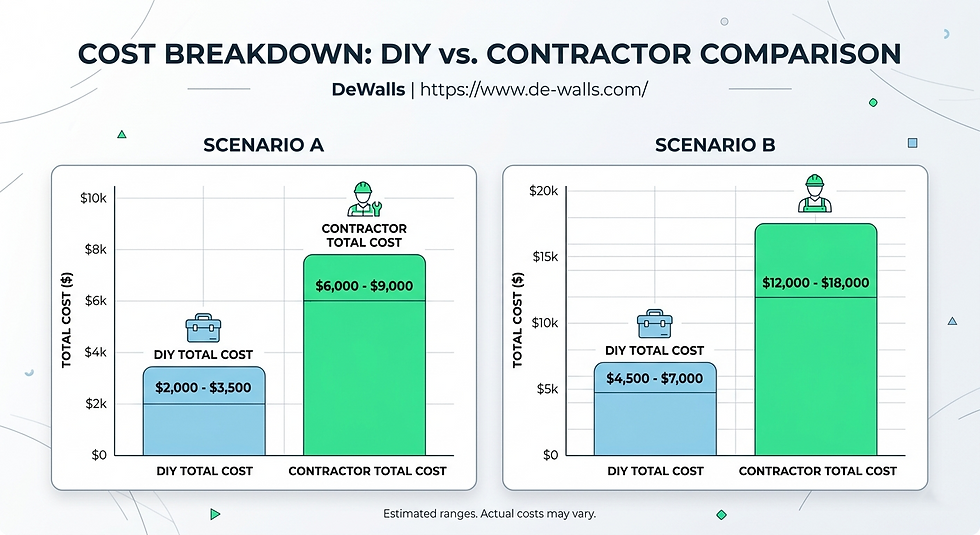
DIY Cost Breakdown - Scenario A: 1,200 sq ft Dallas Office Suite
Cost Category | Detail | Estimated Cost |
Mass-Loaded Vinyl (MLV) | $2–$5/sq ft, approx. 600 sq ft | $1,200–$3,000 |
QuietRock / Soundproof Drywall | $40–$70 per 4×8 sheet, approx. 40 panels | $1,600–$2,800 |
Resilient Channel + Isolation Clips | $1.50–$3.00/linear ft, approx. 400 linear ft | $600–$1,200 |
Rockwool Safe'n'Sound Batt Insulation | Approx. $1.50/sq ft, 600 sq ft | $900 |
Acoustic Caulk and Green Glue Compound | 40–60 tubes total | $300–$600 |
Commercial Door Sweeps + Acoustic Seals | 3 doors at $80–$200 per door | $240–$600 |
Tool Rental or Purchase | Drywall lift, caulk gun, misc. | $400–$1,200 |
Building Permit - City of Dallas | Required for any structural wall modification | $350–$750 |
ASTM E336 Field Sound Test | Required by inspector or requested by tenant | $900–$2,500 |
Rework Risk Buffer | Industry-observed correction rate on DIY commercial installs | $1,200–$2,000 |
Your Labor (80–120 hours) | $0 billed; real opportunity cost varies | $0 |
Total DIY Estimated Cost | $7,690–$15,550 |
Why the rework risk buffer is not optional padding:
Acoustic engineering research identifies the following real-world failures in DIY commercial installs:
A single unsealed flanking path drops a field STC measurement by 10 to 20 points.
Not caulking the wall-to-floor joint alone reduces a properly built STC 50 wall to an effective STC of 33 to 39 - well below the Texas code minimum.
An ungasketed door or a one-inch-square hole in a wall drops a certified STC 50 partition to STC 30.
Contractor Cost Breakdown - Scenario A: 1,200 sq ft Dallas Office Suite
Cost Category | Detail | Estimated Cost |
Labor ($75–$140/hr, Dallas market 2026) | 50–70 hours for a 3-office isolation scope | $3,750–$9,800 |
Materials (contractor wholesale, 10–20% below retail) | Same assembly components | $4,200–$6,500 |
Project Management and Acoustic Design | Included in most commercial bids | $500–$1,500 |
Permit Application and City Coordination | Handled and guaranteed compliant | $350–$750 |
UL Fire-Rated Assembly Documentation | Specific UL listing in project documents | Included |
STC Rating Certification | Assembly-specific certified rating | Included |
Post-Installation Sound Test (ASTM E336) | Field verification of STC performance | $0–$1,200 |
Workmanship Warranty | Typically 1–3 years | Included |
Total Contractor Estimated Cost | $12,300–$22,750 |
Contractor Cost Breakdown - Scenario B: 2,500 sq ft Houston Restaurant + Event Space
Cost Category | Detail | Estimated Cost |
Labor ($85–$150/hr, Houston market 2026) | 80–120 hours | $6,800–$18,000 |
Materials - fire-rated assemblies and specialty products | Full assembly scope | $9,000–$15,000 |
HVAC Noise Isolation | Duct lining, vibration mounts, flex connectors | $2,500–$6,000 |
Acoustic Engineering Consultation | Required for STC 55+ in mixed-use occupancy | $1,500–$4,000 |
Permits (Building + Mechanical + Fire) | Multi-permit Houston commercial project | $800–$2,000 |
Fire-Rated Assembly Certification | 2-hour rating documentation included | Included |
Total Contractor Estimated Cost | $22,600–$47,000 |
The Hidden Costs That Erase DIY's Apparent Savings
The tables above reflect visible, plannable costs. Here is what most comparison guides never mention:
1. Flanking Path Correction - $2,000 to $6,000 per partition Sound travels through structural connections, HVAC boots, electrical box cutouts, pipe penetrations, and wall-to-ceiling junctions - not just through walls. Correcting missed flanking paths after a wall is finished and painted costs $2,000 to $6,000 per partition.
2. Compliance Testing Costs - $900 to $5,000+ ASTM E336 field testing costs $900 to $2,500 per cycle. DIY installations frequently fail at this stage. A second test after corrections adds another $900 to $2,500 - plus the cost of all corrections required before retesting.
3. Delayed Occupancy and Lost Revenue - $6,000 to $24,000 A licensed contractor completes a 1,200 sq ft suite in 8 to 12 business days. A weekend-and-evening DIY project takes 10 to 16 weeks before counting permit processing time. At $3,000 to $8,000 per month in lost rental income, that delay is a real, calculable cost.
4. Insurance Coverage Voids - Variable exposure Some Texas commercial insurance policies require code-compliant alterations for coverage to apply. An unpermitted installation may void coverage for incidents in the affected space or create dispute grounds on future claims.
5. HIPAA Exposure in Medical Spaces - Potentially unlimited liability HHS requires covered entities to implement "reasonable safeguards" for oral PHI communications. A licensed contractor provides written documentation that serves as good-faith compliance evidence during an HHS audit. A DIY installation with no documentation provides zero defense.
Texas Commercial Soundproofing Contractor vs. DIY - A Space-by-Space Guide
The Texas commercial soundproofing contractor vs. DIY decision is not universal across Texas commercial space types. Here is how the analysis works for each major category.

Texas Restaurant and Bar Soundproofing
The acoustic challenge: Restaurants and bars operate in some of the most acoustically complex commercial environments. Kitchen equipment, HVAC systems, entertainment audio, and patron crowd noise all create competing sound sources requiring coordinated isolation - not a single-wall fix.
The regulatory stakes:
TABC-licensed venues face active noise ordinance enforcement in Dallas and Austin.
Dallas noise ordinance fines reach $2,000 per day per violation, with each day counted separately.
Austin's Chapter 9-2 limits are under increasing scrutiny as residential density grows around entertainment corridors.
DIY risks specific to Texas restaurants and bars:
Kitchen exhaust penetrations through shared walls are a primary flanking path requiring professional sealing.
HVAC duct runs connecting dining and kitchen areas transfer mechanical noise to every connected space simultaneously.
Entertainment system vibration requires structural decoupling that surface-level DIY treatments cannot achieve.
The verdict: Hire a licensed commercial soundproofing contractor. The documentation a contractor provides is also your primary legal defense when a noise complaint is filed with the city.
Texas Medical and Dental Office Soundproofing
The federal obligation: The HIPAA Privacy Rule, enforced by the HHS Office for Civil Rights, requires covered entities to implement reasonable safeguards preventing inappropriate disclosure of protected health information in oral communications.
HHS guidance explicitly identifies the following as documented HIPAA safeguards:
Acoustical door seal kits on exam room doors.
Fabric-wrapped acoustic wall panels reducing ambient sound transmission.
Specialty ceiling tiles with documented noise-barrier properties.
What HIPAA actually requires: HIPAA does not mandate fully sealed, soundproofed rooms. It requires reasonable, documented effort. A medical practice must demonstrate - during an audit - that specific acoustic steps were taken. A licensed contractor provides:
Product specifications tied to installed assemblies.
Installation records with material identification.
STC certification for walls between exam rooms.
A documented paper trail that satisfies an HHS audit.
A DIY installation with no documentation provides none of these.
The verdict: Hire a licensed commercial acoustic contractor. The compliance documentation alone justifies the contractor cost before factoring in the acoustic performance risk of DIY execution in clinical spaces.
Texas Office and Co-Working Space Soundproofing
Two distinct needs that most owners conflate:
Office and co-working spaces in Texas require two different types of work:
Structural sound isolation between enclosed offices and meeting rooms - requires permits, fire-rated assemblies, and STC certification.
Acoustic surface treatment in open areas to reduce echo and improve speech intelligibility - requires no permits and is genuinely manageable as a DIY task.
The common and costly mistake: Treating these as a single project. Property owners either:
Hire a contractor for everything - correct for structural work but unnecessarily expensive for acoustic panels.
DIY everything - and end up with wall assemblies that fail STC 50 requirements between tenant spaces.
The verdict: Use the hybrid approach. Hire a licensed contractor for structural demising walls, permit documentation, and HVAC penetration work. Complete acoustic panels, door sweeps, and soft furnishing upgrades yourself after structural work is inspected and approved.
Understanding the range of acoustic treatment options for Texas commercial offices helps property owners plan both phases of the hybrid approach more accurately before soliciting contractor bids.
Texas Recording Studio and Production Suite Soundproofing
Why this scope carries the highest DIY risk of any commercial space type:
A commercial recording studio requires room-within-a-room construction - an entirely new structure built inside the existing building shell with zero direct physical contact between the inner and outer structures.
This scope requires:
Structurally decoupled ceiling assemblies.
Wall framing isolated from the outer building structure at every single connection point.
Specialized HVAC configurations preventing mechanical noise transmission.
Why errors are not correctable without full teardown: A room-within-a-room structure accidentally connected at any single point - one screw bridging both assemblies, one conduit spanning both structures - defeats the entire decoupling system. Correcting that error after walls are finished means complete demolition and rebuild of the inner structure.
The verdict: Hire a licensed contractor with specific acoustic engineering credentials. Request verified NRC (Noise Reduction Coefficient) and STC performance targets from an acoustic engineer before construction begins. Reviewing completed acoustic project portfolios from specialists gives you a realistic understanding of what proper room-within-a-room construction looks like.
Texas Medical Spa, Therapy, and Wellness Center Soundproofing
The regulatory gray zone: Medical spas, therapy practices, and wellness centers may not qualify as HIPAA-covered entities, but they carry strong client confidentiality obligations - ethically and contractually.
Why contractor installation is the safer path:
Texas's Health and Safety Code governs these facility types through state health licensing requirements.
Physical environment standards are inspectable, and acoustic separation between treatment rooms and waiting areas is increasingly evaluated during licensing inspections.
A licensed contractor provides written documentation that protects the business during state audits.
The verdict: Hire a licensed commercial soundproofing contractor.
Texas Warehouse, Industrial, and Manufacturing Facility Soundproofing
The federal noise requirement: OSHA 29 CFR 1910.95 requires employers to establish a hearing conservation program for employees exposed to an 8-hour TWA of 85 dB(A) or above. At 90 dB(A) TWA, engineering controls - actual physical noise reduction, not just hearing protection - become federally required.
What is DIY-viable in this setting:
Installing MLV curtain barriers between machinery zones and quieter work areas.
Adding acoustic partition walls to separate noisy equipment from operational areas.
Hanging ceiling-mounted acoustic baffles in open warehouse environments.
What is not DIY-viable:
OSHA compliance documentation proving engineering controls reduce exposure to compliant levels.
Noise measurement and reporting required to satisfy federal enforcement review.
Any documentation OSHA or the Texas Workforce Commission would require as verified proof of compliance.
The verdict: Hybrid approach. DIY for physical barriers and acoustic baffles. Licensed contractor and/or industrial hygienist for engineering controls documentation.
For Texas industrial facilities, reviewing the scope of industrial noise control solutions - including vibration isolation, equipment enclosures, and barrier systems - helps operators structure a realistic project scope before requesting contractor bids.
DIY Soundproofing Methods That Genuinely Work in Texas Commercial Spaces
There is real, meaningful work Texas property owners can do themselves - work that reduces project costs without touching any code-required structural or fire-rated element. Here is exactly what works, how to execute it correctly, and what Texas-specific conditions to account for.
Method 1: Acoustic Panel Installation - Surface Absorption Treatment
What acoustic panels do - and what they cannot:
Acoustic treatment and soundproofing are two completely different things. Many DIY guides blur this distinction in ways that cost property owners thousands of dollars solving the wrong problem.
Acoustic panels absorb mid-to-high frequency sound energy within a room, reducing echo and reverberation time. They do not block sound from traveling between rooms.
Use acoustic panels when your goal is improving speech clarity in a conference room, reducing echo in a restaurant dining area, or improving the comfort of an open co-working floor plan.
Do not use acoustic panels when your goal is stopping sound from traveling to the tenant next door. That requires structural soundproofing - not surface treatment.
How to install acoustic panels correctly in Texas - step by step:
Calculate your room volume in cubic feet (length × width × ceiling height). For commercial offices and conference rooms, target a reverberation time (RT60) of 0.3 to 0.5 seconds. Use a free online RT60 calculator with the panel's published NRC (absorption coefficient) rating.
Locate the first reflection points on the side walls. Have someone slowly slide a mirror along the side wall while you sit at your primary working position. Where you first see your own reflection is the first reflection point - that is the priority placement position.
Install panels at these three priority positions:
First reflection points on both side walls.
The rear wall facing the primary speaker or conversation position.
A ceiling cloud directly above the primary work or conversation zone.
Mount panels using French cleats or Z-clips, not direct adhesive. This allows repositioning if the room's use changes and avoids wall surface damage when panels are removed.
Texas Gulf Coast and East Texas note (Houston, Beaumont, Gulf Coast): Specify panels with moisture-resistant backing material. Leave a half-inch air gap between the panel back and the wall surface to prevent trapped moisture from creating mold growth - a documented failure mode in Texas coastal markets.
Realistic cost and savings:
Materials: $8 to $25 per square foot for fabric-wrapped panels.
DIY saves $1,500 to $4,000 on a standard commercial suite compared to contractor installation of the same panels.

Method 2: Door and Window Gap Sealing - The Highest ROI Task in Commercial DIY Soundproofing
Why this outperforms almost any other DIY task on a per-dollar basis:
Sound does not respect walls. It travels through every gap, crack, and opening with no resistance. Acoustic engineering research documents these real-world performance impacts:
A 1/4-inch gap under a commercial door reduces effective STC performance by 10 to 15 points on an otherwise fully compliant wall assembly.
The acoustic equivalent of a one-inch-square hole anywhere in a wall - including through an electrical outlet box - drops an STC 50 partition to STC 30.
That is not a marginal reduction. That is the difference between meeting Texas commercial code and failing an inspection entirely.
How to audit and seal gaps in a Texas commercial space - step by step:
Conduct a light test after dark. Position a flashlight at the base of every door and at the perimeter of every window frame while someone observes from the other side. Every visible light path is a sound path.
Install commercial-grade automatic door bottoms on every door in the affected area. Do not substitute residential door sweeps on commercial doors - high daily cycle counts degrade residential hardware within 6 to 12 months. Specify commercial-rated brands such as Pemko, Reese, or NGP for high-traffic applications.
Apply acoustic door seal gaskets to the head and both jambs of every door frame. These purpose-designed compression seals create a full acoustic seal when the door closes completely.
For single-pane commercial windows, install acoustic window inserts - a secondary interior pane fitted into the existing frame. Properly installed inserts improve window STC from approximately STC 26–28 to STC 42–48.
Seal all perimeter gaps between finished walls and the floor using non-hardening acoustic caulk. Specify OSI SC-175 or an equivalent non-hardening formula that remains flexible through Texas thermal expansion cycles. Standard painters caulk hardens, cracks, and opens sound paths within one to two seasonal cycles.
🔧 Texas maintenance requirement: Inspect all acoustic sealants and door sweep condition on an annual schedule. Texas heat degrades sealant products at approximately twice the rate of temperate-climate installations.
Realistic cost and savings:
Materials: $400 to $1,500 per commercial suite for all doors and windows.
DIY saves the full contractor labor cost on this scope.
Method 3: Mass-Loaded Vinyl Addition to Existing Walls - Viable With Critical Limitations
What MLV does and where it fits in commercial soundproofing:
Mass-Loaded Vinyl adds acoustic mass to wall assemblies, improving STC performance by approximately 3 to 8 points when correctly installed. It is a legitimate DIY-viable improvement - with limitations that most online guides fail to state clearly.
What MLV alone cannot accomplish in Texas commercial construction:
For commercial soundproofing applications in Texas, MLV alone cannot create a code-compliant, fire-rated, STC 50 wall assembly. A compliant Texas commercial demising wall requires:
A documented stud type and spacing specification.
A specific insulation product within the wall cavity.
Type X gypsum board in the correct layer configuration.
Decoupling elements such as resilient channel or isolation clips.
All components referenced under a UL-listed assembly number.
How to install MLV correctly in Texas conditions - step by step:
Order MLV with 10 percent material overage to account for seam overlaps and cuts.
Store rolls in a climate-controlled space 24 hours before installation. MLV stored in direct Texas summer sun becomes difficult to unroll evenly. Work methodically to maintain panel alignment as the material warms.
Hang MLV vertically from the top of the wall, working one panel at a time from floor to ceiling.
Overlap seams by 2 to 3 inches on every adjacent panel edge.
Seal every seam and the full perimeter of every MLV panel with non-hardening acoustic caulk. Unsealed edges become flanking paths that cancel the mass benefit of the MLV.
Cover all installed MLV with a fire-rated finish layer before occupancy. In Texas commercial spaces, exposed MLV does not meet fire code. Type X drywall is the standard compliant cover layer.
Specify Class A per ASTM E84 for fire performance on all MLV purchased for Texas commercial use. Verify the product data sheet before purchasing - standard residential MLV products may not carry this rating.
Realistic cost: $2 to $5 per square foot for standard 1-lb MLV. Appropriate as a performance enhancer within a compliant, permitted wall assembly - not a standalone compliance solution.
What DIY Cannot Achieve in Texas Commercial Spaces - A Complete Reference List
Regardless of skill level, tool access, or available budget, the following tasks require a licensed Texas commercial soundproofing contractor:
Fire-rated wall assembly construction with documented UL assembly listings.
Floating floor systems and structurally decoupled ceiling assemblies.
HVAC duct lining, duct silencers, and mechanical vibration isolation systems.
Fire-rated penetration sealing around conduit, plumbing, and ductwork using intumescent products per UL listing specifications.
STC-rated demising wall construction between tenant spaces in multi-tenant commercial buildings.
Post-installation ASTM E336 field sound testing and formal STC performance certification.
Building permit compliance documentation for any of the above scope items.
If your project scope includes any item on this list, professional involvement is not optional - it is the direct consequence of how Texas commercial building code is written, enforced, and inspected.
How to Find and Vet a Commercial Soundproofing Contractor in Texas
Texas does not license "acoustic contractors" as a separate trade category. This means anyone can use the title, and the market includes a wide range of skill levels. Distinguishing qualified contractors from under-qualified ones requires asking specific questions before accepting any bid.

Credentials and Licensing to Verify Before Accepting Any Texas Contractor Bid
Credential | Why It Matters | How to Verify |
General Contractor License | Required for structural modifications in commercial buildings | Texas Secretary of State or local municipality licensing database |
Commercial Liability Insurance ($1M+ minimum) | Protects the property owner if damage occurs during work | Request ACORD 25 Certificate of Insurance directly from the carrier - never accept a photocopy |
Workers' Compensation Coverage | Required for contractor employees on Texas commercial job sites | Request the workers' comp certificate directly |
UL Assembly Familiarity | Confirms fire-rated assembly compliance capability | Ask for a sample UL assembly specification from a recently completed project |
ASTM E336 Field Testing Experience | Validates that STC claims are based on verified testing, not estimates | Request a field test report from a past Texas commercial project |
Beyond these credentials, look for contractor membership in:
National Systems Contractors Association (NSCA)
Acoustical Society of America (ASA)
These associations signal professional engagement with the technical standards governing acoustic work.
Seven Questions to Ask Every Texas Commercial Soundproofing Contractor Before Signing
Question 1: "Can you provide a specific UL assembly number for the wall system you plan to install?" A qualified contractor can name specific UL-listed assemblies - such as UL U305 or UL U419 - certified simultaneously for both STC rating and fire-resistance rating. If a contractor quotes an STC number without a UL assembly reference, they are estimating, not certifying.
Question 2: "Have you pulled permits with [Dallas / Fort Worth / Houston / Austin / San Antonio] specifically?" City-specific permit experience matters. Dallas's plan review requirements, Austin's engineer-sealed drawing standards, and Houston's lack of traditional zoning each create nuances an out-of-market contractor may not know.
Question 3: "How do you handle HVAC penetrations and electrical box flanking paths in your project scope?" Any contractor who does not immediately address flanking paths when discussing commercial soundproofing scope is not approaching the problem correctly. Flanking is the primary failure mode of commercial acoustic installations.
Question 4: "What is your warranty commitment if post-installation testing shows the assembly does not achieve the specified STC rating?" Contracts should specify exactly what constitutes acceptable performance and what the contractor's obligation is when that performance is not achieved.
Question 5: "Will you conduct post-installation ASTM E336 field sound testing?" Field testing is the only verification that completed work matches the contract specification. A contractor who considers STC ratings certified without any field verification has not certified anything.
Question 6: "Can you provide Texas commercial project references - not residential work?" Commercial acoustic construction and residential soundproofing are different disciplines. Residential experience does not transfer to Texas commercial fire-rating and permit requirements.
Question 7: "Does your bid include permits, fire-rated penetration sealing, and post-installation testing?" Excluding permits, testing, or fire-rated penetration sealing produces an incomplete number. Adding those items back in typically adds $2,000 to $5,000 to the lowest quote received.
Red Flags That Signal an Unqualified Texas Contractor
Walk away from any contractor who exhibits the following:
Quotes STC ratings without naming a UL assembly. An STC number without an assembly reference is an opinion, not a certification.
Makes no mention of fire ratings anywhere in their proposal. A Texas commercial soundproofing contractor who does not raise fire ratings does not understand state commercial code requirements.
Bids more than 30 percent below competing quotes. This signals unlicensed labor, cut-rate material substitutions, scope exclusions, or no permit application in the plan.
Does not include a permit application in scope. Either they plan to work without permits - making you liable as property owner - or they do not know permits are required.
Cannot name specific products by manufacturer and model. Qualified contractors specify by name: Rockwool Safe'n'Sound, QuietRock 545, Kinetics RIM clips, Green Glue Noiseproofing Compound.
Offers no post-installation testing. A contractor guaranteeing STC performance who refuses to verify it has guaranteed nothing.
Why Texas-Local Contractor Experience Matters - City by City
Dallas and Fort Worth: Local contractors know which project types require engineer-sealed drawings, understand Fort Worth's third-party inspection requirements, and avoid the permit delays and submission rejections that out-of-market contractors create.
Houston: Experienced Houston contractors build with compliance documentation as a priority - because documented STC performance is the property owner's only technical defense in a complaint-driven enforcement environment.
Austin: Local contractors have navigated the city's increasing acoustic compliance scrutiny, know which projects require engineer-sealed drawings, and have working relationships with the Austin building department that reduce review timeline risk.
San Antonio: The most contractor-friendly major Texas market, but CPS Energy and SAWS coordination for HVAC and plumbing work adds complexity that out-of-market contractors frequently miss.
When evaluating commercial soundproofing services in Texas, city-specific permit experience and documentation track records should be among your first screening criteria - not something you ask about after receiving bids.
The Hybrid Approach - Save 25 to 35 Percent Without Losing Compliance
The binary framing of "DIY or contractor" is the wrong frame for most Texas commercial soundproofing decisions. The real question is not which one to pick - it is which parts of the project belong in each category.

The hybrid approach organizes any commercial soundproofing project in Texas around one organizing principle:
Does this task require code compliance documentation?
Yes → Hire a licensed Texas commercial soundproofing contractor.
No → Complete the work yourself after the contractor's scope is inspected and approved.
Phase 1: Contractor Scope - The Non-Negotiable Compliance Layer
Everything in Phase 1 requires a permit, must meet a fire rating, must carry STC certification, or must coordinate with mechanical and electrical trades:
Structural demising wall construction with fire-rated, STC-rated assemblies and full UL documentation.
HVAC penetration sealing and vibration isolation for ductwork adjacent to new walls.
Electrical box and pipe penetration fire and acoustic sealing using intumescent products per UL specifications.
Permit application, plan submission, and inspection coordination with the relevant Texas city building authority.
Post-installation ASTM E336 field testing and formal STC performance documentation.
None of these can be safely assigned to a property owner doing weekend work. All must be complete, permitted, and formally inspected before Phase 2 begins.
Phase 2: DIY Scope - The Performance Enhancement Layer
After the contractor's work is complete, permitted, inspected, and fully documented, the following become genuine DIY territory:
Acoustic panel installation for sound absorption treatment within individual spaces.
Door sweep and acoustic seal gasket upgrades on all interior doors.
Acoustic window insert installation on single-pane commercial windows.
Soft furnishing and furniture arrangement to improve acoustic comfort in open-plan areas.
Acoustic ceiling tile replacement in existing lay-in grid ceiling systems.
None of these items touch any fire-rated or permitted assembly. None require a permit. All improve the acoustic experience of the space in meaningful, measurable ways.
Hybrid Approach Cost Comparison - 1,200 sq ft Dallas Office Suite
Scope | Who Performs It | Estimated Cost |
Phase 1: Contractor - structural isolation, permits, fire rating, STC certification, field testing | Licensed Texas Commercial Soundproofing Contractor | $10,000–$16,000 |
Phase 2: DIY - acoustic panels, door seals, window inserts, furnishings | Property Owner | $1,500–$3,500 |
Total Hybrid Project Cost | $11,500–$19,500 | |
Full Contractor Cost (same total scope) | $16,000–$24,000 | |
Hybrid Savings vs. Full Contractor | $4,500–$6,500 (25–35%) |
The hybrid approach preserves every compliance element that matters: permits, UL fire-rated assembly documentation, STC certification, and ASTM E336 field test records. The savings come entirely from Phase 2 labor that a property owner can genuinely execute - not from Phase 1 work that requires professional execution and documented compliance.
For most Texas office owners, co-working space operators, and commercial property owners, this is the financially optimal path.
Texas City Cost and Code Reference - Dallas, Fort Worth, Houston, Austin, San Antonio

Dallas–Fort Worth Commercial Soundproofing
Market data at a glance:
Contractor labor rates (2026): $75–$140 per hour for commercial acoustic work.
Typical project timeline: 7–12 business days for a 1,200 to 2,000 sq ft office suite scope.
Permit timeline: 15–25 business days for commercial interior alteration plan review.
Noise ordinance: Dallas City Code; fines up to $2,000 per day per violation; each day is a separate offense.
Market condition: Competitive - three or more bids are recommended for projects over $20,000.
DFW note: Projects involving fire-rated assembly modifications may require engineer-sealed drawings depending on occupancy classification. Verify this with the building department before submitting permit applications.
Key local search terms: Dallas commercial soundproofing · Fort Worth acoustic contractor · DFW soundproofing contractor · commercial noise control Dallas TX · McKinney TX soundproofing · Frisco TX soundproofing contractor.
Houston Commercial Soundproofing
Market data at a glance:
Contractor labor rates (2026): $80–$145 per hour.
Material cost premium: Expect 8 to 12 percent above standard pricing for humidity-resistant products appropriate for Gulf Coast conditions.
Noise ordinance: Chapter 30; commercial noise limit of 68 dB(A) at the receiving property; fines up to $1,000 per offense.
Market condition: High demand with significant variation in commercial acoustic specialization.
Houston note: The absence of traditional zoning makes enforcement entirely complaint-driven. Documented STC compliance is the only reliable legal defense when a neighbor or tenant complaint is filed.
Key local search terms: Houston commercial soundproofing · commercial soundproofing contractor Houston TX · noise control Houston · acoustic contractor Houston TX.
Austin Commercial Soundproofing
Market data at a glance:
Contractor labor rates (2026): $90–$150+ per hour - highest in Texas due to sustained construction demand.
Permit timeline: 15–25 business days; engineer-sealed drawings required for more project types than in any other major Texas city.
Noise ordinance: City Code Chapter 9-2; commercial properties may not exceed 85 dB(A) beyond the property line between 10 p.m. and 2 a.m.
Market condition: Tightest contractor availability in Texas - begin contractor engagement 4 to 8 weeks ahead of your intended construction start date.
Austin note: The regulatory direction in Austin is toward stricter enforcement, not relaxed standards. Local contractor experience with the Austin building department is more valuable here than anywhere else in the state.
Key local search terms: Austin commercial soundproofing contractor · soundproofing contractor Austin TX · noise control Austin commercial · acoustic treatment Austin.
San Antonio Commercial Soundproofing
Market data at a glance:
Contractor labor rates (2026): $60–$120 per hour - the most competitive major Texas market.
Permit process: Most straightforward among major Texas markets.
Market condition: Best contractor availability relative to Austin. The hybrid approach is particularly cost-effective here because lower contractor rates make Phase 1 more affordable.
San Antonio note: Projects involving HVAC or plumbing penetrations require CPS Energy and SAWS coordination. Confirm your contractor has budgeted for this coordination time before signing.
Key local search terms: San Antonio commercial soundproofing · acoustic contractor San Antonio TX · soundproofing contractor San Antonio · noise control San Antonio commercial.
Frequently Asked Questions

Is it worth hiring a soundproofing contractor for a commercial space?
Yes, in most Texas commercial scenarios.
A licensed contractor provides:
UL-documented fire-rated assemblies.
Certified STC ratings tied to specific tested assemblies.
Permit coordination with your Texas city's building department.
Post-installation ASTM E336 field testing.
None of these are available from DIY work. For regulated spaces (medical, restaurant, industrial) or any multi-tenant building, contractor documentation is legally required, not optional.
How much does commercial soundproofing cost in Texas?
Cost ranges vary significantly by scope and space type:
DIY - 1,200 sq ft Dallas office suite: $7,690–$15,550 with permits and testing included.
Contractor - same scope: $12,300–$22,750 including fire-rated certification, STC documentation, and warranty.
Complex projects (Houston restaurant, recording studio): $22,600–$47,000+ for full contractor scope.
Once hidden DIY costs - rework, delayed occupancy, compliance testing - are factored in, the numbers are closer than they first appear.
Can I DIY soundproofing in a commercial building in Texas?
Yes, for surface acoustic treatment only:
Acoustic panels.
Door gap sealing.
Soft furnishings.
However, any structural wall construction requires a building permit, fire-rated assembly documentation, and STC certification regardless of who performs the work. DIY is legal in Texas but cannot self-certify code compliance.
What STC rating is required for commercial buildings in Texas?
STC 50 minimum between tenant spaces per IBC 2021 Section 1206, adopted in Texas. Key facts:
Texas building inspectors require this to be tied to a documented, UL-listed wall assembly - not a claimed or estimated rating.
Field-tested installations may satisfy code at a Normalized Noise Isolation Class of 45, accounting for the 3 to 5 point lab-to-field gap.
STC 55 is the ICC-recommended "acceptable" threshold; STC 60 is "preferred."
Does DIY soundproofing actually work in commercial spaces?
It depends entirely on what you are trying to achieve:
For acoustic treatment (reducing echo within one room): Yes, DIY works well and produces meaningful improvements.
For sound isolation between rooms: No - not to the standard Texas commercial code requires. DIY surface treatments cannot achieve the certified STC 50 performance mandated between tenant spaces.
What soundproofing materials do commercial contractors use?
Licensed Texas contractors typically specify:
Rockwool Safe'n'Sound or Owens Corning 703 for cavity insulation.
QuietRock 545 or CertainTeed SilentFX for acoustic drywall.
Kinetics RIM or Mason Industries clips for structural decoupling.
Green Glue Noiseproofing Compound as a damping layer.
Class A MLV (per ASTM E84) as supplemental mass.
OSI SC-175 acoustic caulk for gap sealing.
All components are specified within a named UL-listed assembly certifying both STC and fire rating simultaneously.
How long does commercial soundproofing take in Texas?
Timelines vary significantly between approaches:
Licensed contractor - 1,200 to 2,000 sq ft office suite: 7 to 12 business days (excluding permit processing).
DIY - same scope on evenings and weekends: 10 to 16 weeks, before counting 15 to 25 business days of permit review in Dallas and Austin.
Complex contractor projects (HVAC isolation, room-within-a-room): 3 to 6 weeks.
The timeline gap directly affects tenant occupancy schedules and the rental income that depends on them.
Do I need a permit for soundproofing a commercial building in Texas?
Yes. Any structural wall modification in a Texas commercial building requires a building permit regardless of who performs the work.
Dallas and Austin: 15 to 25 business days average permit review time.
Houston and San Antonio: Generally faster, but full IBC compliance is still required.
Unpermitted work: Creates property owner liability, may void commercial insurance coverage, and surfaces during any future tenant or buyer due diligence.
Final Verdict and Next Steps

Here is the bottom line, stated plainly.
DIY saves real money in Texas commercial soundproofing - but only under conditions that do not describe most commercial soundproofing projects.
Those five conditions are:
No structural wall construction is involved in the project scope.
No shared demising walls with adjacent tenants exist in the building.
No regulated industry obligations apply - no HIPAA, OSHA, TABC, or state licensing requirements.
No HVAC or mechanical work is included in the soundproofing scope.
No hard occupancy or lease commencement deadline is driving the construction timeline.
If all five conditions are true, DIY - specifically for acoustic surface treatment such as panels, door seals, and window inserts - is legitimate, cost-effective, and the right call.
Outside those conditions, the cost of a compliance failure - rework, code violations, delayed tenancy, insurance exposure, or tenant liability - consistently exceeds the contractor fee that was avoided.
The Final Decision Matrix
Your Texas Commercial Space Situation | Best Approach | Primary Reason |
Single room, surface acoustic treatment only, no permits needed | DIY | No compliance risk; manageable scope |
Multi-tenant office with shared demising walls | Hybrid | Structural work requires code compliance; surface treatment is DIY-viable |
Medical, dental, legal, or childcare space | Contractor | HIPAA, state licensing, and documentation requirements |
Restaurant, bar, or entertainment venue | Contractor | TABC compliance, city noise ordinance, and HVAC complexity |
Recording studio or production suite | Contractor + acoustic engineering | Room-within-a-room construction cannot be corrected without full teardown |
Warehouse or manufacturing with OSHA exposure | Hybrid | DIY barriers viable; OSHA engineering controls documentation requires professional involvement |
Office or co-working space, tight budget, flexible timeline | Hybrid | 25–35% cost savings vs. full contractor with full compliance preserved |
One Practical Step Before You Commit to Either Path
Before committing to full DIY, full contractor, or the hybrid approach, one conversation with a qualified acoustic specialist costs nothing at the assessment stage and can change the financial outcome of the entire project.
An experienced commercial acoustic specialist can:
Review your specific Texas space type and confirm which code requirements apply.
Identify exactly which parts of your scope require professional involvement.
Tell you which parts you can genuinely handle yourself.
Give you a realistic cost range for your city and timeline - without a sales pitch.
Texas commercial property owners can review common questions about soundproofing options, scope, and process to build a baseline understanding before the first contractor conversation. Reviewing real completed commercial acoustic projects - with documented STC certifications and visible installation quality - is one of the most practical ways to understand what code-compliant work actually looks like before committing to any bid.
Whether you end up with a full contractor scope, a hybrid project, or qualified DIY work, the most important decision is making it with accurate information - not with the assumption that the cheapest first step is automatically the most cost-effective outcome.


Comments