


Restaurant Noise Problem? Complete Acoustic Fix Guide for Texas Owners


The fastest and most effective fix for restaurant noise in Texas is installing acoustic ceiling baffles or clouds rated NRC 0.85 or higher above your bar and kitchen pass. This single treatment reduces reverberation by 30–50% and brings a typical Texas dining room down from a painful 80–90 dB to the comfortable 65–70 dB range where guests can hold a real conversation. If you want to start before spending anything, three free changes make a measurable difference tonight:
· Add tablecloths or fabric runners to every table.
· Place heavy rugs at the entrance and behind the bar.
· Cap your background music at 65 dB using the free NIOSH Sound Level Meter app.
That Echo Is Quietly Killing Your Star Rating
Picture a packed Friday night at your Houston, Dallas, or Austin restaurant. Every table is full. The kitchen is firing. The music is playing. From the outside, it looks like pure success.
But at table nine, a couple leans toward each other - not romantically, just to be heard. By the time the check arrives, they have barely exchanged a full sentence in two hours. That night, one of them pulls out their phone and writes:
"Food was excellent. Service was good. Couldn't hear my husband across the table. Probably won't be back."
That review does not mention acoustics. It does not mention decibels or echo. But it is a restaurant noise complaint - and it is actively depressing your Google rating, your repeat business, and your revenue without you seeing it in real time.
The Data Every Texas Restaurant Owner Should Know
· Noise is the number one complaint among American diners, ranking above slow service, bad food, and high prices - confirmed by both Consumer Reports and Zagat's annual dining surveys.
· The OpenTable Diner Insights report found that noise outranks food quality as the leading complaint in one-star and two-star restaurant reviews.
· According to SoundPrint data collected from thousands of restaurants in 2023, 63% of restaurants measured too loud for comfortable conversation.
· Research published in Frontiers in Built Environment found that 24% of Americans rank noise as their single biggest restaurant complaint - ahead of price, service speed, or food quality.
· A study on restaurant noise and sales found that for every 1 dB increase in noise level, restaurant revenue decreases by approximately 1%.
Texas restaurants face a compounded version of this problem. The design choices that define modern Texas dining - polished concrete, exposed brick, open industrial ceilings, live kitchen concepts - are acoustically hostile by default. Every surface that makes a Texas restaurant look authentic and current is also a surface that reflects sound back into the room at near-full intensity.
The good news: this is not a permanent condition. It is an engineering problem with well-tested, well-understood solutions available at every budget level. This guide covers the complete restaurant noise acoustic fix process for Texas owners - from free changes you can make tonight to professional treatment for spaces that need it.
Why Texas Restaurants Are Among the Loudest in the Country
This is not about one restaurant or one noisy Saturday night. It is about a design culture that swept Texas's entire dining scene over the past decade and left operators managing acoustic environments that work against them every single service.

The Texas Interior Design Problem
The restaurant design movement that took over in the 1990s and 2000s replaced virtually every sound-absorbing element a dining room used to have. Heavy drapes, deep carpets, upholstered seating, and dropped ceilings all gave way to surfaces that look great and perform terribly in acoustic terms.
In Texas, this trend hit harder than most other states because the culture already leaned toward large, open, lively spaces. The result is that most Texas dining rooms feature a combination of these high-reflection surfaces:
· Polished concrete floors - dominant in Austin food halls, Dallas upscale-casual restaurants, and Houston's Midtown corridor. Concrete carries a Noise Reduction Coefficient (NRC) of just 0.01–0.02, meaning it reflects approximately 98–99% of every sound wave that strikes it.
· Exposed brick and raw stone walls - common in San Antonio's Pearl District, Fort Worth's Sundance Square, and converted East Austin warehouse buildings. Brick scatters sound slightly but absorbs almost none of its energy.
· Open industrial ceilings at 14–20 feet - when sound travels upward and bounces off a steel deck or exposed concrete ceiling 18 feet above, it arrives back slightly out of phase with the original sound, compounding the echo rather than simply repeating it.
· Hardwood tables and metal furniture - every hard chair, every bare wooden bench, every metal table base is a reflective surface operating at seated ear level, exactly where voices originate.
· Open kitchen concepts - a commercial hood fan generates 65–75 dB continuously throughout the entire service. Adding live kitchen clatter directly into the dining room builds a permanent noise floor that accelerates the noise spiral before the first guest sits down.
When all five of these elements exist in a single space - and in Texas, they frequently do - the reverberation time (RT60) in that room can reach 2.5 to 4 seconds. The comfortable dining target is 0.6 to 1.0 seconds. That is not a small shortfall. It is a fundamental mismatch between the room's physics and the activity it is meant to support.
The Texas Climate Factor That Makes It Worse
Here is something most acoustic guides skip entirely: in Texas, your HVAC system is a noise machine that runs almost every day of the year.
· Commercial HVAC systems generate a constant background hum of 55–65 dB.
· In cooler states, that system takes seasonal breaks. In Texas, it runs through April, May, June, July, August, September, and often well into October.
· That continuous baseline hum does not just add to the room volume - it triggers the noise spiral before the dining room is even half full.
· Your restaurant starts every service already acoustically elevated.
The Cultural Dining Layer
Texas restaurant culture is inherently high-energy and social. Consider what a typical Texas dining environment combines:
· Sports bars operating inside full-service restaurants
· Live music licensing in Austin, San Antonio, and Dallas entertainment zones
· Communal tables and open high-top bar seating
· Large group dining encouraged by family-style menus
· Loud game-day viewing in shared restaurant-bar concepts
None of this is a problem to eliminate. It is the identity of Texas dining. The goal of a proper restaurant noise acoustic fix in Texas is not to make your space feel like a library - it is to make it feel like a lively, social Texas restaurant where guests can actually hear the person sitting across from them.
The Science Behind Your Noise Problem (No Engineering Degree Required)
Understanding two concepts - the Lombard Effect and reverberation time - will explain why certain treatments work, why some do not, and how to make smarter decisions about where to focus your budget.
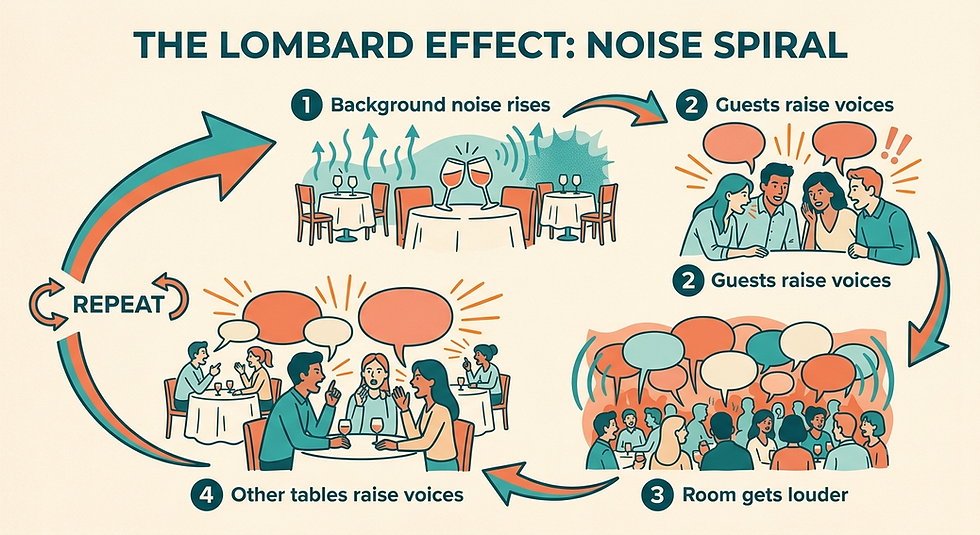
The Lombard Effect: Your Restaurant's Built-In Noise Multiplier
The Lombard Effect is the primary reason a half-full restaurant can sound just as overwhelming as a packed one when the acoustics are untreated.
Here is exactly how the spiral unfolds in your dining room:
1. Background noise rises as the first tables fill up.
2. Guests unconsciously raise their voices to be heard - this is an involuntary reflex, not a deliberate choice.
3. Their louder voices raise the ambient noise of the room further.
4. Tables that arrive next hear a louder room and raise their voices even higher in response.
5. The room spirals louder with each wave of seated guests, even though no single person is being deliberately loud.
6. Within 30 minutes of a full house, the room can climb from 65 dB to 85+ dB - the equivalent of standing next to a running lawnmower.
What the research says:
· Research published in the Journal of the Acoustical Society of America (Bottalico, 2018) found that diners begin to notice disturbance at around 52 dB and start raising their voice at approximately 57 dB of ambient noise.
· The same research found that willingness to spend time and money in a restaurant decreased measurably as noise levels climbed above 52 dB.
· Acoustic research published in Acta Acustica (2023) confirmed the Lombard Effect in every restaurant environment studied, with noise increasing by more than 3 dB for every doubling of occupancy in spaces without adequate acoustic absorption.
· A 2024 study by Underwood and Wang found that noise-related complaints from diners increase significantly around 70 dB.
At 85 dB, your guests are not consciously processing the danger, but their nervous systems are - and they associate the experience with stress and fatigue, not enjoyment or satisfaction.
RT60: The Single Number That Defines Your Problem

RT60 is the time in seconds it takes for sound to decay by 60 decibels after its source stops. Put simply: it is how long sound lingers in your room after it is made.
Here is what different RT60 values mean for a Texas restaurant dining room:
RT60 Value | What It Means for Your Dining Room |
Under 0.7 seconds | Comfortable conversation; Lombard spiral significantly suppressed |
0.7–1.0 seconds | Acceptable for most dining environments |
1.0–2.0 seconds | Lombard Effect worsens; sounds stack before earlier sounds finish decaying |
2.0–4.0 seconds | Typical untreated Texas restaurant with hard surfaces and high ceilings |
Research published in the Acoustic Bulletin (2025) found that spaces with RT60 below 0.7 seconds allow tables to be placed significantly closer together without triggering guests to raise their voices. Good acoustic treatment is not just comfort - it is what makes a dense, profitable floor plan possible.
Sound Absorption vs. Sound Isolation - Know Which Problem You Have
This distinction prevents one of the most expensive mistakes Texas restaurant owners make: buying the wrong product entirely.
Sound absorption:
· Reduces echo and reverberation inside your dining room.
· Acoustic panels, ceiling baffles, and soft furnishings convert sound wave energy into heat rather than reflecting it back.
· This is what the vast majority of Texas restaurants need.
Sound isolation:
· Stops noise from crossing a physical barrier.
· Prevents kitchen noise from bleeding through a shared wall into the dining room.
· Prevents your restaurant from disturbing the business next door.
· Requires mass (dense walls, heavy doors) and structural decoupling (air gaps, resilient mounts).
Most Texas restaurant noise problems are absorption problems, not isolation problems. For restaurant owners dealing with noise crossing walls - such as an open kitchen separated only by a partition from the dining area - acoustic doors and wall isolation solutions address the structural boundary problem that panels alone cannot solve. Starting with this distinction prevents the common and costly mistake of installing heavy soundproofing materials when acoustic panels were all the space needed.
Run This Free 15-Minute Noise Audit Before You Spend Anything

The biggest mistake Texas restaurant owners make when addressing noise is buying products before identifying where the problem actually lives. These four steps take 15 minutes, cost absolutely nothing, and will tell you how serious your problem is, where it is worst, and what treatment has the highest probability of fixing it.
Step 1: Download the Free Decibel Meter App
Download the NIOSH Sound Level Meter app - free for both iOS and Android, published by the National Institute for Occupational Safety and Health. This is the same tool used by OSHA-certified safety inspectors.
Measure in these four locations during your busiest service:
· Center of the main dining room floor
· Directly in front of the bar
· Near the kitchen pass or expo window
· At the entrance or host stand
What your readings mean:
Decibel Reading | Status | Action Needed |
Below 65 dB | Comfortable conversation zone | Maintain; minor soft furnishing additions may help |
65–70 dB | Approaching complaint threshold | Start with Tier 1 free fixes immediately |
70–77 dB | Guests must raise their voices | Tier 1 + Tier 2 panel treatment recommended |
77–85 dB | Active guest discomfort; reviews affected | Tier 2 treatment urgent; consult professional |
Above 85 dB | OSHA occupational noise hazard for staff | Professional assessment needed immediately |
Write down every reading. You will use these numbers after treatment to measure your improvement and document results.
Step 2: Perform the Clap Test
With the restaurant completely empty, follow these steps:
1. Stand in the center of the dining room floor.
2. Clap once, sharply, with both hands.
3. Listen carefully to how long the echo takes to completely die away.
What your clap tells you:
· Under 0.8 seconds: Minimal reverberation. Soft furnishing changes may be sufficient.
· 1.0–1.5 seconds: Moderate RT60. Mid-range ceiling and wall panel treatment recommended.
· 2 seconds or more: Significant reverberation. Professional assessment is worth considering, particularly for ceilings above 14 feet.
This test is a legitimate field method used by acoustic consultants as a rapid first-pass assessment before deploying calibrated equipment. Your ears are more reliable than most people assume.
Step 3: Map Your Noise Hot Spots
Grab a pen and sketch a rough floor plan of your dining room. Then mark each of these locations:
· Open kitchen or pass-through window
· Bar area (bar top and well)
· High-traffic server corridors
· Any two hard walls that directly face each other - these create flutter echo, rapid back-and-forth bouncing that stacks on itself
· HVAC vent locations and the direction they push air
· Any glass-heavy wall elevations
Where your hot spots cluster most densely, that is where your treatment budget does the most measurable work. Acoustic treatment is strategic, not uniform - it is about placing materials at the points of highest sound energy concentration, not covering every surface equally.

Step 4: Mine Your Reviews for Acoustic Intelligence
This is the step almost no Texas restaurant owner takes - and it is where you will find the most honest picture of your acoustic situation without leaving your office.
Go to your Google Business profile and your Yelp page. Search the text of your reviews for these exact phrases:
· "couldn't hear"
· "hard to have a conversation"
· "too loud"
· "had to shout"
· "couldn't hear our server"
· "great food but"
· "won't be back"
· "noisy"
· "very loud"
· "so loud"
Pay special attention to the phrase "great food but." Research from Performance Acoustics found that phrases like "great food but we won't be back" are noise complaints expressed without using the word noise. Restaurant owners who search only for the word "noise" often find few results and conclude they have no problem - while the actual acoustic complaint footprint in their reviews is substantially larger.
Three or more of these patterns in your last six months of reviews means you have a documented acoustic problem actively pulling down your star rating, your discovery on Google Maps, and your new customer conversion rate.
The Complete Restaurant Noise Acoustic Fix for Texas - Organized by Budget

Tier 1: Free and Low-Cost Fixes (Under $500)
Start here before purchasing a single acoustic product.
These changes cost nothing or very little. They can all be completed this week without any contractor or installation crew. Most importantly, they address the noise spiral at its point of initiation rather than trying to contain it after it has already built up.
Fix 1: Reposition Your Tables and Furniture
Look at your current floor plan with fresh eyes and identify these specific problem configurations:
· Tables positioned between two directly facing hard walls - this creates flutter echo, the rapid back-and-forth bouncing that gives a room a harsh, metallic noise quality.
· Long rows of hard-seat chairs running parallel to a bare wall - every chair is a sound reflector at ear level.
· Open space between the kitchen pass and the nearest table - sound from the kitchen travels this gap unobstructed.
What to move and where:
1. Offset any tables sitting in direct line between two parallel hard walls - even a 3-foot diagonal shift disrupts the reflection angle meaningfully.
2. Move high-backed chairs and any booth units toward the center of open areas - dense upholstered furniture at ear level absorbs and scatters sound, reducing how far voices carry across the room.
3. Relocate large, dense indoor plants - fiddle-leaf figs, bird of paradise, large pothos - to echo-prone corners near the bar or kitchen pass. Dense foliage is a legitimate low-cost acoustic diffuser used intentionally by acoustic designers in commercial hospitality environments.
4. Add felt or rubber pads to all chair and table legs - the continuous scraping of furniture on concrete or tile floors contributes meaningfully to the physical noise floor throughout every service.
Fix 2: Add Soft Furnishings Strategically
Soft furnishings are the fastest free change you can make. Every soft surface added to a hard-surfaced room is converting a reflective surface into an absorptive one.
Priority soft furnishing additions, in order of impact:
1. Tablecloths or fabric runners on every table - a fork dropped on bare hardwood produces a sharp, room-piercing crack; the same fork on a tablecloth makes a muffled thud that barely carries past the table edge. Multiply this difference across 40 tables over three hours of service and the cumulative acoustic impact is significant.
2. Heavy area rugs at the entrance zone - this is where foot traffic noise (heels on tile, chairs scraping, door closing) most often initiates the noise spiral at the start of service.
3. Area rug directly behind the bar - the bar generates the highest density of hard-surface noise events: glasses on countertops, ice in metal shakers, bar stools on tile.
4. Padded chair alternatives at tables nearest the kitchen pass - these are the tables most likely to raise their voices first, triggering the Lombard spiral for the rest of the room.
5. Heavy fabric panels or acoustic curtains on any glass-heavy wall elevations - glass carries an NRC of approximately 0.03, making it one of the most reflective surfaces in a restaurant.
Fix 3: Recalibrate Your Background Music
This is the highest-impact free change most Texas restaurants can make - and the one most consistently done by instinct rather than measurement.
The problem with how most restaurants run music:
· Music set above 65 dB means guests arrive and immediately hear the music competing with ambient noise.
· This triggers the Lombard Effect before the dining room is even 30% full.
· Your room starts climbing before it has a chance to settle.
How to fix it - in order:
1. Measure your background music level using the free NIOSH app at the center of the dining room before service starts. Do not guess. Many operators assume their music is at 60 dB when it is actually running at 72–75 dB.
2. Cap music at 60–65 dB maximum. This is the range where music is clearly present and contributing to atmosphere without functioning as a noise source itself.
3. Switch to a distributed low-volume speaker system if you are currently running two or four centralized high-volume speakers. More speakers at lower individual volume produces equivalent perceived music presence throughout the room while reducing per-speaker contribution to overall room excitation.
4. Reduce bass-heavy playlists in rooms with hard surfaces and open ceilings. Low-frequency bass lines excite room resonance - a deep bass note in a concrete-floored room with 16-foot ceilings bounces off every reflective surface, compounding the room volume without anyone choosing to be loud.
5. Lower volume by 5 dB increments during the first 30 minutes of service - before the room fills up. Guests arriving to a quieter room speak at lower baseline volumes, and the Lombard spiral starts from a much lower floor.
Expected result from all Tier 1 changes combined: 5–15 dB reduction in peak noise. The difference is noticeable from the first service. No contractor required. No capital expenditure needed.
Tier 2: Mid-Range Acoustic Treatment ($500–$5,000)
This is where the real acoustic transformation happens.
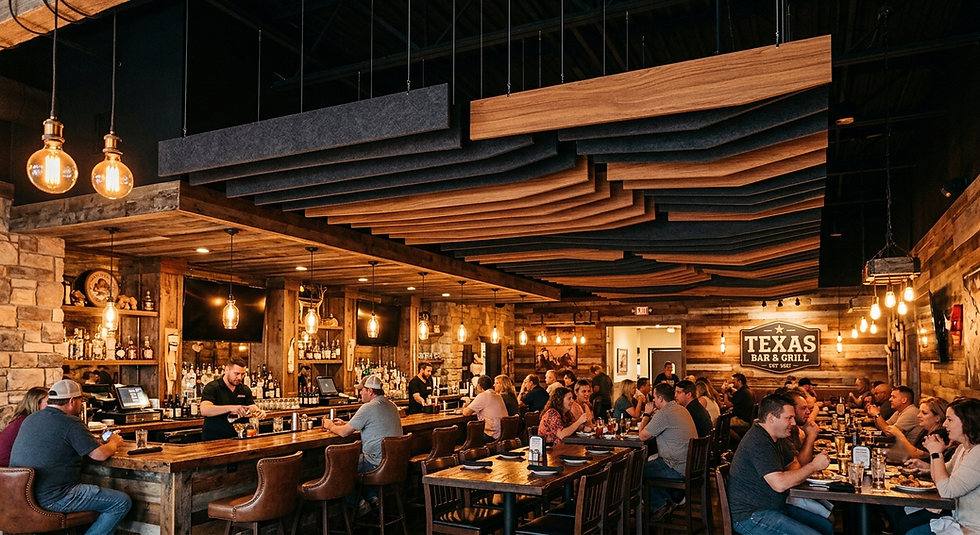
The products in this tier are designed specifically for hospitality environments. When correctly specified and placed, they deliver the 30–50% reverberation reduction referenced throughout published acoustic research on restaurant noise control. Most Texas restaurant owners who complete Tier 2 treatment describe the change as immediately noticeable - both in how the room sounds during service and in how much less effort guests are making to hold a conversation.
Fix 4: Acoustic Ceiling Baffles and Clouds
The ceiling is the most important surface to treat in any Texas restaurant - and the most consistently overlooked.
Why the ceiling matters more than walls:
· It is the largest single uninterrupted hard surface in most dining rooms.
· It is directly in the path of sound waves traveling upward from every conversation simultaneously.
· It is typically untouched by any décor, soft furnishings, or layout considerations.
· It delivers the highest acoustic return per square foot of any surface in the room.
For a detailed breakdown of ceiling panel types, NRC specifications, and placement strategies specific to restaurant environments, the acoustic ceiling panels for restaurants guide covers material selection, Texas design integration, and installation considerations in depth.
The NRC specification you must get right:
Always require NRC 0.85 or higher from your supplier. NRC is the standardized measure of how much sound a material absorbs across the speech frequency range (250 Hz to 2000 Hz).
Material | NRC Rating | Sound Reflected Back |
Polished concrete | 0.01–0.02 | 98–99% |
Standard drywall | 0.05 | 95% |
Low-grade foam panels | 0.40 | 60% |
Quality acoustic baffles | 0.85–1.0 | 0–15% |
A panel rated NRC 0.85 provides nearly twice the acoustic work per square foot compared to a panel rated NRC 0.45. When budget limits your panel count, specifying higher-NRC products is more cost-effective than buying more lower-performing ones.
Research indicates that treating just 15–25% of a room's ceiling area with NRC 0.85+ material produces a clearly audible improvement. You do not need to cover every square foot.
Ceiling treatment placement - in priority order:
1. Directly above the bar area - typically the single loudest zone in any Texas restaurant
2. Above the kitchen pass or expo window - captures noise at its highest-intensity source
3. Above the densest seating section - suppresses the Lombard spiral where it builds fastest
4. Above any open corridor between the kitchen and the dining room
Texas design-matching ceiling treatment options:
· Timber slatted acoustic baffles - natural wood finish in ash, oak, or walnut; trending strongly in Austin and Dallas restaurant design; reads as architectural detail, not acoustic product
· Perforated black or dark-gray metal clouds - suited to industrial, brewery, and warehouse-conversion concepts in Fort Worth and East Austin
· Fabric-wrapped ceiling clouds in brand colors - used in modern upscale and fine-casual concepts in Houston and San Antonio; can be shaped to define dining zones visually while solving the acoustic problem
· Natural fiber suspended panels - used in Texas Hill Country, farm-to-table, and organic-aesthetic concepts; pairs naturally with reclaimed wood and stone palettes
Fix 5: Acoustic Wall Panel Treatments

Wall panels address the second-biggest source of reverberation after the ceiling. In a room with parallel hard walls - which describes most long, narrow Texas dining rooms - sound bounces between the two opposing surfaces in a rapid flutter echo that adds a harsh, grainy character to the room's overall noise quality.
Where to target wall panel placement:
· The wall directly opposite your loudest noise source (usually the wall facing the open kitchen or the bar back wall)
· Both walls flanking the bar area
· End walls in any dining room with a long, narrow footprint
· Any surface where guests sit within six feet and can audibly hear their own voice echoing back
The single most important installation rule:
Always treat opposing parallel walls simultaneously.
Installing panels on one wall and leaving the directly facing wall bare means flutter echo continues bouncing between them. The treatment on the first wall is partially wasted because the untreated wall reflects sound back at full strength. This is the most common wall panel installation error in Texas restaurant acoustic retrofits.
Wall panel types that work in Texas restaurant environments:
· Fabric-wrapped acoustic panels - fiberglass or mineral wool core wrapped in acoustically transparent fabric; NRC 0.85–1.0; available in any color, size, or custom shape; full-color custom printing of logos, murals, and brand photography is available on the panel face
· Slatted timber acoustic panels - narrow wood strips over an absorptive backing material; NRC 0.60–0.80 depending on backing depth; currently one of the most popular hospitality interior finishes in Texas; reads as intentional contemporary design
· Upholstered headboard-style panels - mounted at seated height behind booth seating; particularly effective in longer dining rooms with banquette configurations running the length of one wall
For a broader comparison of acoustic panel materials, fire ratings, and commercial performance specifications, the best acoustic panels for soundproofing guide covers the full product landscape with application-specific recommendations.
Fix 6: Booth and Banquette Upgrades
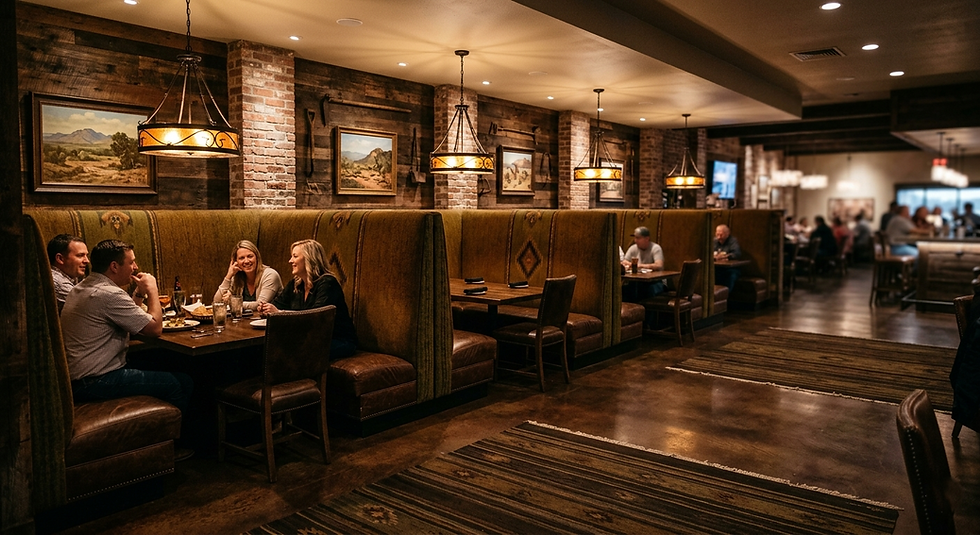
High-backed upholstered banquettes are the most undervalued dual-purpose investment available to a Texas restaurant operator. They accomplish three things at once:
1. Increase seating density - high-back booths allow tables to be placed closer together without guests feeling crowded, improving revenue per square foot.
2. Improve visual warmth - they transform a hard, industrial room into a space that feels inviting and intimate.
3. Create acoustic pockets - semi-enclosed zones where sound is trapped and absorbed within the booth rather than radiating outward across the full dining room.
Each booth you add to an open-plan hard-surface dining room is effectively a small acoustic zone carved out of a larger reflective space. For Texas restaurants that want to maintain a lively, high-energy atmosphere without the noise reaching genuinely uncomfortable levels, strategic booth placement is a way to create acoustic contrast without softening the overall concept.
For restaurant owners who also want to create flexible private dining zones within a larger dining room, operable partition systems offer the ability to divide a noisy open-plan space into separate acoustic environments that can be opened or closed depending on the booking configuration.
Expected result from Tier 2 combined:
· RT60 reduction from a typical 2–4 seconds to approximately 0.8–1.2 seconds
· Peak ambient noise drops 10–20 dB
· Documented case studies show Yelp ratings improving from 3.8 to 4.5 stars within two months of treatment
· Average customer dwell time increasing by approximately 20%
Tier 3: Professional Acoustic Treatment ($5,000 and Up)
When the problem is beyond panels and furniture repositioning.
Not every Texas restaurant needs a professional acoustic consultant. But some spaces genuinely do - and knowing the difference between a DIY problem and an engineered one saves you from investing in treatment that produces partial results in a room that requires a more comprehensive solution.
When to Bring In a Professional
Consider a professional acoustic assessment if any of the following apply:
· Your NIOSH app readings stay above 80 dB during service even after completing Tier 1 changes
· Your dining room ceiling is above 14–15 feet
· Your venue holds a combined live music and full-service dining license
· You have received a formal noise complaint or city citation
· A renovation is planned and you want acoustics addressed at the design stage rather than retrofitted after finishes are installed
· Your dining room has an unusual architectural configuration - curved walls, large skylight panels, a mezzanine level, or a combined indoor-outdoor section
What a Professional Acoustic Consultation Includes
A qualified acoustic consultant working in a Texas restaurant context will deliver the following:
1. On-site RT60 measurement using calibrated professional equipment, establishing an exact before-treatment baseline
2. Zone-by-zone surface analysis identifying where noise energy is highest and which materials will most efficiently reduce it in your specific room geometry
3. Coordination with your interior designer to ensure acoustic treatment integrates with your brand aesthetic rather than competing with it
4. Structural ceiling treatment coordination for Texas commercial buildings with steel decks, concrete slabs, or existing mechanical infrastructure
5. Texas commercial building permit navigation - structural ceiling modifications in most Texas municipalities require permit review; a professional contractor manages this as part of the project scope
6. Pre/post dB measurement verification providing documented proof of before-and-after performance - valuable both for your own records and for city compliance if you are responding to a noise citation
Finding the Right Acoustic Contractor in Texas
When evaluating acoustic contractors for a Texas restaurant project, always request a hospitality-specific project portfolio. The acoustic requirements of a restaurant dining room are meaningfully different from those of an office building, a church, or a home recording studio - and contractors without hospitality experience frequently make specification errors that produce mediocre results at professional prices.
Questions to ask any acoustic contractor before signing:
· Can you show me completed restaurant projects similar in size and concept to mine?
· What NRC ratings will you specify for ceiling and wall treatment?
· Do you provide pre- and post-installation RT60 measurement with documented results?
· Are all your materials Class A fire-rated per Texas commercial building code?
· How do you schedule installation to minimize disruption to restaurant operating hours?
DeWalls Acoustic Specialties is headquartered in McKinney, TX, with more than 50 years of combined team experience in acoustic specialty contracting. They serve restaurant and commercial environments across the Dallas–Fort Worth Metroplex, Houston, Austin, and San Antonio - with Class A fire-rated materials, warranty-backed installation, and documented pre/post measurement results on every project.
For Texas restaurant owners evaluating acoustic contractors, DeWalls brings specific hospitality experience that generalist soundproofing contractors typically lack - understanding both the NRC specifications a dining room needs and the design-integration requirements a Texas restaurant concept demands.
The DeWalls team also provides the noise control and vibration assessment services relevant when HVAC noise, kitchen equipment vibration, or external traffic noise is contributing to the problem alongside the room's interior acoustic profile - a common scenario in Texas urban restaurant locations where multiple noise sources operate simultaneously.
Texas Restaurant Noise Ordinances - What Every Owner Must Know
Restaurant noise issues operate on two separate levels, and understanding the difference between them protects you both commercially and legally.
· Internal dining room noise - the volume inside your four walls - affects your reviews and revenue but carries no legal threshold in Texas.
· External noise - sound that crosses your building's boundary and reaches neighboring properties or public space - is where Texas ordinance law becomes relevant.
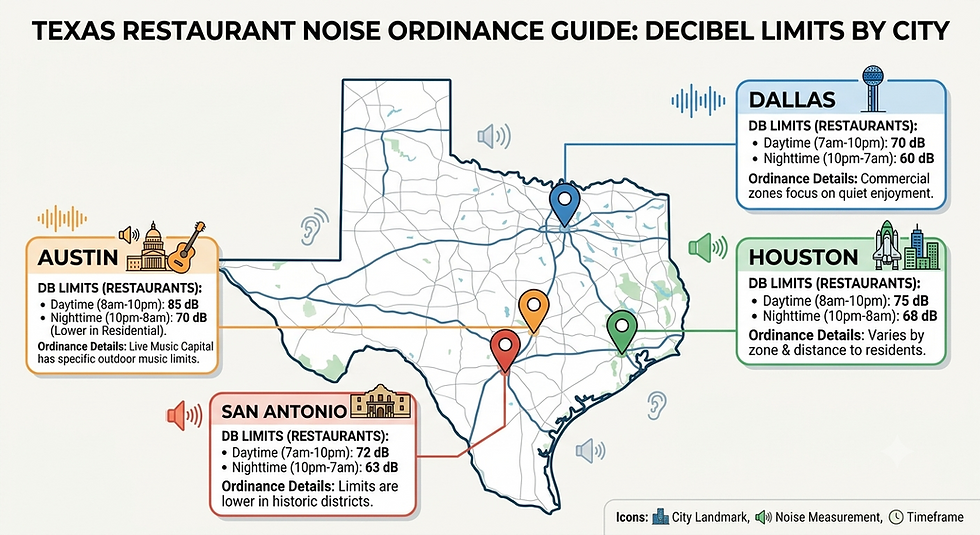
Texas Has No Statewide Restaurant Noise Law
Key facts every Texas restaurant owner should know:
· Texas has no statewide restaurant noise statute.
· Noise is regulated entirely at the city and county level.
· Texas counties have no authority to enact noise ordinances - enforcement outside city limits relies on the state Disorderly Conduct statute.
· The state-level threshold under Texas Penal Code § 42.01 sets 85 dB as the presumed-unreasonable level after a warning, classified as a Class C misdemeanor with fines up to $500.
City-by-City Rules for Texas Restaurant Owners
Austin:
· Governed by Title 9, Chapter 9-2 of the Austin Code of Ordinances.
· Bars and restaurants cannot emit sound exceeding 70 dBA at the property line.
· A permit is required for all commercial establishments using sound equipment outdoors in any space not fully enclosed by four walls and a roof.
· Rapid mixed-use development near South Congress, East Sixth Street, and the Domain has placed more restaurants adjacent to residential units - making property-line compliance increasingly significant.
Houston:
· Residential property-line sound is limited to 58 dBA during nighttime hours (10 p.m. to 8 a.m.).
· Fines reach up to $1,000 per offense per hour of violation - among the steepest enforcement structures in Texas.
· Restaurants near Midtown, Montrose, and Heights residential streets face meaningful exposure to fine escalation.
Dallas:
· Violations can result in fines up to $2,000 per day, with each day counted as a separate offense.
· Complaints can be filed through the city's 311 app, making enforcement response faster and more accessible for neighbors.
San Antonio:
· Violations are classified as Class C misdemeanors with fines ranging from $100 to $2,000 depending on intent and prior history.
· Restaurants in historic and tourism zones - including the River Walk area - face additional oversight from district-specific code enforcement officers.
What Triggers Enforcement vs. What Does Not
What is NOT subject to Texas restaurant noise ordinances:
· The ambient noise level inside your dining room walls
· Guest conversation volume during normal service
· Kitchen equipment noise contained within the building
What IS subject to ordinance enforcement:
· Outdoor patio speakers or amplified music on a terrace
· Open roll-up garage-style doors or windows during service
· Rooftop music or events
· Live music audible from neighboring residential properties
· HVAC discharge noise reaching neighboring property lines
If you have already received a formal citation:
Document your acoustic treatment immediately. Professional acoustic assessment combined with installed, measurable improvement - supported by pre/post RT60 data - has been accepted by Texas cities including Austin and Dallas as evidence of good-faith remediation in first-offense cases.
Acoustic Treatment Does Not Have to Look Like Acoustic Treatment
The most common objection Texas restaurant owners raise when this topic comes up is some version of: "I don't want my restaurant to look like a corporate call center."
It is a fair concern based on what acoustic products looked like 20 years ago. Today, it is not a valid concern at all.
Modern hospitality acoustic products are designed for exactly the environments where they are most needed. The best ones are indistinguishable from intentional interior design decisions - because in many cases, they are.

Matching Treatment to Your Texas Restaurant Concept
Industrial and Brewery Concepts (Austin, Dallas, Fort Worth):
· Perforated black or charcoal metal ceiling baffles read as intentional structure, not treatment
· Exposed-edge acoustic clouds in dark powder-coated finishes align with the raw industrial palette
· Slatted timber wall panels in dark-stained oak or walnut complement the material language without softening the concept's edge
Texas Hill Country and Rustic Farm-to-Table Concepts:
· Natural wood slatted acoustic panels in ash, maple, or unstained pine - warm and organic
· Burlap or natural linen-wrapped acoustic panels read as deliberate textile choices
· Reclaimed wood-faced acoustic panels for spaces where weathered texture is central to the brand
Modern Upscale and Fine-Casual (Houston, Dallas Uptown, San Antonio Pearl District):
· Seamless fabric-wrapped panels specified in brand-palette colors appear as clean, designed wall surfaces
· Shaped ceiling clouds with curved edges and irregular spacing read as architectural features defining zones within the dining room
· Acoustic treatment becomes the design feature that visually separates the bar zone from the main dining area
Sports Bar and Casual Concepts:
· Acoustic panels mounted directly behind televisions - serve double duty as noise treatment and visual framing for screens
· Padded booth backs below and adjacent to TV walls
· Carpet tiles under bar stools and high-top seating areas address constant floor-level noise throughout service
Tex-Mex and High-Vibrancy Concepts:
· Custom-printed acoustic panels carrying brand murals, logo graphics, or regional photography - full-color print on acoustically transparent fabric; acoustic performance is identical to a solid-color panel; the treatment becomes a branding asset
The Design Integration Rule That Saves You the Most Money
The single biggest cost mistake Texas restaurants make with acoustic treatment is retrofitting it after interior design is already finalized. This forces compromise in placement that reduces acoustic effectiveness - and often produces a look that feels added-on rather than designed.
If any renovation is planned, follow these three steps:
1. Brief your interior designer on acoustic requirements before any material is specified - slatted timber panels instead of solid wood cladding, acoustic ceiling tile instead of standard drywall cloud features, upholstered wall elements instead of hard-surface artwork installations.
2. Specify Class A fire-rated acoustic products at the design stage - this is a Texas commercial building code requirement that is far easier to meet upfront than to retrofit.
3. Include acoustic performance targets (RT60 below 1.0 second at full occupancy) in the design brief alongside aesthetic targets - this gives your designer and contractor a measurable outcome to build toward.
The cost of building acoustics into a renovation from the beginning is almost always lower than retrofitting equivalent performance after the fact.
The Business Case: Why Restaurant Acoustic Treatment Pays for Itself
Acoustic treatment is often categorized as a comfort upgrade - something you do to make guests feel better, which sounds important but is hard to put a number on. The business case is more concrete than most owners expect, and it runs through three independently measurable channels.

Channel 1: Reviews and Online Discovery
· Research on restaurant noise and sales confirmed that for every 1 dB increase in noise level, restaurant revenue decreased by approximately 1% - measured through actual sales data, not surveys.
· A noise-related three-star Google review reaches hundreds of potential diners before you even see it - and it carries particular weight because it describes a repeatable experience that cannot be fixed with a comped appetizer.
· One documented case study describes a restaurant with 85 dB ambient noise and persistent noise-related Yelp complaints. After installing custom acoustic wall panels for $2,400, ambient noise dropped to 72 dB. The Yelp rating improved from 3.8 to 4.5 stars within two months. The owner reported an estimated $3,500 per month in additional revenue. The acoustic treatment paid for itself in under one month.
Channel 2: Dwell Time and Per-Cover Spending
· Research found that patrons in quieter restaurant environments lingered longer and spent substantially more - including 40% more on alcohol - compared to patrons in louder versions of the same space.
· Guests who can hear their companions have every reason to order another round, split a dessert, or stay through coffee. Guests who are uncomfortable leave as soon as the meal is finished.
· In a restaurant generating $50,000 per month in revenue, a conservative 5% increase in per-cover spending from improved dwell time adds $2,500 per month.
Channel 3: Staff Performance and Retention
· OSHA's Occupational Noise Exposure Standard (29 CFR 1910.95) requires employers to implement a hearing conservation program when workers are exposed to sustained noise at 85 dB or above.
· Research from Performance Acoustics found that staff working in high-noise dining rooms experience elevated cognitive load throughout their shifts:
· Verbal orders are heard less accurately, leading to kitchen errors and remakes
· Front-of-house to back-of-house communication at the pass becomes effortful and unreliable
· Staff fatigue accelerates, reducing service quality in the final service hours
· In Texas, where restaurant staff turnover rates run well above the national average and replacing a trained server or line cook costs $1,500–$5,000 per position, reducing noise-related turnover by even two or three positions annually produces thousands of dollars in retained investment.
The Numbers in One Place
Treatment Tier | Approximate Cost | Noise Reduction | Estimated Revenue Impact |
Tier 1 - Free layout and furnishing changes | $0–$500 | 5–15 dB | Immediate; reduced complaint rate from first service |
Tier 2 - Ceiling baffles and wall panels | $500–$5,000 | 10–20 dB / 30–50% RT60 reduction | Positive within 1–2 operating months |
Tier 3 - Professional full treatment | $5,000–$20,000+ | Full RT60 correction to target range | Positive within 2–4 operating quarters |
Your Complete Texas Restaurant Acoustic Fix Checklist
Use this checklist as a working reference before, during, and after your acoustic treatment project. Print it, share it with your manager, or hand it to your contractor as a starting framework.

Before You Spend Anything
Download the NIOSH SLM app (free, iOS and Android) and measure peak dB at the bar, dining center, kitchen pass, and entrance during a busy Friday or Saturday service
Perform the clap test in an empty dining room and note the length of the echo tail
Search your last six months of Google and Yelp reviews for noise-related language patterns (list provided in Section 4)
Sketch a rough floor plan and mark your noise hot spots - kitchen pass, bar, parallel walls, HVAC vents
Free and Low-Cost (Do This Week)
Reposition tables to break direct parallel sight lines between hard opposing walls
Add tablecloths or fabric runners to all tables
Place heavy area rugs at the entrance and directly behind the bar
Cap background music at 60–65 dB maximum - measure it with the free app, do not guess
Add felt or rubber pads to all chair and table legs
Replace hard-seat chairs nearest the kitchen pass with padded or upholstered alternatives
Relocate large, dense indoor plants to echo-prone corners
Add heavy fabric curtains or panels to any glass-heavy wall elevations
Mid-Range Treatment ($500–$5,000)
Install acoustic ceiling baffles or clouds above the bar and kitchen pass first - specify NRC 0.85 or higher
Apply wall panels to your loudest wall and its directly opposing wall simultaneously
Upgrade open dining sections to high-backed upholstered banquettes where the layout allows
Request NRC certification documentation from your supplier before purchasing any acoustic panel product
Add acoustic curtains or heavy fabric elements to remaining glass-heavy wall areas
Professional Treatment ($5,000+)
Book an on-site RT60 measurement with a qualified Texas acoustic contractor
Request a hospitality-specific project portfolio before signing any contractor agreement
Brief acoustic requirements at the start of any renovation - not after finishes are specified
Retain all invoices, consultation reports, and pre/post RT60 measurement results for city compliance documentation
Confirm all specified materials are Class A fire-rated per Texas commercial building code
Frequently Asked Questions
How do I fix the noise in my restaurant?
Start with three free changes that work immediately:
1. Add tablecloths to every table to dampen cutlery noise.
2. Place heavy rugs at the entrance and behind the bar.
3. Cap background music at 65 dB using the free NIOSH app.
For lasting results, install acoustic ceiling baffles rated NRC 0.85+ above your bar and kitchen pass. This single treatment reduces reverberation by 30–50% and brings most Texas dining rooms into the comfortable 65–70 dB conversation range within one to two days of installation.
What is an acceptable noise level for a restaurant?
The industry target is 65–70 dB - the range where guests can converse at a normal voice level without effort. Research published in 2024 found that noise complaints increase noticeably around 70 dB. At 77 dB, guests must actively raise their voices. At 85 dB, your staff faces OSHA occupational noise exposure thresholds and your dining room is as loud as standing next to a running lawnmower. Measure free with the NIOSH Sound Level Meter app during peak service.
What is the main cause of echo in a restaurant?
The combination of polished concrete floors, exposed brick or stone walls, open industrial ceilings, and hard furniture creates a room where nearly every surface reflects rather than absorbs sound. These materials carry NRC values of 0.01–0.05, meaning 95–99% of sound energy bounces back into the room on every reflection. In Texas restaurants with this surface profile, reverberation time (RT60) typically reaches 2–4 seconds - four times the 0.6–1.0 second target for dining comfort.
Do acoustic panels really work in restaurants?
Yes - when correctly specified and placed, they absolutely work. The critical specification is NRC 0.85 or higher. Low-grade foam panels typically achieve NRC 0.40, which is why some DIY acoustic attempts produce disappointing results. Research confirms that treating just 15–25% of ceiling area with NRC 0.85+ material produces a clearly audible improvement. Treating both a loud wall and its directly facing parallel wall simultaneously eliminates the flutter echo that single-wall treatment alone cannot resolve.
How much does restaurant soundproofing cost in Texas?
Costs range from under $500 for layout and furnishing changes up to $20,000 or more for full professional treatment in large-volume spaces. Most Texas restaurants achieve meaningful, guest-noticeable improvement with mid-range panel and baffle treatment in the $1,500–$5,000 range. A 500 sq ft dining room treated with quality NRC 1.0 ceiling tiles costs approximately $2,100 in materials. Professional consultation fees in Texas typically run $500–$2,000 for assessment and specification.
Are there specific noise laws for Texas restaurants?
Texas has no statewide restaurant noise law - ordinances are city-level. Key limits by city:
· Austin: 70 dBA at property line; outdoor amplified sound requires a permit
· Houston: 58 dBA at residential property lines at night; fines up to $1,000 per offense per hour
· Dallas: Fines up to $2,000 per day per violation
· San Antonio: Class C misdemeanor; fines $100–$2,000
These ordinances apply to noise crossing your building's boundary, not internal dining room volume.
Is loud restaurant noise an OSHA violation?
It can be. OSHA's 29 CFR 1910.95 requires employers to implement a formal hearing conservation program when workers are exposed to sustained noise at 85 dB or above averaged over an eight-hour shift. Restaurant bar environments and open kitchen dining rooms frequently reach or exceed this threshold during peak service. Acoustic treatment that brings peak noise below 80 dB during service directly reduces occupational hearing exposure for your staff.
How long does acoustic panel installation take in a restaurant?
· Tier 1 (free changes): A few hours; completed before or after service.
· Tier 2 (ceiling baffles and wall panels): Typically one to two days depending on ceiling height and total coverage area. Most Texas contractors schedule installation during morning prep time or on a closed day.
· Tier 3 (full professional treatment): Three to five days for larger spaces.
There is no curing or drying time involved - the acoustic improvement is audible immediately after installation is complete.
Your Restaurant Should Be Remembered for the Food - Not the Volume
A noisy Texas restaurant is not proof that your dining room is lively or your concept is working. It is proof that your room has the wrong surface materials in the wrong configuration - and that problem has a structured, budget-appropriate, well-documented solution.
Texas restaurants face a more acute version of this problem than most markets because of the design culture, the climate, and the social energy that defines how Texans dine. But every element of that challenge is addressable. Polished concrete, open ceilings, exposed brick, running HVAC, and live kitchens are all manageable with the right acoustic strategy applied in the right order.
The path forward:
1. Run the 15-minute free audit tonight.
2. Make the four free changes before your next service.
3. Invest in ceiling baffles and wall panels when budget allows.
4. Bring in a professional for spaces that need an engineered solution.
The return - in Google ratings, in repeat visits, in dwell time, in staff retention, and in the simple fact that your guests can actually hear each other - is real, measurable, and documented across hundreds of Texas restaurant projects.
For Texas restaurant owners ready to take the next step, DeWalls Acoustic Specialties serves the Dallas–Fort Worth Metroplex, Houston, Austin, and San Antonio with professional acoustic treatment designed specifically for restaurant and commercial environments. With more than 50 years of combined team experience, Class A fire-rated materials, warranty-backed installation, and documented pre/post measurement results, their team brings both the acoustic engineering knowledge and the hospitality design experience Texas restaurant operators need. Contact the DeWalls team with your ceiling height, approximate square footage, and NIOSH app readings - that is all it takes to start building a treatment plan for your specific space.


Comments