


Acoustic Treatment Solutions: Why Every Room Needs Its Own Plan


Short answer: The same acoustic panels will not fix every room, because rooms differ in size, surfaces, layout, and how people use them. The right acoustic treatment solution matches the room. That means the right product, in the right amount, in the right spots.
Two rooms can be the same size and sound nothing alike. In one, you hear everything clearly. In the other, you lean in, repeat yourself, and talk louder. The cause is how sound bounces around inside the space.
Poor room acoustics make it hard to follow a sermon, talk over dinner, run a meeting, or trust a recording. This guide covers why one fix does not fit every room, what different spaces need, and how to pick a contractor.
In This Article
Why one-size-fits-all acoustic treatment fails
What different spaces need
Common treatment options
Acoustic treatment vs. soundproofing
What a professional assessment covers
How to choose an acoustic treatment contractor
FAQs
Why One-Size-Fits-All Acoustic Treatment Fails
Acoustic treatment changes how sound behaves inside a room. Mostly, it absorbs the reflections that cause echo and reverberation (the sound that lingers after someone stops talking). How much a room needs depends on:
Room size and ceiling height: bigger, taller rooms let sound linger longer.
Surfaces: glass, concrete, drywall, and hard floors reflect sound. Soft and porous materials absorb it.
Layout and furniture: shelves, seating, and fixtures absorb and scatter sound.
Number of people: people absorb sound too. A full room sounds different from an empty one.
Use: a room for speech needs different acoustics than a room for music or recording.
How the room sounds now: the current echo shows what is missing.
Example: two conference rooms
Take two conference rooms of the same size. The first has a high hard ceiling, glass walls, and a bare floor. The second has a lower acoustic ceiling, carpet, and fabric-covered walls. The first will likely sound harsh and echoey. The second may already sound fine. The same panels would help the first room a lot and the second one very little.
Panels in the wrong spot, or in the wrong amount, can leave the main problem in place. Too much absorption can also make a room sound dead. A custom plan avoids both.
What Different Spaces Need
The basics are the same everywhere. The priorities change by space. Here is a quick view, with details below.
Space | Main problem | What usually helps |
Churches | Speech is hard to understand in a tall, hard room | Wall panels, ceiling clouds |
Restaurants | Noise builds up at peak hours | Ceiling and wall treatment |
Offices | Echo in meeting rooms, talk carrying in open plans | Wall panels, ceiling treatment |
Recording studios | Reflections and low-frequency buildup | Panels, bass traps, ceiling treatment |
Home theaters | Unclear dialogue, uneven bass | Treatment planned around seating and speakers |
Schools and auditoriums | Students and audiences cannot hear clearly | Reverberation control based on room use |
Churches and worship spaces
Worship spaces are often large and tall, with hard surfaces like plaster, wood, stone, and tile. Sound lingers, so speech gets muddy. Music, on the other hand, often benefits from some reverb. The goal is to balance both.
Acoustic panels for churches and ceiling clouds can bring reverb down. How much to absorb depends on how the space is used. A sanctuary with a tall ceiling may need treatment high on the walls or overhead. A fellowship hall with a lower ceiling may do better with wall treatment.
Restaurants and hospitality
In a busy restaurant, conversations compete with music, kitchen noise, and every other table. Glass, tile, and exposed ceilings let sound build up. People talk louder to be heard, and the room gets louder.
Restaurant acoustic treatment usually focuses on ceilings and walls, and it can match the look the owner wants. Booths, open kitchens, bars, and patios each move sound differently, so the bar may need a different plan than the dining room.
Offices and corporate spaces
In open offices, conversations and calls carry. In meeting rooms, echo makes people harder to understand, in person and on video calls. Office acoustic solutions often combine wall panels, ceiling treatment, and a smart layout.
Treatment works inside a room. Privacy between rooms is a separate issue that depends on walls, doors, and ceilings.
Podcast and recording studios
Unwanted reflections change how a voice or instrument sounds, and recordings come out inconsistent. Studios usually combine acoustic panels, bass traps for low-frequency buildup, and ceiling treatment, placed around the mic and talent. A small voice-over room and a larger live room need different plans.
Home theaters and media rooms
Clear dialogue depends on controlling reflections. Many rooms also have uneven bass, strong in some seats and weak in others. Seating position, speaker layout, screen size, and room shape all affect where treatment helps most. See our media room solutions.
Schools, auditoriums, and performance spaces
In classrooms and lecture halls, the goal is speech clarity from every seat. In auditoriums, the goal is balanced reverb that supports the performance and keeps speech clear. A classroom, a gym, and a cafeteria in the same school are three different problems.
Common Acoustic Treatment Options
Option | What it does | Best for |
Fabric-wrapped acoustic panels | Absorb reflections on walls and improve speech clarity | Offices, churches, studios, theaters |
Ceiling clouds | Hang over a space to absorb sound from large ceilings | Open rooms with hard ceilings |
Baffles | Hang vertically and expose more surface to the sound | Tall or open ceilings |
Bass traps | Control low-frequency buildup, usually in corners | Studios, home theaters |
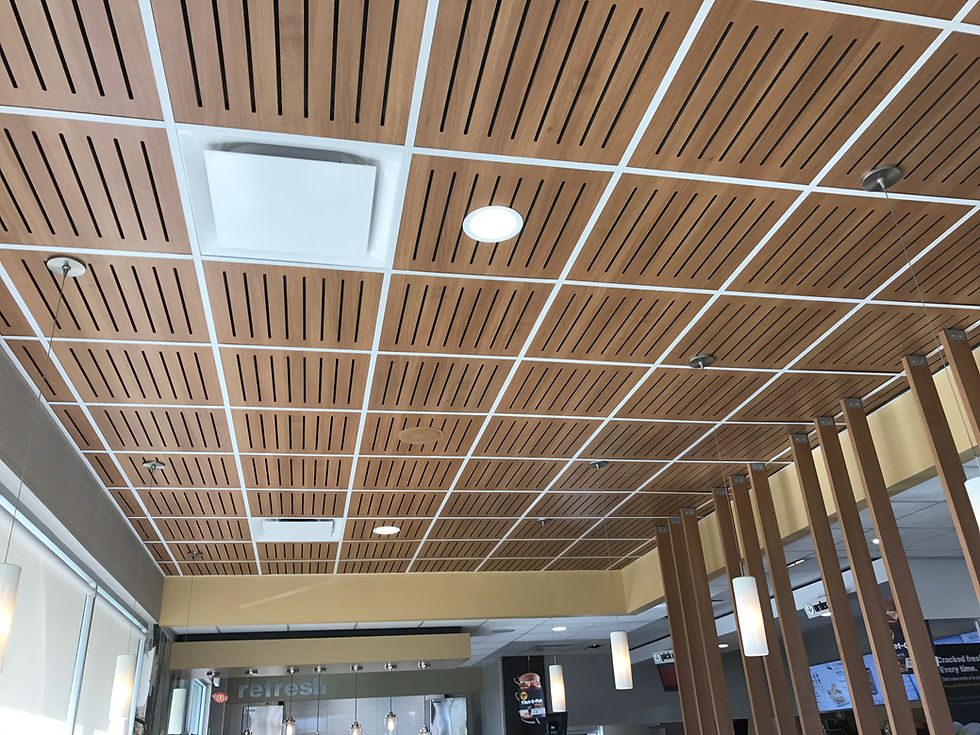
Other systems | Felt, slat, and decorative wall treatments, ceiling tiles | Spaces where the look matters |
Material, placement, thickness, coverage, and mounting method all depend on the room. Placement matters as much as the product:
Panels work best where they catch reflections.
Ceilings are often the largest reflective surface in a room.
Bass traps work in corners, where low frequencies collect.
Too little coverage leaves the problem. Too much leaves the room sounding lifeless.
Acoustic Treatment vs. Soundproofing
These are two different jobs.
Acoustic treatment improves how sound behaves inside a room. It fixes echo and unclear speech.
Soundproofing limits how much sound passes between rooms or from outside. It needs a different approach, such as added mass, sealed gaps, and separated structures.
Acoustic panels do not stop noise from passing through a wall. If your problem is noise coming through a wall or from outside, see our soundproofing services. Some rooms need both.
What a Professional Acoustic Assessment Covers
A good assessment starts with listening: what are you trying to fix, and what bothers you now? Then a specialist typically will:
Learn your goals and the problems you notice.
Check the room's size and current conditions.
Find the problem reflections and reverb.
Choose the right materials and treatment methods.
Plan where each treatment goes.
Balance sound performance, looks, and function.
Not every project needs the same depth. A small room may need a site visit and good judgment. A large worship space or performance venue may call for a deeper look, such as acoustic simulation or measurements. Photos, plans, and a short talk about how the room is used answer many questions. For new builds and renovations, bring in an acoustic specialist early so the treatment fits the design.
How to Choose an Acoustic Treatment Contractor
When you compare an acoustic treatment contractor, look for:
Experience with different types of spaces, not just one.
Custom plans, not the same product every time.
Knowledge of materials and installation, since mounting and placement affect results.
Ability to work with architects, designers, and general contractors.
Care for both sound performance and how the space looks.
A contractor who asks how the room is used, and can explain why a recommendation fits your space, is a better sign than one who leads with a product.
DeWalls Acoustic Specialties is based in McKinney, TX and works with businesses, architects, designers, and contractors. We start with the problem, not a product. See our acoustic treatment and panel installation services.
Get Help With Your Room
Tell us how the room is used and what bothers you. We will help you work out what it needs. Contact DeWalls Acoustic Specialties at 888-539-7217 or info@de-walls.com to talk through your project.
FAQs
What is acoustic treatment?
Acoustic treatment improves how sound behaves inside a room, mainly by absorbing reflections that cause echo and reverb. It uses products like acoustic panels, ceiling clouds, baffles, and bass traps.
Why can't the same acoustic treatment go in every room?
Every room has different dimensions, surfaces, layout, occupancy, and use. The amount, type, and placement that work in one room may not work in another.
Does acoustic treatment soundproof a room?
No. Acoustic treatment improves the sound inside a room. It does not stop sound from entering or leaving. That is a soundproofing, or sound isolation, job.
How many acoustic panels does a room need?
There is no set number. It depends on the room's size, surfaces, use, and the result you want. Covering every wall is not always right.
Do I need a professional acoustic assessment?
Not always. A small room may need little more than a site visit. Larger or more demanding spaces, like worship spaces, auditoriums, and studios, often benefit from a deeper look.


Comments