


Industrial Acoustic Consultant Texas: When You Need One & Why


Industrial noise does not announce itself as a crisis. It creeps in slowly, one shift at a time, until a plant manager is staring at an OSHA citation, a stack of workers' compensation claims, or a stack of angry letters from a new residential development that just moved in next door. By the time most Texas facility owners search for an industrial acoustic consultant Texas teams can rely on, the noise problem has already cost them money, time, or goodwill.
This guide exists to change that timeline.
Whether you run a manufacturing plant in Houston, a compressor station in the Permian Basin, a distribution warehouse in the Dallas-Fort Worth corridor, or a processing facility near San Antonio, understanding exactly when to bring in an industrial acoustic consultant can save your business from regulatory penalties, worker health claims, and community disputes that are far more expensive than the consultation itself.
Below, we break down what an industrial acoustic consultant actually does, why Texas facilities face a particular set of noise challenges, the specific trigger points that signal it is time to call one, and what the consulting process looks like from first phone call to final sign-off.
What Does an Industrial Acoustic Consultant in Texas Actually Do?
An industrial acoustic consultant is a specialist who measures, analyzes, and designs solutions for noise and vibration problems inside and around industrial environments. This is different from a general contractor who installs insulation or drywall. An acoustic consultant works from data first, and construction or material recommendations come second.
Think of the relationship this way:
A soundproofing contractor answers the question, "How do I install this material correctly."
An acoustic consultant answers the question, "What is actually causing this noise, how loud is it in decibels, and what combination of engineering controls will bring it into compliance or comfort."
Core Responsibilities of an Industrial Acoustic Consultant
Most industrial acoustic engagements in Texas include some combination of the following:
On-site noise surveys using calibrated sound level meters and dosimeters to measure actual decibel readings at various points across a facility.
Source identification, meaning pinpointing exactly which machines, ductwork, compressors, or processes are generating the problem noise, rather than treating the whole building as one undifferentiated issue.
Regulatory gap analysis, comparing current noise exposure levels against OSHA permissible exposure limits, EPA guidance, and local Texas municipal noise ordinances.
Vibration assessment, since industrial noise problems frequently travel through structure-borne paths, not just airborne ones.
Engineering recommendations, ranked by cost, disruption to operations, and expected decibel reduction.
Post-installation verification testing, confirming that whatever noise control measures were installed actually achieved the predicted results.
Tools and Methods Used
A credible consultant does not rely on guesswork. Expect the process to involve:
Class 1 or Class 2 sound level meters calibrated to ANSI standards.
Octave band frequency analysis, since low-frequency machinery hum and high-frequency compressor whine require completely different treatment approaches.
Personal noise dosimeters worn by workers over a full shift to capture real exposure data, not a single snapshot reading.
Vibration accelerometers for structure-borne noise diagnostics.
Acoustic modeling software to predict how sound will propagate before a single dollar is spent on materials.
Why Texas Industrial Facilities Face Unique Noise Challenges
Texas is not a uniform noise environment. The state's industrial footprint, rapid population growth, and patchwork of local ordinances create a set of pressures that facility operators in other states simply do not deal with in the same combination.
Explosive Residential Growth Around Industrial Corridors
Texas cities are growing faster than almost anywhere else in the country, and new residential subdivisions are frequently built within earshot of existing industrial zones. A compressor station that operated quietly for a decade because its nearest neighbor was a mile of open ranchland can suddenly find itself fielding noise complaints once a new housing development goes up along the property line.
This dynamic is especially visible around:
The Houston Ship Channel and surrounding petrochemical corridor.
The Permian Basin, including Midland-Odessa, where oilfield compressor and processing noise increasingly borders new residential construction.
Dallas-Fort Worth's outer suburbs, where warehousing and light manufacturing sit closer to master-planned communities every year.
A Patchwork of Municipal Noise Ordinances
Unlike states with a single statewide noise code, Texas cities set their own rules. This creates real compliance risk for facilities operating in more than one location:
Decibel limits vary from city to city, and sometimes by zoning district within the same city.
Permitted hours for high-noise activity differ, so a task that is fine at 2 p.m. in one location may be restricted after 10 p.m. in another.
Enforcement mechanisms range from a warning letter to a formal citation, depending on the municipality.
A facility operating identical equipment across multiple Texas cities can be fully compliant in one and in violation in another.
OSHA Enforcement and Hearing Conservation Requirements
Federal OSHA noise exposure standards apply uniformly, but how facilities respond to them varies widely across the state:
Enforcement intensity and inspection frequency differ by region and industry.
Self-reporting expectations depend heavily on how proactive a facility's safety program already is.
Many Texas manufacturers and processing plants still rely on hearing protection alone as their primary noise control strategy.
OSHA's hierarchy of controls actually places engineering controls above personal protective equipment, meaning hearing protection should be the last line of defense, not the first.
Climate-Driven Structural Factors
Texas heat and humidity affect acoustic material performance in ways that consultants in cooler climates rarely have to plan around:
Gulf Coast humidity requires moisture-resistant materials that resist mold and material breakdown.
West Texas heat and UV exposure call for materials that will not degrade or become brittle in direct sun.
Coastal salt air in South Texas can corrode standard hardware, requiring marine-grade fasteners.
An experienced consultant accounts for these regional factors from the start, rather than discovering material failure two years into a project.

Facilities weighing engineering controls against ordinance and OSHA requirements often start with a broader look at available noise control solutions before narrowing down to a specific plan.
Signs Your Facility Needs an Industrial Acoustic Consultant in Texas
Some noise problems are obvious. Others build quietly until they become a legal or financial emergency. Watch for these signals:
Workers are raising their voices or using hand signals to communicate across normal working distances.
Employees report ringing in their ears (tinnitus) after a shift, even occasionally.
You have received one or more noise complaints from neighbors, a municipality, or a regulatory body.
Your facility is planning to install new machinery, compressors, or processing equipment.
A recent OSHA inspection flagged noise exposure concerns, even informally.
You are expanding or relocating near a residential area.
Hearing protection compliance among staff is inconsistent, or workers report discomfort wearing it for full shifts.
Your facility's insurance provider has raised questions about occupational noise exposure documentation.
You are preparing for a merger, acquisition, or sale, and noise-related liability needs to be assessed as part of due diligence.
Vibration from equipment is noticeable in adjacent offices, control rooms, or nearby structures.
If two or more of these apply to your facility right now, a consultation is worth scheduling before the issue escalates further. A short noise assessment and analysis is usually enough to tell you whether the problem is minor or something that needs a more structured plan.
The Real Cost of Ignoring Industrial Noise Problems in Texas
Facility operators sometimes treat noise as a background annoyance rather than a genuine business risk. The numbers tell a different story.
Hearing Loss and Long-Term Health Liability
Occupational hearing loss is one of the most common and most preventable workplace injuries in the country. Here is why it carries so much long-term risk:
Once documented, it becomes a permanent medical record tied to your facility.
It can surface in workers' compensation claims years after an employee's exposure occurred.
Unlike an acute injury, hearing loss develops cumulatively, so a facility can be accumulating liability for years before anyone notices a problem.
Claims tied to undocumented exposure are far harder to defend than claims where a facility can show a proactive noise management history.
OSHA Fines and Regulatory Exposure
Noise-related citations are not limited to a single fine. A facility found out of compliance can face:
Direct financial penalties tied to the violation.
Increased inspection frequency going forward.
Mandatory corrective action timelines that can disrupt production schedules.
Reputational damage if the citation becomes part of a public enforcement record.
Productivity and Turnover Costs
Chronic noise exposure does more than damage hearing. It changes how people work and how long they stay:
Elevated stress hormones and fatigue build up over repeated loud shifts.
Error rates climb in consistently loud environments, since verbal communication and concentration both suffer.
Workers in loud facilities report higher turnover intent than those in comparable, quieter roles.
Replacing skilled industrial labor in a tight Texas labor market is expensive and slow, making retention a real financial argument for noise control.
Community and Legal Risk
Noise complaints that go unresolved rarely stay small. Left unaddressed, they tend to escalate in a fairly predictable pattern:
An informal complaint to the facility, often ignored or handled inconsistently.
A formal complaint filed with the city or county.
A nuisance claim or zoning dispute, particularly in growing residential corridors.
Restrictions on operating hours or conditions attached to future expansion permits.
For facilities near growing residential areas, a poor community relationship over noise can complicate future expansion permits or public hearings long after the original complaint is forgotten.
Most of this is avoidable. A facility that addresses a rising noise concern early, before a formal complaint or citation, generally spends far less than one that waits and ends up managing the problem under regulatory or legal pressure.

When You Need an Industrial Acoustic Consultant in Texas: Key Trigger Scenarios
This is the heart of the question most facility managers are actually asking. Below are the specific situations where bringing in an industrial acoustic consultant stops being optional and starts being the responsible move.
1. New Construction, Expansion, or Equipment Installation
Acoustic problems are dramatically cheaper to solve on paper than after concrete is poured. If your facility is:
Building a new production line.
Expanding square footage.
Adding compressors, generators, or HVAC equipment.
...bringing a consultant in during the design phase allows noise control to be built into the structure itself, rather than retrofitted afterward at a much higher cost.
2. An OSHA Citation or Internal Audit Flag
If OSHA has cited your facility, or if an internal safety audit flagged noise exposure as a concern, a documented third-party acoustic assessment helps in several ways:
It demonstrates good-faith corrective action to inspectors and insurers.
It gives you a defensible, measured baseline if a claim is filed later.
It identifies whether the root cause is a single machine or a broader facility-wide pattern.
3. Community or Municipal Noise Complaints
Once a formal complaint is filed with a city or county, the clock is running. A professional consultation produces the kind of measured, documented data that can be presented as evidence of a good-faith response:
To a municipality or code enforcement office reviewing the complaint.
To a zoning board considering future permits or restrictions.
Directly to a concerned neighbor, which can defuse the situation before it escalates further.
4. Equipment Upgrades or Process Changes
New machinery rarely operates at the same noise profile as what it replaced. A few common triggers to watch for:
Installing a higher-capacity compressor, pump, or generator than the unit it replaces.
Adding a new production line or shift that changes total daily noise exposure.
Swapping HVAC or refrigeration equipment without checking its decibel rating in advance.
Even a routine equipment swap can shift a facility from compliant to non-compliant without anyone realizing it until the next inspection.
5. Mergers, Acquisitions, or Facility Repurposing
Acoustic liability is an underappreciated line item in industrial due diligence. Buyers and sellers alike benefit from knowing, in advance:
Whether the facility has any history of noise complaints or citations.
Whether current noise levels comply with OSHA and local ordinance requirements.
What it would cost to bring an out-of-compliance facility up to standard.
Buyers acquiring a facility with undocumented or unresolved noise exposure issues are inheriting a liability, whether or not it shows up on the balance sheet.
6. Vibration Complaints From Adjacent Spaces
If control rooms, offices, laboratories, or nearby tenant spaces are experiencing noticeable structural vibration, this typically indicates a mechanical isolation problem that general contracting alone cannot solve. This requires the kind of vibration isolation assessment covered under comprehensive noise control and vibration solutions designed specifically for industrial and commercial Texas facilities. If the affected space is an on-site office or control room rather than the production floor itself, the treatment approach shifts toward the methods used in office soundproofing projects, since occupied workspaces have different comfort and speech-privacy requirements than a production floor.
7. Preparing for a Public Hearing or Permit Application
Facilities seeking permits for expansion near residential zones are increasingly asked to submit acoustic impact documentation as part of the approval process. Having this in place ahead of time helps in a few concrete ways:
It puts you ahead of the process instead of reacting to it during a public hearing.
It gives planning boards a measured basis for approval rather than relying on estimates or neighbor opinion alone.
It shortens the back-and-forth that often delays permit approval timelines.
What to Expect From an Industrial Acoustic Consultant in Texas
Knowing the process in advance removes a lot of the anxiety around bringing in an outside expert. Here is what a well-run engagement typically looks like, from first call to final report.
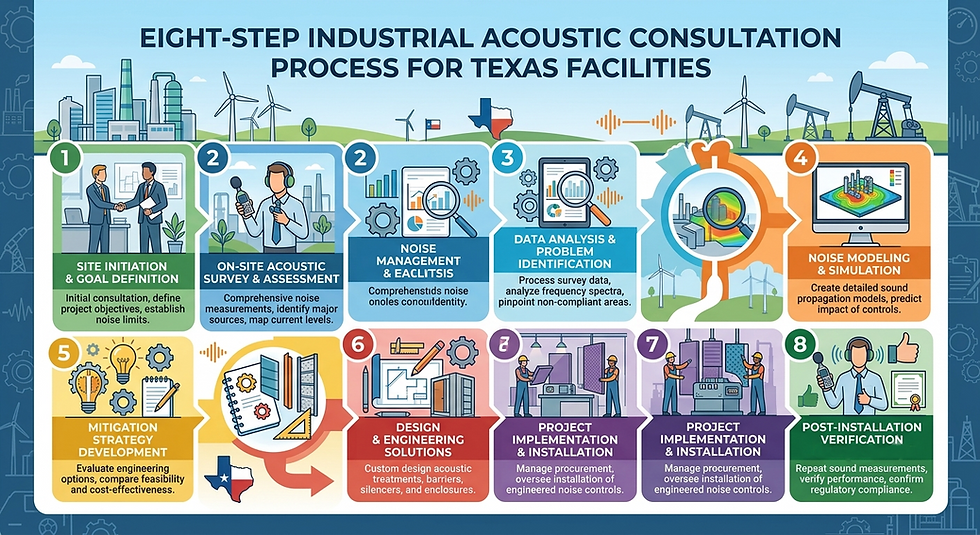
Initial consultation and scoping call. You describe the problem, the facility type, and the urgency. A reputable consultant asks pointed questions before quoting anything, rather than offering a one-size-fits-all package.
On-site or virtual assessment. A technician visits the facility (or in some limited cases conducts a remote review using submitted data) to gather baseline measurements across the affected areas.
Data collection. Sound level readings, frequency analysis, and, where relevant, vibration data are collected across multiple points and, ideally, multiple shifts or operating conditions.
Source analysis. The consultant identifies which specific pieces of equipment, structural elements, or processes are the primary contributors, rather than treating the noise as one undifferentiated problem.
Regulatory comparison. Measured data is compared against OSHA permissible exposure limits, applicable EPA guidance, and any local Texas noise ordinances that apply to your specific location.
Recommendations report. You receive a written summary explaining the current acoustic environment, the regulatory gaps if any exist, and a prioritized list of engineering controls ranked by cost and expected decibel reduction.
Implementation planning. If you move forward, the consultant (or a partnered installation team) develops a phased plan, since many facilities cannot afford to address every issue simultaneously.
Post-installation verification. After materials or engineering controls are installed, follow-up measurements confirm that the predicted noise reduction was actually achieved.
A consultation that skips steps four through six and jumps straight to selling you panels is not really a consultation. It is a sales call wearing a consultant's badge.
Industrial Acoustic Consultant vs. General Contractor: Key Differences
Facility managers frequently conflate these two roles, and the confusion costs money.
Factor | Industrial Acoustic Consultant | General Soundproofing Contractor |
Starting point | Measured data and source diagnosis | Assumed problem based on description |
Deliverable | Written analysis and ranked recommendations | Material installation |
Regulatory comparison | Included as standard practice | Rarely included |
Verification testing | Standard practice | Often skipped |
Best used for | Complex, high-liability, or regulated environments | Straightforward, well-understood noise problems |
In practice, the strongest outcomes come from working with a partner who can offer both functions, moving from diagnosis to installation to verification under one continuous process rather than handing the project off between two disconnected vendors.
How to Choose the Right Industrial Acoustic Consultant in Texas
Not every acoustic contractor is equipped to handle industrial-scale environments. Manufacturing plants, processing facilities, and compressor stations involve a different level of complexity than a home theater or a restaurant dining room. When evaluating a potential consultant, consider the following.
Look for Documented Industrial Experience
Ask directly:
Have you worked with facilities similar to mine, in terms of scale and equipment type?
Can you provide examples of OSHA-related noise reduction projects?
Do you understand the specific ordinance structure in my city or county?
Confirm They Use Calibrated Measurement Equipment
Any consultant offering opinions without measured decibel data is guessing. Before hiring, ask:
What specific equipment do you use for sound and vibration measurement?
When was it last calibrated, and to what standard?
Will the calibration certificate be referenced in the final report?
Evaluate Whether They Are Advisors or Salespeople
A trustworthy consultant will sometimes recommend less, not more. Watch for these signals:
They suggest a smaller, phased intervention when that genuinely fits the budget and problem.
They explain trade-offs honestly, including where a cheaper option is a reasonable choice.
Every conversation does not end with a recommendation for the most expensive package available.
Ask About Post-Installation Verification
If a consultant cannot describe how they confirm results after installation, you have no way of knowing whether the recommended solution actually worked. Look for:
A defined follow-up testing process after materials or engineering controls are installed.
A written comparison of before-and-after decibel readings.
A willingness to adjust the plan if the predicted reduction was not achieved.
Consider Regional Familiarity
Texas is enormous, and acoustic solutions that work in humid Houston are not automatically appropriate for arid West Texas or the freeze-thaw cycles of the Panhandle. Ask a prospective consultant:
Have you worked on projects in my specific region of Texas?
How do you account for local climate when selecting materials?
Do you understand the noise ordinance structure in my city or county?
A consultant with statewide Texas experience understands these regional material and climate considerations, and typically walks clients through the full acoustic treatment process before recommending a single product.

Common Industrial Noise Control Solutions Recommended by an Acoustic Consultant in Texas
Every facility is different, but most industrial acoustic recommendations draw from a consistent toolkit. Understanding these options in advance helps facility managers have a more productive first conversation.
Acoustic enclosures. Mineral wool-core enclosures built around compressors, pumps, or generators contain noise at the source, which is almost always more effective and less expensive than treating an entire room.
Vibration isolation mounts. Rubber, spring, or air-based isolation mounts prevent mechanical vibration from transferring into the building structure, addressing structure-borne noise that surface treatments alone cannot fix.
Acoustic barriers and walls. Solid mass barriers, often built from concrete, engineered panels, or layered materials, block noise transmission between operational zones and neighboring properties.
Mass-loaded vinyl (MLV) and specialized wall assemblies. These materials add density to existing walls, reducing sound transmission without requiring a full structural rebuild.
Silencers and inlet/outlet treatments. For ductwork, exhaust systems, and rooftop equipment, silencers reduce noise at the point where air or gas moves through the system.
Sealing and gap treatment. Even a well-designed acoustic barrier fails if sound leaks through unsealed gaps, doors, or penetrations, which is why sealing is treated as a standard final step rather than an afterthought.
A full breakdown of material options and expected lifespans, including how Texas humidity and UV exposure affect material selection, is available in this guide on acoustic panels for soundproofing.
For facilities dealing specifically with machinery, compressors, or processing noise, industrial and commercial noise control services typically combine several of these approaches into a single phased plan rather than relying on one material alone. Facilities with unusual layouts, tight equipment clearances, or aesthetic requirements in shared or public-facing spaces sometimes need a more tailored approach, which is where custom acoustic solutions built around the exact dimensions of the space tend to outperform off-the-shelf materials.
Industries That Most Often Need Industrial Acoustic Consulting in Texas
Not every industrial noise problem looks the same, and the right consultant adjusts their approach based on the type of facility involved. Below are the sectors that most frequently reach out for professional acoustic support, along with the noise challenges specific to each.
Oil and Gas Operations
Compressor stations, gas processing plants, and drilling operations generate some of the most intense and persistent industrial noise in the state. Common challenges include:
Continuous compressor noise that runs around the clock, unlike facilities with defined shift patterns.
Wide-open terrain in West Texas that allows sound to travel farther than it would in denser urban environments.
Encroaching residential development near legacy oilfield infrastructure that was originally sited far from any neighbors.
Worker exposure concerns for field personnel who spend extended periods near high-decibel equipment.
Manufacturing and Fabrication Plants
Stamping presses, CNC machinery, welding operations, and material handling equipment create a mix of continuous and impulsive noise. Manufacturing facilities often need:
Source-specific enclosures around the loudest individual machines rather than a blanket facility-wide treatment.
Hearing conservation program audits, since manufacturing environments are among the most heavily scrutinized by OSHA for noise compliance.
Vibration isolation for heavy presses or stamping equipment that transmits noise through the building's foundation.
Food and Beverage Processing
Processing lines, packaging equipment, and refrigeration systems generate consistent mid-to-high frequency noise, often in facilities that also require strict sanitation standards, which limits which acoustic materials can even be considered.
Washable, non-porous acoustic materials are typically required to meet food safety standards.
Refrigeration compressors and blast freezer equipment are frequent sources of both noise and vibration complaints.
Facilities located near residential areas often face additional pressure around early morning or overnight shift noise.
Warehousing, Distribution, and Logistics
Loading dock activity, forklift traffic, HVAC systems, and truck idling all contribute to a facility's noise footprint, and these facilities are increasingly built close to mixed-use developments across the Dallas-Fort Worth and Houston metro areas.
Loading dock noise is one of the single most common triggers for neighbor complaints in suburban logistics parks.
Rooftop HVAC and refrigeration units require targeted vibration isolation and inlet or outlet silencers.
Facilities operating 24-hour schedules face particular scrutiny for nighttime noise levels near residential zones.
Power Generation and Utility Facilities
Generators, turbines, and substations produce continuous low-frequency noise that travels efficiently over long distances and is notoriously difficult to mask with simple barriers.
Low-frequency noise typically requires mass-loaded materials and structural decoupling rather than standard acoustic foam, which performs poorly at low frequencies.
Community noise ordinance compliance is often a central concern for facilities near populated areas.
Backup generator testing schedules frequently trigger the highest volume of noise complaints, since testing often occurs at unpredictable times.
Common Myths About Hiring an Industrial Acoustic Consultant in Texas
Facility managers often delay calling a consultant because of a handful of persistent misconceptions. It is worth addressing these directly:
"We already installed acoustic panels, so we are covered." Acoustic panels reduce reverberation and echo inside a space. They do very little to stop sound from leaving the building or reaching a property line, which is a completely different problem requiring mass, isolation, and sealing rather than absorption alone.
"Hearing protection is enough to satisfy OSHA." Personal protective equipment sits at the bottom of OSHA's hierarchy of controls. Facilities relying solely on hearing protection, without evidence that engineering and administrative controls were considered, are in a weaker compliance position than they may realize.
"Our facility has always been loud, so nothing has really changed." What changes is not always the facility. Growing residential development, updated equipment, or shifting shift patterns can all move a previously acceptable noise level into problematic territory without any change to the machinery itself.
"A quick site visit and a verbal opinion is basically the same as a full assessment." Verbal impressions are not measured data. Without calibrated readings and documented analysis, there is no defensible record to present to OSHA, a municipality, or an insurer if a dispute arises later.
"This is going to shut down our operations for weeks." Most acoustic assessments are designed to be minimally disruptive, and many engineering controls can be installed in phases around a facility's existing production schedule rather than requiring a full shutdown.
A general soundproofing overview is a useful starting point for facility managers who want to understand the difference between absorption, isolation, and sealing before their first consultation call.
An Industrial Acoustic Consultant in Texas at Work: A Practical Example
Consider a mid-sized processing facility operating near a growing suburb outside Dallas. For years, the facility ran without incident, its nearest neighbor a stretch of undeveloped land. Within a two-year window, a new residential subdivision was built along the eastern property line.
Here is how the situation unfolded, step by step:
A new residential subdivision was built along the facility's eastern property line.
The city received a handful of noise complaints tied to a compressor unit that ran nearly continuously.
The facility's initial instinct was to add a simple sound barrier fence, a common but often insufficient first response.
A proper acoustic consultation revealed the real source: low-frequency vibration traveling through the concrete pad and into the ground, re-emerging as audible noise at the property line nearly 200 feet away.
A surface barrier alone would have done almost nothing to solve this, because the noise was not traveling primarily through the air.
The actual fix combined:
Vibration isolation mounts installed beneath the compressor unit.
A partial acoustic enclosure around the unit itself.
Targeted sealing of nearby structural gaps that were allowing secondary airborne leakage.
Post-installation verification testing showed a substantial reduction at the property line, and the noise complaints stopped. The lesson here is straightforward. Guessing at the noise source without measurement often leads facilities to spend money on the wrong solution entirely.

Regulatory Landscape: OSHA, EPA, and Texas Noise Ordinances
Understanding the regulatory environment is part of what separates a genuine industrial acoustic consultant from a general contractor offering an opinion.
OSHA Noise Exposure Standards
Federal OSHA regulations set a permissible exposure limit and require hearing conservation programs once average exposure crosses defined thresholds over an eight-hour shift. Key points facility managers should understand:
Exposure limits are time-weighted, meaning both loudness and duration matter, not loudness alone.
OSHA's hierarchy of controls places engineering solutions and administrative controls above personal protective equipment as the preferred method of compliance.
Documentation matters. A facility that can demonstrate a proactive, measured approach to noise management is in a stronger position during any inspection or claim than one relying solely on informal practices.
EPA and Environmental Noise Guidance
While EPA noise regulation at the federal level has evolved over the decades, its influence is still felt locally:
Many historical EPA guidance documents still inform how municipalities set their own local noise standards.
Community noise impact is a recurring theme in these guidelines, particularly for facilities near residential zones.
Local ordinances often borrow language and decibel benchmarks originally drawn from this federal guidance.
Local Texas Municipal Ordinances
This is where things get genuinely complicated for multi-location operators. Texas cities set their own:
Maximum permitted decibel levels, often varying by time of day.
Permitted hours for high-noise industrial activity.
Enforcement mechanisms, ranging from fines to operational restrictions.
A facility operating identical equipment in Houston, Dallas, and Midland could be fully compliant in one jurisdiction while technically in violation in another. This is precisely why a consultant familiar with regional Texas ordinance patterns brings more value than a generic national noise control provider unfamiliar with local specifics.
Industrial Acoustic Consultant Texas Cost: What Drives the Price
Facility managers preparing a budget request understandably want to know what factors move the price up or down before they ever get on a call with a provider. While exact numbers depend on the specific project, the following factors consistently influence cost.
Facility Size and Number of Noise Sources
Pricing generally scales with the scope of the problem rather than square footage alone:
A single compressor unit assessment costs far less than a full-facility survey.
A 200,000 square foot manufacturing plant with dozens of individual machines requires more measurement points and more analysis time.
Consultants typically scope pricing around the number of distinct noise sources identified during the initial call.
Depth of Analysis Required
Not every project needs the same level of detail:
A basic decibel survey costs less than a full engagement.
Octave band frequency analysis, multi-shift dosimetry, and vibration testing add depth and cost.
Facilities facing an active OSHA concern or a formal complaint generally need the deeper level of analysis to produce defensible documentation.
Number of Locations
Multi-site operators often see efficiencies when they consolidate:
A more efficient per-facility rate is common when several locations are assessed under one engagement.
Travel, reporting templates, and regulatory research can be shared across sites.
A single point of contact across all locations simplifies scheduling and reporting.
Implementation Scope
The consultation itself is typically a smaller line item compared to the cost of the engineering controls that follow:
The recommendations report should rank solutions by cost and expected decibel reduction.
This allows facilities to address the highest-impact, most urgent items first.
Remaining items can be phased in over subsequent budget cycles rather than tackled all at once.
Return on Investment Considerations
When evaluating whether the investment makes sense, facility managers should weigh the consultation and implementation cost against the following avoided costs:
Potential OSHA fines and the cost of mandatory corrective action under a compressed timeline.
Workers' compensation exposure tied to documented hearing loss claims.
Turnover and recruiting costs associated with an uncomfortable working environment.
Legal costs and reputational damage from unresolved community noise disputes.
Lost time and rushed decision-making that comes from addressing a noise problem reactively instead of proactively.
Viewed this way, a proactive acoustic consultation is less an added expense and more a form of risk management, similar to a safety audit or an insurance policy review.

Industrial Acoustic Consultant Texas: Regional Considerations Across the State
Texas industrial noise challenges are not uniform, and neither are the solutions.
Houston and the Gulf Coast Petrochemical Corridor
Dense industrial clustering means multiple noise sources often overlap in the same area.
High humidity affects material longevity, making moisture-resistant materials a priority.
Increasingly close residential development along historically industrial land raises the stakes on community noise management.
Moisture-resistant materials and rigorous sealing practices matter more here than almost anywhere else in the state.
Dallas-Fort Worth Metroplex
Warehousing, light manufacturing, and distribution facilities dominate this region.
Many operate close to rapidly expanding suburban and mixed-use developments.
Loading dock activity, HVAC systems, and machinery noise are the most common triggers for consultation requests in this corridor.
Permian Basin and West Texas
Compressor stations, processing facilities, and oilfield operations deal with wide-open acoustic propagation across flat terrain.
Noise travels much farther here than in denser urban environments, without natural obstruction.
Facilities in Midland-Odessa frequently need consultants who understand both OSHA compliance for field workers and community noise concerns as residential development creeps closer to established oilfield infrastructure.
San Antonio and South-Central Texas
A mix of manufacturing, food processing, and logistics facilities defines this region.
Facilities often deal with a combination of OSHA compliance needs and municipal ordinance compliance.
The metro area's rapid population growth continues to push residential development closer to established industrial zones.
Facilities anywhere in the state benefit from working with a partner offering commercial soundproofing and industrial noise control across Texas, since regional experience translates directly into fewer surprises during implementation.
Building a Long-Term Noise Management Strategy With an Industrial Acoustic Consultant
A single consultation solves a single problem. Facilities that treat acoustic management as an ongoing discipline, rather than a one-time fix, tend to avoid repeat issues.
Consider building the following into your facility's standard operating procedures:
Annual or biannual noise surveys, especially for facilities near growing residential areas.
Noise impact assessments before any new equipment purchase, not after installation.
A documented hearing conservation program that goes beyond simply distributing ear protection.
A designated point of contact for community noise concerns, so complaints are addressed quickly rather than escalating.
Vendor pre-qualification for noise output when sourcing new machinery, so acoustic performance becomes a purchasing criterion rather than an afterthought.
This kind of proactive posture is far less expensive, in both money and stress, than reacting to a citation or a lawsuit after the fact. A broader acoustic treatment program can serve as the foundation for this kind of ongoing effort, giving facility managers a documented baseline to measure future changes against.
How to Prepare for Your First Call With an Industrial Acoustic Consultant in Texas
Facility managers get more value out of an initial consultation when they arrive with a clear picture of the problem, even an informal one. Before the first call, it helps to gather:
A general description of the noise problem, including where it is loudest, when it occurs, and whether it is constant or intermittent.
Any prior complaints or citations, whether from employees, neighbors, or regulatory bodies, along with dates if available.
A rough facility layout, showing where major equipment is located relative to property lines, offices, or neighboring structures.
A list of equipment believed to be contributing to the noise, even if the exact source is not yet confirmed.
Information about any upcoming changes, such as planned equipment purchases, expansions, or new construction, since timing affects how a consultant scopes the project.
Internal stakeholders who should be involved, whether that is a safety manager, plant engineer, or operations director, so the right people are part of the scoping conversation from the start.
None of this needs to be a polished report. A consultant's job during the scoping call is to ask the right follow-up questions and translate an informal description into a structured assessment plan. Facilities that come prepared, even with rough notes, tend to move through the initial scoping process faster and get a more accurate quote earlier in the process.
Questions Worth Asking During the Scoping Call
What measurement equipment do you use, and is it currently calibrated to ANSI standards.
Will the assessment include vibration testing, or only airborne noise measurement.
How long will the on-site portion of the assessment take, and will it disrupt normal operations.
What does the final report include, and will it compare our facility against OSHA and local ordinance requirements.
Do you offer post-installation verification testing as part of the engagement, or as a separate service.
Can you provide references from similar industrial facilities in Texas.
A consultant who answers these questions clearly and specifically, rather than vaguely, is generally a strong signal of genuine industrial experience.
Frequently Asked Questions
What does an industrial acoustic consultant do?
An industrial acoustic consultant measures noise and vibration levels, identifies the exact source, and recommends engineering controls ranked by cost and effectiveness.
How much does an industrial acoustic consultant cost in Texas?
Cost depends on facility size, the number of noise sources, and whether vibration testing is included. Most consultants scope the project during an initial consultation before quoting a firm price.
Does OSHA require an acoustic consultant?
OSHA does not name a specific consultant requirement, but facilities exceeding noise exposure thresholds must run a hearing conservation program and pursue engineering controls where feasible.
What is the difference between an acoustic consultant and a soundproofing contractor?
A consultant measures and diagnoses the problem first. A contractor typically installs materials based on an assumed cause. The strongest results come from a provider who does both.
How long does an industrial noise assessment take?
Most single-facility assessments take one to a few days on-site, depending on how many noise sources and shifts need to be measured.
Can a neighbor's noise complaint really affect plant operations?
Yes. An unresolved complaint can escalate into a formal nuisance claim, a zoning dispute, or restricted operating hours, especially near growing residential areas.
What is the difference between noise and vibration in an industrial facility?
Noise travels through the air. Vibration travels through solid structures like concrete pads or building frames before re-emerging as sound elsewhere. Many facilities deal with both at once.
When is the best time to hire an industrial acoustic consultant?
Ideally before construction, expansion, or new equipment installation, since noise control is far cheaper to build in early than to retrofit later. The next best time is right after a complaint, citation, or equipment change.
Final Thoughts on Hiring an Industrial Acoustic Consultant in Texas
Industrial noise is rarely just a comfort issue. It is a regulatory issue, a health and safety issue, a community relations issue, and, ultimately, a financial one. Texas facilities operating in a state defined by rapid growth, diverse climate conditions, and a patchwork of local ordinances face a more complex acoustic environment than facilities in almost any other region.
Key takeaways to carry forward:
Noise problems are cheapest to solve early, ideally before construction or equipment installation begins.
Measured data, not assumptions, should drive every acoustic decision.
Texas facilities face a unique mix of climate, regulatory, and residential-growth pressures.
A proactive noise management strategy protects workers, community relationships, and long-term facility value.
Bringing in an experienced industrial acoustic consultant Texas teams trust is not an admission that something has gone wrong. It is a proactive step that protects workers, protects community relationships, and protects the long-term value of the facility itself. Several qualified providers operate across the state, and facility managers are well served by comparing experience, methodology, and regional familiarity before choosing a partner for a project of this scale.
The facilities that fare best over the long run are rarely the ones that wait for a citation, a lawsuit, or a wave of neighbor complaints to act. They are the ones that treat acoustic performance as a standard part of facility management, alongside safety audits, equipment maintenance schedules, and environmental compliance reviews. Whether your facility is dealing with an active problem today or simply planning ahead for future growth near a residential corridor, the earlier a measured, data-driven assessment enters the conversation, the more options remain on the table, and the less expensive those options tend to be.
For facilities ready to take that first step, a free consultation and noise assessment is typically the most efficient way to understand exactly where a facility stands and what a realistic, phased solution could look like. Facilities that want to see the full range of available approaches beforehand can also review the complete noise control and vibration solutions overview for a sense of what a phased plan might include.


Comments