


5 Signs Your Texas Commercial Space Needs Professional Soundproofing

Updated: Aug 10

If you own, lease, or manage a Texas commercial space, there's a good chance noise has already cost you something - a client, a lease renewal, a productive afternoon, or at the very least, your patience. Most business owners don't think about acoustics until a problem forces the issue.
Texas is in the middle of one of the most aggressive commercial construction booms in the country, and that growth comes with a side effect that rarely makes it onto a site plan: noise. A few reasons this shows up so often:
Houston, Dallas-Fort Worth, Austin, and San Antonio are converting warehouses into offices and subdividing big-box retail into multi-tenant suites.
Open-concept floor plans are packing more people per square foot than ever before.
Most commercial buildings were designed to be built fast and leased quickly - not for acoustic performance.
We've walked through hundreds of Texas commercial spaces over the years - medical suites in Dallas, open-plan offices in Austin, restaurants in Houston, and multi-tenant retail centers in San Antonio - and the pattern is remarkably consistent: businesses rarely book a soundproofing consultation as a proactive upgrade. They reach out because something has already gone wrong.
Why Acoustic Problems Are So Common in Texas Commercial Spaces
This isn't a generic problem - it's shaped by how the state builds and repurposes real estate. Here's what's driving it:
Rapid adaptive reuse. Old warehouses turned into loft offices, former retail boxes split into medical suites, and industrial shells converted into breweries and event spaces - all built for a completely different purpose, with high ceilings, concrete floors, and exposed structural elements that reflect sound rather than absorb it.
Open floor plans by default. Modern leasing in cities like Austin and Dallas leans heavily toward open-concept layouts to maximize flexibility, eliminating the physical barriers that once contained noise to a single room.
Hard, reflective interior finishes. Polished concrete floors, exposed brick, glass partition walls, and drywall ceilings are all popular - and all acoustically hostile, bouncing sound instead of absorbing it.
Multi-tenant density. Mixed-use developments and subdivided retail centers pack unrelated businesses - a gym next to a law office, a restaurant beneath residential units - into structures never built with acoustic separation in mind.
Climate-driven construction choices. Texas heat means HVAC systems run harder and longer than in most states, and rooftop units, ductwork, and mechanical rooms generate persistent low-frequency noise that standard construction does little to dampen.
Put these factors together, and you get a state full of commercial spaces where noise complaints aren't a rare nuisance - they're practically baked into the building stock. That's why working with a contractor who specializes in commercial soundproofing in Texas means starting from an understanding of these regional patterns, rather than applying a generic national playbook.

Sign #1: Employees, Clients, or Patients Keep Mentioning the Noise
The first and most obvious sign is also the one business owners dismiss the longest: people keep bringing it up.
If you've heard any version of the following more than once, pay attention:
"Sorry, can you repeat that? It's really loud in here."
"I can hear everything from the next office over."
"It's hard to focus with all the background noise."
"Is there somewhere quieter we could talk?"
One offhand comment might mean nothing. A pattern of complaints across different people, on different days, signals a structural problem - not a one-off bad day.
Why This Matters More Than It Seems
Noise complaints are almost never really about the noise itself. They're proxies for something more consequential:
Client confidence. A client who has to strain to hear you subconsciously downgrades their perception of your professionalism - even if they never say so directly.
Employee wellbeing. Chronic exposure to elevated noise levels is a documented contributor to workplace stress, fatigue, and reduced job satisfaction.
Patient trust. In medical, dental, and mental health settings, audible conversations from adjacent rooms raise real concerns about privacy - covered in detail below.
What to Listen For in Your Texas Commercial Space
To gauge whether your space has crossed the threshold, actively audit it instead of waiting for complaints:
Stand in a conference room with the door closed and have someone speak normally in the hallway - can you make out words?
Sit at a workstation during a busy period and count how many separate conversations you can follow without trying.
Ask your front desk or reception staff - they absorb more ambient feedback than anyone else in the building.
A commercial space with healthy acoustics should let people work, meet, and communicate without straining to hear or unintentionally overhearing others. If that's not happening consistently, it's your first sign.

Sign #2: Confidential Conversations Aren't Actually Confidential
This is the sign with the highest stakes, and it's the one we see most often in medical offices, legal practices, financial firms, and HR departments across Texas.
A private conversation happens behind a closed door - a diagnosis, a legal strategy, a salary negotiation, a termination - and someone in the next room hears enough of it to reconstruct what was said.
The Compliance Angle
Healthcare providers face real compliance exposure. HIPAA's Privacy Rule requires "reasonable safeguards" to protect patient confidentiality, including verbal conversations in exam rooms and consultation offices.
Standard interior walls with a single layer of drywall on each side typically test in the STC 30–33 range - low enough that normal conversational speech is often intelligible on the other side.
Law firms, accounting practices, and financial advisories face a similar exposure under attorney-client privilege and fiduciary confidentiality standards, even without a formal regulation like HIPAA.
Understanding STC Ratings for a Texas Commercial Space
Sound Transmission Class (STC) measures how much airborne sound a wall, door, or floor assembly blocks. Use the table below as a quick reference:
STC Rating | What You'll Actually Hear | Suitable For |
25–30 | Normal speech is easily understood through the wall | Not recommended for any private conversation |
33–35 | Loud speech is understood; normal speech is audible | Open offices, general work areas |
42–45 | Loud speech is audible but not intelligible | Private offices, standard meeting rooms |
46–49 | Loud speech heard only faintly | HR offices, legal consultation rooms |
50+ | Loud sounds barely perceptible, if at all | Therapy offices, medical exam rooms, executive suites |
Most speculative-build commercial interiors in Texas land somewhere around STC 30–35 out of the box. A dedicated acoustic treatment assessment is the only reliable way to know where your walls currently stand.
Practical Signs of a Confidentiality Problem
A patient or client has ever said, "I could hear the conversation in the next room," even in passing.
Staff have started whispering or stepping outside to have sensitive conversations - a workaround that signals they've already identified the problem themselves.
Your HR or leadership team avoids having difficult conversations in certain rooms because "the walls are thin."
You've had a near-miss where confidential information was accidentally overheard.
If any of these sound familiar, this isn't a cosmetic issue - it's a liability issue, and one of the clearest triggers for a professional soundproofing assessment.
Sign #3: Echo and Reverberation Are Undermining Meetings and Calls
The third sign shows up constantly in modern open-plan Texas offices, and it's become far more noticeable since hybrid and remote work turned every conference room into a video call studio.
Reverberation happens when sound waves bounce repeatedly off hard, parallel surfaces before they decay, creating a hollow, echoey quality to speech.
Where This Shows Up Most
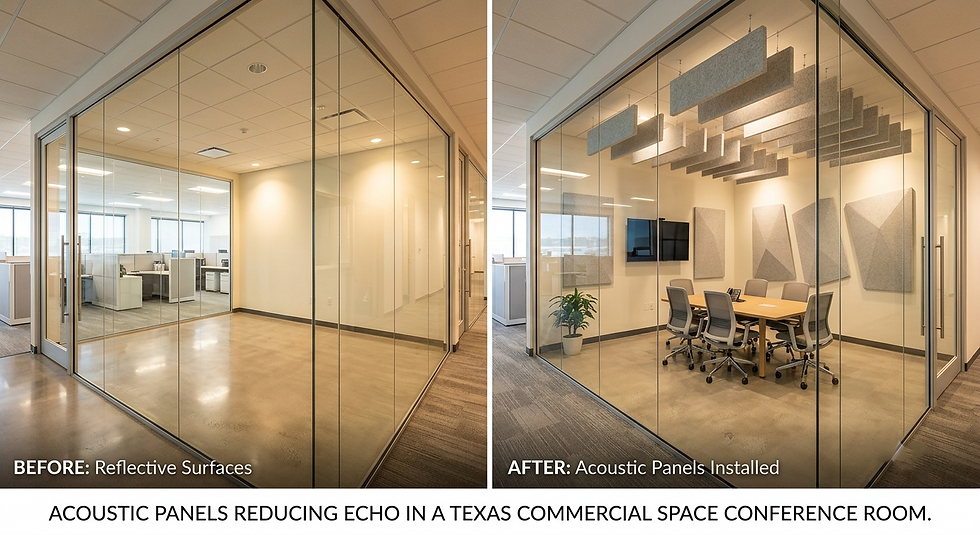
Glass-walled conference rooms. Sleek but acoustically brutal - parallel glass surfaces reflect sound almost perfectly, creating pronounced echo.
Open-plan offices with exposed ceilings. The "industrial loft" aesthetic trades acoustic ceiling tile for exposed structure and ductwork, removing one of a building's primary sound absorbers.
Lobbies and reception areas. High ceilings and hard flooring create long reverberation times that make simple check-in conversations feel chaotic.
Call centers and sales floors. Dozens of simultaneous phone conversations in a reflective room compound into a wall of noise.
Why Reverberation Is a Business Problem, Not Just an Annoyance
Meeting fatigue. Straining to parse speech through echo is cognitively exhausting.
Video call quality. Remote participants bear the brunt of in-room echo, since conferencing microphones pick up reflected sound along with direct speech - one of the most common, and most fixable, issues we address when reworking office acoustics for hybrid Texas workplaces.
Perceived professionalism. Clients dialing into a call and hearing an echoey, tinny room form an impression, whether or not it's fair.
A Simple Test for Any Texas Commercial Space
Clap once, sharply, in the middle of the room:
In a well-treated space, the sound should die out almost immediately.
If you hear a distinct "tail" or ringing quality lasting more than a second, the room has a reverberation problem that acoustic treatment - not furniture rearrangement - is designed to solve.
Sign #4: You're Getting Noise Complaints From Neighboring Tenants (or Getting Complained About)
This sign is specific to multi-tenant buildings, and it's one of the fastest-growing categories of inquiries we see across Texas's mixed-use developments.
Texas's commercial real estate landscape increasingly favors flexible, subdivided buildings - a single structure might house a gym, a restaurant, a coworking space, and a medical clinic, separated by nothing more than a single demising wall built to code minimums.
What This Looks Like in Practice
A fitness studio's bass-heavy class schedule bleeding through the wall into a neighboring office during business hours.
A restaurant or bar's evening noise carrying into upstairs residential or office units in mixed-use buildings.
Impact noise - footsteps, dropped equipment, dolly wheels - transmitting through floor-ceiling assemblies between stacked tenants.
A shared HVAC system or mechanical room creating persistent low-frequency hum that multiple tenants can hear simultaneously.
The Lease Compliance Angle
Many commercial leases include quiet enjoyment clauses or explicit noise-level provisions, particularly in mixed-use and multi-tenant retail developments.
A pattern of documented noise complaints can escalate into a lease compliance issue, with pressure eventually landing on the noisier (or more noise-sensitive) tenant to resolve it.
Targeted noise control solutions aimed at the shared wall, floor, or mechanical system typically resolve this far more durably than asking a neighboring business to "keep it down."
Signs You're in This Category
You've received (or sent) a written or verbal noise complaint through your property manager.
You can identify specific hours of the day when noise from a neighboring business becomes disruptive.
Sound seems to travel unusually well through a specific wall, floor, or ceiling - often a sign of a flanking path.
Your lease includes acoustic or "quiet enjoyment" language you've never had formally evaluated.
Sign #5: Productivity, Focus, and Retention Are Quietly Declining
The final sign is the hardest to pin directly on noise, because it shows up as a slow accumulation of smaller problems:
Employees wearing noise-cancelling headphones at their desks all day, even during collaborative work.
A noticeable drop in the use of open collaborative areas, with people retreating to quiet corners or empty rooms.
Increased complaints about difficulty concentrating, particularly from employees doing detail-oriented work.
A subtle but real uptick in requests to work from home.
Rising employee turnover, where noise comes up as a contributing frustration in exit conversations.
Why Noise Quietly Erodes Performance
There's a well-established link in occupational research between ambient noise - especially irrelevant background speech - and reduced performance on tasks requiring working memory and sustained attention.
Open-plan offices with poor acoustic treatment are especially prone to this effect, because overheard conversation is inherently attention-grabbing.
For a Texas commercial space housing knowledge workers, analysts, or developers, this isn't a minor comfort issue - it's a productivity issue with a real cost, even if it never shows up as a line item.
How to Recognize This in Your Own Space
Ask yourself honestly:
Do employees consistently choose small enclosed rooms, stairwells, or even their cars over the main open floor?
Has anyone informally requested a "quiet room" or asked whether one exists?
Do you notice a dip in output or an increase in errors during the busiest, loudest parts of the day?
Have exit interviews ever included comments about the work environment being "distracting" or "chaotic"?
When several of these patterns show up together - alongside signs 1 through 4 - acoustic conditions are very likely playing a meaningful role.
Which Types of Texas Commercial Spaces Are Most Affected?
While every commercial space can develop acoustic problems, some categories are disproportionately represented in the inquiries we field across Texas:
Medical, dental, and mental health practices. Confidentiality requirements combine with typically thin interior partition walls.
Open-plan tech and professional service offices. Popular across Austin's and Dallas's growing tech corridors.
Restaurants, bars, and event venues. Hard, cleanable surfaces (tile, glass, metal) maximize noise reflection.
Multi-tenant retail and mixed-use developments. Diverse business types sharing structural walls makes Sign #4 almost inevitable.
Coworking and flexible office spaces. Dozens of unrelated businesses and phone calls in shared floor plans.
Call centers and sales floors. High call volume in reflective rooms compounds quickly.
Recording studios, podcast rooms, and content creation spaces. Isolation and reflection control are both mission-critical here.
You can see examples of how these builds come together in our completed Texas project portfolio.

What Does Professional Soundproofing for a Texas Commercial Space Actually Involve?
It's worth separating two related but distinct acoustic goals, because they require different solutions:
Sound isolation (soundproofing): Preventing sound from traveling between spaces - through walls, floors, ceilings, doors, and windows.
Sound absorption (acoustic treatment): Controlling reflection and reverberation within a space.
Many Texas commercial spaces need a combination of both, which is why our soundproofing services and acoustic treatment work are typically scoped together rather than sold as separate products.
Common Sound Isolation Solutions
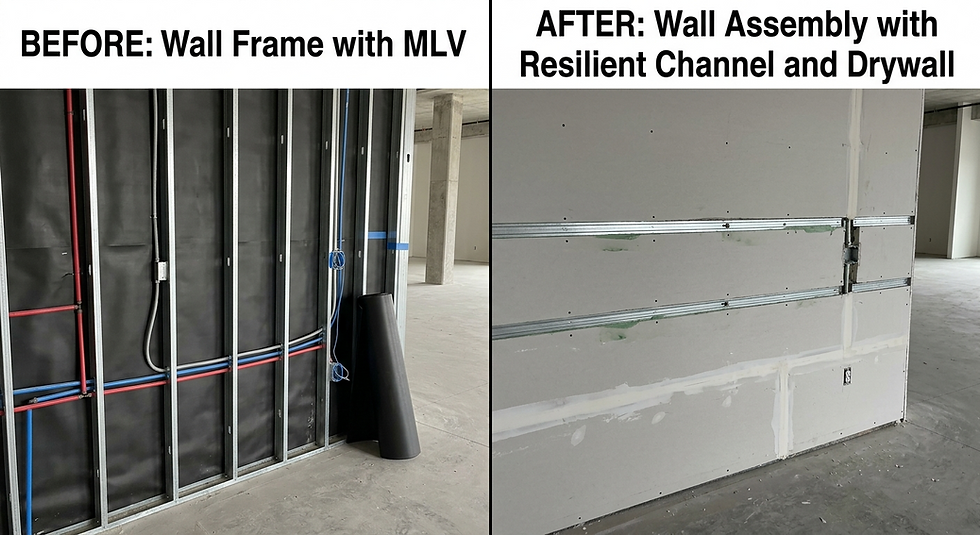
Mass-loaded vinyl (MLV): A dense, flexible material added within a wall or ceiling assembly to block sound transmission without major structural changes.
Resilient channels and decoupled framing: Reduces vibration transferred directly through a wall or ceiling assembly - often more effective than simply adding drywall layers.
Acoustic sealants and gasketing: Seals electrical outlets, ductwork penetrations, and perimeter gaps that are otherwise invisible flanking paths.
Solid-core or acoustic-rated doors with proper seals: Standard hollow-core interior doors are one of the weakest points in almost any commercial partition.
Double or laminated glazing: Reduces airborne noise transmission and exterior traffic noise near busy Texas roadways.
Floor underlayment and ceiling isolation clips: Address impact noise transmission between stacked tenants.
Common Sound Absorption Solutions
Acoustic wall panels: Absorb sound energy rather than reflecting it, directly reducing echo and reverberation.
Ceiling baffles and clouds: Treat exposed-ceiling spaces without requiring a full drop-ceiling installation.
Acoustic ceiling tile: A traditional but highly effective absorption solution for standard drop-ceiling offices.
Sound-absorbing flooring and area treatments: Reduce both footstep noise and overall room reflectivity.
Why This Isn't a DIY Project
We understand the appeal of a quick fix - foam panels, a rearranged furniture layout, a "soundproofing" spray marketed on social media. In our experience, these underperform for one core reason: they treat symptoms without addressing the actual sound path.
A space with an echo problem (needing absorption) won't be helped by adding mass to the walls.
A confidentiality problem (needing isolation) won't be solved by hanging foam panels that only address in-room reflection.
What a Professional Acoustic Assessment Actually Looks Like
On-site listening and testing. A trained assessor tests specific walls, doors, and ceilings, often using sound level meters to establish a baseline.
Identifying the specific sign driving the request. Confidentiality, reverberation, tenant-separation, or a combination - the diagnosis determines the entire solution path.
Locating flanking paths. A wall can be well-built and still underperform if sound sneaks around it through an open plenum, an unsealed penetration, or HVAC ductwork.
Reviewing the building's construction type. A converted warehouse, a standard drywall suite, and a masonry historic building each call for different approaches.
A written scope and rationale, not just a materials list.
This is also the point where cost estimates become meaningful. Without this step, any number you're quoted is a guess.
Texas-Specific Considerations by Metro Area
Acoustic problems aren't uniform across the state. The building stock, dominant industries, and noise sources shift by market:
Houston. Energy sector offices, sprawling medical campuses around the Texas Medical Center, and a huge volume of adaptive reuse projects near downtown and Midtown. Humidity and heat mean HVAC systems run near-continuously, making mechanical noise control a bigger factor here.
Dallas-Fort Worth. Heavily concentrated in corporate relocations and open-plan office buildouts, often built to code minimums for acoustic separation. A large multi-tenant retail and mixed-use footprint makes Sign #4 especially common.
Austin. Tech-driven growth has produced open, collaborative office space - exposed ceilings, glass conference rooms, communal work areas - alongside a fast-growing content creation sector needing serious isolation for media rooms and podcast studios.
San Antonio. A significant share of converted historic and mixed-use buildings, where thick masonry exterior walls isolate well against outside noise, but thin interior renovation partitions do little to separate individual tenant spaces.
Common Myths About Commercial Soundproofing
Before you invest in a solution, it's worth clearing up a few misconceptions:
"Foam panels will soundproof my office." Foam absorbs sound within a room but does very little to block sound traveling between rooms. Confidentiality or tenant-noise problems need mass and decoupling, not just absorption.
"Adding more drywall automatically blocks more sound." Simply stacking a second layer directly against the first provides only a modest improvement. The bigger gains come from decoupling - physically separating layers so vibration can't transfer directly between them.
"If the walls go up to the ceiling, sound can't get around them." Many commercial partitions stop at the drop ceiling rather than the structural deck, leaving an open plenum that sound travels through freely.
"Soundproofing means total silence." No solution eliminates sound entirely - the realistic goal is reducing transmission and reflection to an appropriate level for the space's function.
"This is a problem I can solve with furniture placement alone." Rearranging furniture modestly reduces direct line-of-sight noise but doesn't address the wall, ceiling, or floor assembly driving most transmission.
How Much Does Soundproofing a Texas Commercial Space Cost?
Costs vary based on scope, size, and construction type. A few general principles hold true across most projects:
Targeted room treatments - a single conference room's echo problem, for example - are typically the most cost-effective and fastest to implement.
Wall assembly upgrades for confidentiality or tenant-separation issues involve more labor and materials, often requiring opening and rebuilding portions of the wall.
Whole-space acoustic overhauls, addressing multiple rooms or a full open floor plan, represent the largest investment but the most comprehensive results.
How to Think About ROI
Weigh the investment against what the underlying problem is already costing your business:
The cost of a lease dispute or compliance issue driven by an unresolved noise complaint.
The cost of client attrition tied to a perception of unprofessionalism or confidentiality concerns.
The cost of employee turnover and reduced productivity in a chronically distracting environment.
The cost of redesigning or relocating entirely, versus treating the acoustic issue in place.
In nearly every case we've evaluated, a targeted, professionally designed acoustic solution costs meaningfully less than the downstream cost of leaving the problem unresolved.
Choosing a Soundproofing Partner for Your Texas Commercial Space
Not every contractor who advertises "soundproofing" brings the same level of expertise. Look for:
A formal acoustic assessment, not just a sales visit. A qualified contractor measures your space's actual acoustic performance rather than recommending a standard package.
Familiarity with your building type. Converted warehouses, mixed-use retail, medical suites, and standard office towers each have different structural realities.
Knowledge of relevant compliance standards, particularly for healthcare, legal, and financial clients.
Transparent material and method explanations. You should understand why a solution is recommended, not just what it costs.
References or case examples from similar Texas commercial projects.
Realistic expectations. Be cautious of any contractor promising "complete silence" without first assessing your space.
If you're weighing a few options, it's worth reading through a few common questions on our FAQ page or learning more about our background on the about us page before committing to a scope of work.
A Composite Example: How This Plays Out in Practice
A composite scenario drawn from patterns common across many similar Texas projects:
A behavioral health practice leases a suite in a converted retail center in the Dallas-Fort Worth area, subdivided using standard single-layer drywall partitions.
Within months, therapists notice clients hesitating before discussing sensitive topics, occasionally asking, "Can anyone hear us?"
An acoustic assessment reveals the shared walls test around STC 32 - well below the STC 45+ threshold appropriate for confidential conversations.
The fix: resilient channel and an additional layer of mass-loaded drywall on the shared walls, solid-core doors with acoustic seals, and sealing unaddressed penetrations where electrical conduit passed directly through the wall cavity.
Post-treatment, the walls test above STC 48, and client comments about privacy stop.
This is a representative pattern, not an unusual one - and it illustrates why a proper acoustic assessment, rather than a generic soundproofing product, is what actually resolves the underlying problem. Our portfolio has more examples of projects like this one.
Quick Self-Audit: Do You Have a Soundproofing Problem?
Run through this checklist. It maps directly back to the five signs covered above.
Sign #1 - General noise complaints
More than one person has mentioned the noise level unprompted
You've noticed people raising their voices to be heard in normal conversation
Reception or front-desk staff regularly comment on the noise
Sign #2 - Confidentiality concerns
A client or patient has ever asked if they could be overheard
Staff have started stepping outside or lowering their voices for sensitive conversations
You've never had your walls independently tested for STC performance
Sign #3 - Echo and reverberation
A sharp clap in the room produces a noticeable "tail" or ringing
Video call participants regularly ask you to repeat yourself
Your conference rooms or lobby have glass walls, concrete floors, or exposed ceilings
Sign #4 - Neighboring tenant conflicts
You or a neighboring tenant have filed a noise complaint through your property manager
You can identify specific times of day when noise from next door becomes disruptive
Sound seems to travel unusually well through one particular wall or ceiling
Sign #5 - Productivity and retention
Employees regularly wear noise-cancelling headphones at their desks
Collaborative or open areas sit empty while people crowd into small enclosed rooms
Focused work noticeably slows down during the loudest parts of the day
If you checked multiple boxes within a single category, that's a strong signal of which type of acoustic problem you're dealing with. If you checked boxes across three or more categories, the issue is likely systemic, and a full-space assessment is the more efficient path forward.

Frequently Asked Questions
How do I know if my office needs soundproofing?
Recurring noise complaints, echo in meeting rooms, overheard private conversations, or a noticeable drop in focus are the clearest signs. If two or more show up regularly, it's worth having the space professionally assessed.
What is the difference between soundproofing and acoustic treatment?
Soundproofing blocks sound from traveling between rooms using mass and sealing. Acoustic treatment absorbs sound inside a room to reduce echo. Most spaces need a mix of both, depending on the problem.
What STC rating is good for an office wall?
An STC of 42–45 is generally the minimum for speech privacy in a standard office. Confidential spaces like therapy or HR rooms typically need STC 50 or higher.
How much does commercial soundproofing cost?
Cost depends on scope - a single room's echo treatment costs far less than a full wall upgrade across multiple rooms. A professional assessment gives an accurate, project-specific estimate.
Can you soundproof an office without major construction?
Yes, in many cases. Solid-core doors, sealed gaps, acoustic panels, and upgraded window glazing all improve performance without opening walls. More severe isolation issues usually require accessing the wall cavity.
Does a noisy office really affect productivity?
Yes. Background noise, especially overheard speech, is well documented to reduce focus and increase recovery time after interruptions, which compounds over a full workday.
Do commercial leases require soundproofing?
Some leases include "quiet enjoyment" or noise provisions, particularly in mixed-use buildings. Whether this creates a formal obligation depends on your specific lease language.
How long does a commercial soundproofing project take?
Targeted treatments like panels or door upgrades often take a few days. Wall or ceiling assembly upgrades take longer, especially if the space needs to stay operational during the work.
The Bottom Line
If your Texas commercial space is showing one or more of these five signs, it's not a coincidence, and it won't resolve on its own:
Recurring noise complaints from employees, clients, or patients
Confidential conversations that aren't actually confidential
Echo and reverberation undermining meetings and calls
Tension with neighboring tenants over noise
A quiet decline in focus, productivity, and retention
Texas's commercial building stock, shaped by rapid growth, adaptive reuse, and open-plan design trends, is particularly prone to these acoustic issues. The good news is that they're solvable, with well-understood, professionally proven solutions - as long as they're diagnosed correctly and addressed with the right combination of sound isolation and absorption strategies.
A professional acoustic assessment is the logical next step. If any of the signs above sound familiar, our team is happy to walk your space and talk through what we're hearing - reach out here to get started, or call us directly to schedule a visit.


Comments