


Soundproofing vs Acoustic Treatment: What You Need to Know


If you've ever typed "how to stop hearing my neighbor's TV" or "why does my home studio still sound bad even with foam on the walls" into a search bar, you've likely landed in the middle of one of the most common - and most expensive - mix-ups in home and commercial construction.
Soundproofing and acoustic treatment are not the same thing. They solve two completely different problems, use different materials, and, most importantly, cost different amounts of money to get wrong.
Why the Soundproofing vs Acoustic Treatment Confusion Costs People Real Money
Walk into almost any home goods store or scroll through any online marketplace, and you'll find "soundproofing foam" panels marketed with promises to block noise from neighbors, traffic, or barking dogs.
Here's the uncomfortable truth: acoustic foam does almost nothing to block sound from entering or leaving a room.
Acoustic foam is lightweight, porous, and designed to absorb mid- and high-frequency sound within a room. It has almost no mass, which means it can't do the one thing true soundproofing requires - blocking sound waves from passing through a barrier. Sound blocking depends on:
Mass
Airtight seals
Decoupling
Not surface texture.
This mismatch between marketing language and acoustic science leads to a familiar and frustrating cycle:
A homeowner buys foam panels to stop hearing their upstairs neighbor.
They install the panels correctly, following every tutorial.
The neighbor's footsteps and bass are exactly as loud as before.
They conclude "soundproofing doesn't work" and move on, frustrated and out several hundred dollars.
The product wasn't defective. The problem was never sound leakage - it was room acoustics being confused with sound isolation. Once you understand the distinction, the right solution becomes obvious, and you stop wasting money on the wrong fix. Getting a proper assessment before buying materials is usually the fastest way to avoid this trap.
What Is Soundproofing?
Soundproofing, more accurately called sound isolation in acoustic engineering circles, refers to construction methods and materials that prevent sound from traveling between two spaces.
Think of soundproofing as building a barrier. The goal is to stop:
Airborne sound - voices, music, traffic.
Structure-borne sound - footsteps, vibration, plumbing.
...from crossing a wall, floor, ceiling, or window.
The Core Principles of Soundproofing
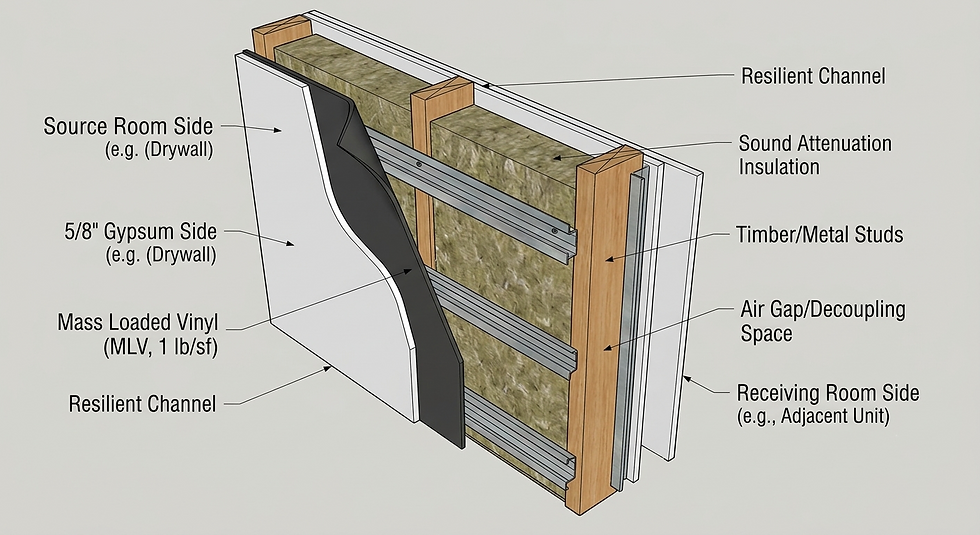
Soundproofing works through four fundamental strategies, often remembered by the acronym MSDC:
Mass - Adding weight and density to a barrier so sound waves have a harder time passing through. A thick concrete wall blocks far more sound than a thin drywall partition.
Damping - Converting sound vibration energy into small amounts of heat, typically using viscoelastic compounds sandwiched between rigid layers.
Decoupling - Physically separating two sides of a wall or floor assembly so vibration can't travel directly through a shared connection. Common methods include:
Resilient channels
Isolation clips
Staggered stud framing
Absorption - Filling wall cavities with insulation to reduce resonance and sound transmission within the assembly itself.
How Soundproofing Is Measured
Soundproofing effectiveness is quantified using two primary metrics that show up constantly in product specs and building codes:
STC (Sound Transmission Class) - Measures how well a wall, door, or window assembly blocks airborne sound.
A standard interior drywall partition typically rates around STC 33, meaning loud speech is audible and understandable through the wall.
A well-built assembly can reach STC 50 or higher, where loud speech is only faintly heard.
IIC (Impact Insulation Class) - Measures how well a floor-ceiling assembly blocks impact noise, such as footsteps or dropped objects, from transmitting to the space below.
Understanding these ratings matters because many building codes and HOA agreements set minimum STC and IIC requirements, particularly for:
Multi-family residential construction
Home theaters adjacent to bedrooms
Commercial-to-residential mixed-use buildings
Common Soundproofing Materials and Methods
Effective soundproofing typically combines several of these approaches rather than relying on a single product:
Mass loaded vinyl (MLV) - A dense, flexible barrier material added within a wall or ceiling cavity to increase mass without excessive thickness.
Resilient channels or sound isolation clips - Metal components that decouple drywall from the framing, interrupting the direct vibration path.
Double drywall with a viscoelastic damping compound - Two layers of drywall with a damping layer between them, converting vibration into heat.
Acoustic caulk and gasketing - Sealing every gap, outlet, and penetration, since even small air gaps can leak a surprising amount of sound.
Solid-core doors with door sweeps and perimeter seals - Hollow-core doors are one of the weakest links in most residential soundproofing plans.
Double or laminated glass windows - Standard single-pane windows are notoriously poor at blocking sound, especially traffic and outdoor noise.
Staggered stud or double stud wall framing - Framing techniques that physically decouple the two faces of a wall.
Homes and businesses dealing with persistent vibration from HVAC equipment, generators, or nearby machinery often need a related but distinct discipline: vibration and noise control, which addresses low-frequency structure-borne noise that standard wall assemblies alone don't fully resolve.
When You Need Soundproofing
Soundproofing is the right investment when your goal involves keeping sound from crossing a boundary. Common scenarios include:
Stopping noise from a home theater or music room from disturbing the rest of the house.
Blocking traffic, construction, or neighborhood noise from entering a bedroom or office.
Preventing conversations in a home office from being overheard elsewhere in the house (or vice versa).
Isolating a podcast or recording studio from HVAC systems, plumbing, or nearby traffic.
Meeting condo or apartment noise regulations to prevent disputes with neighbors.
Reducing noise transfer between adjoining units in multi-family buildings, duplexes, or townhomes.
If your complaint sounds like "I can hear sound coming from somewhere else" or "someone else can hear me," you have a soundproofing problem, and it's worth having it evaluated before assuming any single product will solve it. Residential projects, in particular, tend to involve several surfaces at once, which is where residential soundproofing solutions designed around the specific rooms and noise sources in a home tend to outperform a piecemeal, one-product approach. For a broader look at how these methods come together as a system rather than individual products, our soundproofing services overview walks through the full process.
What Is Acoustic Treatment?
Acoustic treatment, sometimes called room acoustics or acoustic conditioning, refers to materials and techniques used to control how sound behaves once it's already inside a room.
Unlike soundproofing, acoustic treatment has nothing to do with keeping sound in or out. Its entire purpose is improving the quality of sound within the space - making speech clearer, recordings cleaner, and rooms more pleasant to be in.
The Problem Acoustic Treatment Solves
Every hard, flat, parallel surface in a room reflects sound. Without treatment, sound waves bounce repeatedly off walls, ceilings, and floors before finally dissipating. This creates several well-known problems:
Reverberation - The persistence of sound after the original source stops, caused by countless reflections overlapping and decaying over time. Excessive reverberation makes speech muddy and recordings sound distant or "boomy."
Echo - A distinct, delayed repetition of sound, usually noticeable in larger or more reflective rooms.
Standing waves and flutter echo - Rapid, repetitive reflections between two parallel hard surfaces, common in small rectangular rooms like home offices or vocal booths.
Frequency buildup in corners - Bass frequencies tend to accumulate in room corners, creating uneven, "boomy" low-end response.
Acoustic treatment doesn't reduce the volume of sound in a room - it changes its character. A treated room and an untreated room playing the same audio at the same volume will sound dramatically different in clarity, warmth, and intelligibility.

Core Acoustic Treatment Techniques
Acoustic treatment relies on three primary mechanisms:
Absorption - Using porous materials (foam, mineral wool, fiberglass panels) to convert sound energy into small amounts of heat, reducing reflections and reverberation.
Diffusion - Scattering sound reflections in multiple directions rather than absorbing them, preserving a room's natural liveliness while eliminating harsh, distinct echoes.
Bass trapping - Specialized, typically thicker absorptive panels placed in corners to control low-frequency buildup, which standard thin foam panels can't address effectively.
Common Acoustic Treatment Materials
Acoustic foam panels - Lightweight, affordable, and effective at absorbing mid-to-high frequencies. Best suited for home studios, podcast rooms, and small vocal booths.
Fabric-wrapped fiberglass or mineral wool panels - Denser than foam, offering broader frequency absorption and a more polished, professional appearance.
Bass traps - Corner-mounted panels specifically engineered to tame low-frequency buildup.
Acoustic diffusers - Textured, often geometric panels that scatter rather than absorb sound.
Acoustic ceiling tiles and clouds - Suspended or surface-mounted panels that treat reflections from the ceiling plane.
Heavy curtains and rugs - Softer, more residential-friendly options that provide modest absorption benefits.
When You Need Acoustic Treatment
Acoustic treatment is the right investment when your issue is about clarity, not leakage. Common scenarios include:
A home studio or podcast room where recordings sound "boxy," distant, or overly reverberant, even though noise from outside isn't the issue.
A home theater where dialogue sounds muddy or unclear despite a good speaker system.
An open-plan office or restaurant where background chatter makes conversation exhausting.
A conference room where video calls sound echoey to participants on the other end.
A living room or great room with hard floors, tall ceilings, and minimal furniture, creating a harsh, "loud" feeling even at normal volumes.
If your complaint sounds like "sound in this room feels harsh, echoey, or unclear," you have an acoustic treatment problem, not a soundproofing problem. Commercial spaces with this issue - offices, conference rooms, and open floor plans - are usually well served by acoustic treatment services that combine absorption, diffusion, and bass control based on how the room is actually used, rather than a generic panel package.
Soundproofing vs Acoustic Treatment: The Core Differences
It helps to see the distinction laid out side by side, because the differences run deeper than most people expect.
Factor | Soundproofing | Acoustic Treatment |
Primary Goal | Block sound transmission between spaces | Improve sound quality within a space |
What It Controls | Sound entering or leaving a room | Echo, reverberation, and clarity inside a room |
Key Principle | Mass, damping, decoupling, sealing | Absorption, diffusion, bass trapping |
Typical Materials | Mass loaded vinyl, resilient channels, dense drywall, seals | Foam panels, fabric-wrapped panels, diffusers, bass traps |
Measured By | STC and IIC ratings | RT60 (reverberation time), frequency response |
Common Use Cases | Apartments, home theaters, offices, bedrooms near noise | Studios, podcast rooms, conference rooms, restaurants |
Effect on Room Volume | Reduces sound crossing the barrier | Does not reduce transmitted sound; changes its character |
Installation Complexity | Often requires construction, wall or ceiling work | Often surface-mounted, more DIY-friendly |
Typical Cost Range | Higher - involves structural or wall assembly changes | Lower - primarily material and mounting costs |
The Analogy That Makes It Click
Here's a way to think about the difference that tends to stick: soundproofing is like the walls of a thermos, and acoustic treatment is like the inside of a music hall.
A thermos keeps heat in or out through insulation and sealing - it doesn't care what's happening to the liquid inside.
A concert hall is designed with specific surfaces and shapes to control how sound reflects and reaches the audience - it doesn't stop sound from an outside source at all.
A room can have thermos-like isolation and terrible internal acoustics, or beautiful internal acoustics and zero isolation from the outside world. They're independent variables, and treating them as interchangeable is where most soundproofing projects go wrong.
A Quick Sound Science Primer
Sound is vibration traveling through air (and through solid materials, in the case of impact or structure-borne noise) as pressure waves. When those waves hit a surface, one of three things happens:
Reflection - The wave bounces back into the room, contributing to echo and reverberation.
Absorption - The wave's energy is converted into a small amount of heat by a porous material.
Transmission - The wave passes through the material and continues into the adjoining space.
Every surface in every room does some combination of all three, in different proportions, depending on its mass, density, and porosity.
Two key takeaways:
A heavy, dense material like concrete or a mass-loaded wall assembly transmits very little sound - most of it reflects back into the room instead. That's exactly why dense soundproofed rooms often still need acoustic treatment.
A light, porous material like acoustic foam absorbs a meaningful portion of sound energy within the room, but because it has so little mass, it does very little to stop transmission.
You cannot substitute one mechanism for the other, because they're solving for different physical properties of the same sound wave.
How Professionals Diagnose a Soundproofing vs Acoustic Treatment Problem
One of the clearest signs of a qualified acoustic professional - versus someone simply selling panels - is whether they measure before they recommend.
Measuring Sound Transmission
Professionals assess sound isolation using a few standard approaches:
Field STC testing - Using calibrated sound sources and meters on either side of a wall or floor to calculate an approximate Sound Transmission Class rating under real-world conditions.
Sound level readings at different frequencies - Low frequencies (bass, footsteps, subwoofers) travel differently than high frequencies (voices, treble), so a thorough assessment breaks the problem down by frequency range.
Flanking path inspection - Identifying secondary routes sound can travel around a treated wall, such as shared ductwork, electrical penetrations, or a continuous subfloor.
Measuring Room Acoustics
For acoustic treatment, the relevant measurement is typically RT60 - the time it takes for a sound to decay by 60 decibels after the source stops.
Untreated rooms with hard, parallel surfaces often have RT60 values well above what's comfortable for speech or recording.
Recording studios and podcast rooms typically target a relatively short, controlled RT60 for speech clarity.
Home theaters and music rooms often aim for a slightly longer, more balanced RT60 that preserves some natural liveliness without becoming harsh.
Home users don't need lab-grade equipment to get useful data - several smartphone apps can provide rough RT60 estimates, and even a simple clap test can reveal whether a room is under-treated. For anyone unsure which side of the equation their space falls on, a walkthrough with an acoustic specialist typically settles the question faster than trial and error with store-bought panels.

Do You Need Soundproofing, Acoustic Treatment, or Both?
This is the question that actually matters. Here's a practical framework for figuring out what your space actually needs.
Step 1: Identify Where the Problem Is Coming From
Ask yourself: is the sound problem coming from outside the room, or is it happening inside the room regardless of outside noise?
If you can hear sound crossing a wall, floor, or ceiling - traffic, neighbors, a TV in another room - that's a transmission problem, and soundproofing is the fix.
If a room sounds harsh, echoey, or unclear even with the door closed and no outside noise involved, that's an acoustics problem, and treatment is the fix.
Step 2: Consider the Purpose of the Room
Different room types tend to lean toward one need or the other, though many benefit from both:
Home recording studios and podcast rooms - almost always need both.
Home theaters - typically need soundproofing first, acoustic treatment second. Purpose-built media room acoustic solutions are designed around exactly this dual requirement.
Home offices used for video calls - often need acoustic treatment more urgently than soundproofing.
Bedrooms near busy streets or shared walls - almost always need soundproofing as the priority.
Restaurants and open-plan commercial spaces - almost exclusively an acoustic treatment problem.
Multi-family residential walls and floors - a soundproofing-first scenario, often driven by code requirements or HOA rules.
Step 3: Set Realistic Expectations for Budget
Soundproofing is almost always the more expensive of the two, because it frequently requires opening walls, adding mass, or reworking assemblies.
Acoustic treatment tends to be more budget-friendly and can often be added incrementally, room by room, without construction.
This is one reason so many budget "soundproofing" products in stores are actually acoustic treatment products in disguise.
Quick Self-Assessment Checklist
Before reaching for any product or picking up the phone, run through this checklist to narrow down what you're actually dealing with.
Signs you likely need soundproofing:
You can make out words or lyrics from a neighboring room, unit, or the street.
Closing the door or window barely reduces the noise.
Footsteps, bass, or impact noise from above or below is a recurring complaint.
People outside the room can clearly hear conversations happening inside it.
The issue exists regardless of how the room itself is furnished or decorated.
Signs you likely need acoustic treatment:
The room sounds "boxy," hollow, or overly live even with the door shut and no outside noise.
Video call participants describe your audio as echoey or distant.
Music or dialogue sounds muddy, unclear, or bass-heavy in a way that feels off.
Conversations in the room feel unusually tiring or hard to follow, even in a quiet building.
The room has mostly hard, parallel surfaces - bare walls, hardwood or tile floors, minimal furniture.
If you checked boxes in both lists, your space likely needs a combined approach - which is common for studios, media rooms, and any multi-purpose space used for both recording and everyday living.
Real-World Scenarios: Soundproofing vs Acoustic Treatment in Practice
Scenario 1: The Home Podcast Studio
A homeowner converts a spare bedroom into a podcast studio and notices two issues:
Their downstairs neighbor's dog barking is audible in recordings.
Even without the barking, their voice sounds slightly hollow and "roomy" on playback.
These require two different fixes. The barking dog issue is a transmission problem needing sealed gaps and added wall mass. The hollow voice quality is an acoustic treatment issue solved with absorptive panels and a rug - but this wouldn't touch the barking dog problem at all.
Scenario 2: The Open-Concept Restaurant
A restaurant owner gets complaints that the dining room is "too loud." The space has hard flooring, high ceilings, and minimal soft furnishings.
This is almost entirely an acoustic treatment scenario. Fixes include:
Acoustic ceiling clouds
Wall panels
Strategic use of textiles and upholstery
- the kind of project typically handled under commercial acoustic solutions.
Scenario 3: The Shared-Wall Apartment
A tenant can clearly hear their neighbor's television through a shared wall. This is a textbook soundproofing scenario. In rental situations, options often include:
Mass-loaded vinyl overlays
Strategic furniture placement
Sealing outlets and gaps
Working with a landlord on more substantial fixes where possible
Scenario 4: The Home Theater Room
A homeowner wants to avoid disturbing bedrooms above while getting crisp dialogue and impactful bass. This is a both/and scenario:
Soundproofing the ceiling and walls prevents sound from traveling upstairs.
Acoustic treatment - bass traps, absorption panels, and rear-wall diffusion - ensures the sound experience inside the theater itself is clean.
Skip either step and you leave a real gap: skip soundproofing and you'll disturb the household; skip acoustic treatment and even a premium speaker system will sound worse than it should.
Scenario 5: The Manufacturing Facility
A facility manager needs to reduce machinery noise for worker safety and neighboring-property compliance. This falls under industrial noise control, blending soundproofing barriers with vibration isolation.
Room-by-Room Guide: What Most Spaces Actually Need
Home Offices - Almost always an acoustic treatment issue. Hard walls, uncovered windows, and bare desks create reflective surfaces that make a room sound cavernous on a call. Businesses tackling this across multiple rooms often look at dedicated office acoustics solutions.
Bedrooms - Typically soundproofing-first problems, driven by traffic, shared walls, or footsteps from above.
Home Theaters and Media Rooms - Almost always benefit from both.
Home Recording Studios and Podcast Rooms - Another both/and category, and arguably where getting the balance right matters most.
Open-Plan Offices - Overwhelmingly acoustic treatment territory, addressing conversation buildup, keyboard noise, and HVAC hum.
Restaurants and Hospitality Spaces - Almost always about internal acoustics, not transmission.
Multi-Family Residential (Apartments, Condos, Duplexes) - A classic soundproofing scenario, frequently governed by minimum STC and IIC requirements.

How Building Type Affects Your Soundproofing vs Acoustic Treatment Plan
The right approach also depends heavily on what kind of structure you're working with. A few common building types and what they typically require:
Single-family homes - Usually more flexible for soundproofing since walls can often be opened without affecting neighboring units. Acoustic treatment needs vary widely by room use.
Apartments and condos - Soundproofing options are frequently limited to non-structural fixes (furniture placement, door seals, MLV overlays) unless the building's association or ownership structure allows for wall modifications. Acoustic treatment, by contrast, is almost always fully within a tenant's control.
Townhomes and duplexes - Shared walls between units are a common source of complaints, and soundproofing here often focuses on party walls specifically rather than the entire unit.
New construction - The most cost-effective time to address soundproofing is during the framing stage, before drywall goes up, since decoupling techniques like staggered studs are far cheaper to implement before walls are finished.
Older buildings - Older framing, plaster walls, and settled foundations can behave unpredictably, which is part of why professional assessment matters more in older structures than in modern, standardized construction.
Commercial and retail spaces - Acoustic treatment tends to dominate here, particularly in restaurants, gyms, and open-plan offices, though soundproofing becomes relevant in mixed-use buildings with residential units above or beside commercial space.
Common Myths About Soundproofing and Acoustic Treatment
"Foam Panels Will Soundproof My Room" - Foam absorbs sound within a room; it does not block sound from passing through walls due to its lack of mass.
"Thicker Walls Automatically Mean Better Acoustics" - Wall mass primarily affects transmission, not room acoustics. A thick wall can still be highly reflective if untreated.
"Egg Cartons Work Just Like Acoustic Foam" - Egg cartons lack the density and engineered cell structure of real acoustic foam and provide negligible benefit.
"One Soundproofing Product Can Handle the Whole Job" - Sound follows the path of least resistance. A single high-STC door won't help if the surrounding wall has gaps or a flanking path exists.
"More Acoustic Panels Always Means Better Sound" - Over-treating a room can make it sound unnaturally dead and lifeless. Balance absorption with diffusion.
"Soundproofing and Acoustic Treatment Cost the Same" - Soundproofing generally involves more construction-level work and tends to cost more.
Mistakes That Undermine Even a Good Plan
Treating only one surface and ignoring the rest - A perfectly soundproofed wall is undermined by an untreated door, window, or HVAC vent.
Skipping the seal - Even a small unsealed gap can undermine a well-designed soundproofing assembly.
Assuming louder equals worse acoustics - Volume and clarity are different problems.
Placing acoustic panels without considering reflection points - Random placement is far less effective than targeting first-reflection points.
Over-treating with only absorption and no diffusion - Can leave a room sounding unnaturally flat.
Forgetting the ceiling - One of the most commonly overlooked surfaces in both disciplines.
Ignoring low frequencies - Standard thin panels are largely ineffective against bass; persistent "boomy" rooms need dedicated bass trapping.
How to Combine Soundproofing and Acoustic Treatment for the Best Results
A Practical Sequence
Start with an honest room assessment. Identify specific complaints: Is sound entering from elsewhere? Is the room itself harsh or echoey?
Address soundproofing first, where structural work is involved. It's more efficient to add mass or reframe walls before finishing surfaces.
Seal every gap and penetration. Outlets, switch plates, HVAC penetrations, and door perimeters are common flanking paths.
Layer in acoustic treatment once the shell is sealed. Focus on absorption at first-reflection points, bass trapping in corners, and diffusion where liveliness matters.
Test and adjust. Acoustic treatment often benefits from listening tests - moving panels, adding or removing bass traps.
DIY vs Professional: Where the Line Should Be
Reasonable DIY projects:
Mounting foam or fabric-wrapped panels at first-reflection points
Adding door sweeps and weatherstripping
Placing bass traps in corners
Layering rugs and curtains to soften a reflective room
Projects that usually benefit from professional involvement:
Reframing a wall for decoupling
Installing resilient channels or isolation clips correctly
Adding mass loaded vinyl within a wall or ceiling assembly
Any project targeting a specific STC or IIC rating for code compliance
A useful rule of thumb: if a mistake would require tearing open a finished wall to fix, it's worth getting professional input before starting. Reviewing examples of completed soundproofing and acoustic treatment projects can also help set realistic expectations for what a properly executed assembly actually looks like before committing to a DIY approach.
Cost Considerations: What Drives the Price
What Affects Soundproofing Costs
Scope of construction - Surface-level additions vs. a full rebuild with decoupled framing.
Room size and number of surfaces treated - Walls, ceilings, floors, doors, and windows each add cost.
Existing conditions - Older buildings with unusual framing or limited access increase labor costs.
Target STC/IIC rating - Reaching STC 50+ requires more elaborate assemblies.
Window and door upgrades - Often the most expensive individual line items.
What Affects Acoustic Treatment Costs
Panel material and quality - Basic foam is inexpensive; fabric-wrapped fiberglass and diffusers cost more.
Coverage area - More surface area treated means more material.
Custom vs off-the-shelf solutions - Custom shapes, colors, or ceiling clouds cost more.
Installation complexity - Surface-mounted panels are straightforward; suspended clouds require more labor.

Signs You're Looking at the Wrong Solution
Before committing to a purchase or a contractor, it helps to run through a quick sanity check. You're likely being sold the wrong fix if:
A product is marketed as "soundproofing" but the spec sheet only mentions NRC (Noise Reduction Coefficient) ratings, not STC - NRC measures absorption, not transmission blocking.
A contractor recommends foam panels for a noise-from-next-door complaint without ever asking about the wall assembly, framing type, or whether the noise is airborne or impact-based.
An acoustic treatment quote includes no discussion of first-reflection points, room dimensions, or listening/microphone position - a sign the panels are being sold as a generic package rather than a tailored solution.
A soundproofing quote skips doors, windows, and penetrations entirely and focuses only on the largest wall - ignoring the weakest links that will undermine the whole assembly.
You're told "more is always better" for either category, without any reference to your room's specific dimensions, usage, or existing acoustic issues.
None of these signs mean a company is acting in bad faith - often it's simply a knowledge gap. But they're useful checkpoints before signing off on materials or a scope of work.
Sound Isolation vs Sound Quality: Why Both Matter Long-Term
It's worth zooming out for a moment on why this distinction matters beyond a single project.
Sound isolation protects your privacy and peace of mind. Once a wall, floor, or ceiling assembly is properly soundproofed, that benefit is largely permanent - it doesn't degrade over time the way some acoustic treatments can if panels shift or get damaged.
Sound quality protects the value of everything else in the room. A home theater with a premium projector and speaker system, an office with expensive video conferencing equipment, or a studio with professional microphones - all of that investment is only as good as the room's acoustics allow it to sound.
Skipping one undermines the other's value. A perfectly soundproofed room with harsh acoustics still feels unpleasant to spend time in. A beautifully treated room that leaks every sound to the next room over still generates complaints and conflict.
Both add measurable value to a property. Buyers and tenants increasingly ask about noise levels and room acoustics, particularly for home offices, media rooms, and multi-family units - making both soundproofing and acoustic treatment worthwhile long-term investments, not just short-term fixes.
What to Look for When Hiring a Professional
Do they measure before recommending a solution? A professional should assess your specific noise sources and existing construction first.
Can they explain mass, damping, decoupling, and absorption in plain terms? If not, that's a red flag.
Do they address flanking paths? A thoughtful plan accounts for outlets, HVAC penetrations, and door seals.
Can they provide before-and-after data? STC testing and RT60 measurements confirm results objectively.
Do they have experience with your specific room type? Look for relevant, specific experience.
If you're still not sure which side of the soundproofing vs acoustic treatment equation your space falls on, describing the problem to a specialist is usually faster and cheaper than guessing. You can reach out to discuss your specific room and noise concerns before purchasing any materials, or browse our frequently asked questions for quick answers to common project concerns.
Frequently Asked Questions
What is the difference between soundproofing and acoustic treatment?
Soundproofing blocks sound from passing between spaces using mass, sealing, and decoupling. Acoustic treatment controls echo and reverberation inside a room using absorption and diffusion. One stops noise transfer; the other improves sound quality.
Does acoustic foam actually soundproof a room?
No. Acoustic foam absorbs reflections inside a room but has too little mass to block sound transmission through walls. It improves clarity, not isolation.
What is a good STC rating for soundproofing?
A standard wall rates around STC 33. For noticeable sound isolation, most professionals recommend STC 50 or higher.
Can you soundproof a room without construction?
Partial improvement is possible with door sweeps, weatherstripping, and heavy curtains, but significant isolation usually requires adding mass or sealing gaps within the wall or ceiling assembly.
Do acoustic panels stop noise from neighbors?
No. Acoustic panels reduce echo inside a room but don't block sound entering from a shared wall or floor. That requires soundproofing, not acoustic treatment.
What's the difference between absorption and diffusion?
Absorption converts sound energy into heat, reducing reflections. Diffusion scatters reflections in multiple directions instead of eliminating them, keeping a room lively without harsh echo.
Does a home recording studio need soundproofing or acoustic treatment?
Both. Soundproofing keeps outside noise out of recordings, while acoustic treatment prevents the room itself from making recordings sound hollow or distant.
Why does a room still echo after adding acoustic panels?
Usually because panels are undersized, poorly placed relative to reflection points, or bass frequencies aren't addressed with dedicated bass traps rather than standard thin panels.
Final Thoughts: Matching the Solution to the Actual Problem
The soundproofing versus acoustic treatment question ultimately comes down to a single diagnostic question: is your problem about sound crossing a boundary, or sound behaving badly once it's already in the room?
Get that diagnosis right, and the rest of the project - material selection, budget, and installation approach - tends to fall into place.
Get it wrong, and even a well-executed installation can leave the original complaint completely unresolved.
For many real-world spaces - home studios, media rooms, offices used for calls, multi-purpose rooms - the honest answer is that both soundproofing and acoustic treatment play a role. Understanding which is which, and why, is what separates an effective investment from an expensive guess. For more room-specific breakdowns like this one, our blog covers additional soundproofing and acoustic treatment topics in depth.


Comments