


Historic Texas Church Acoustic Restoration: Preservation & Performance


Walk into a century-old Texas sanctuary on a quiet afternoon, and you can hear the building itself breathing. Footsteps on heart-pine floors roll into soft echoes. A single spoken word from the chancel drifts to the back pew on its own, no microphone required. That is not an accident. It is architecture doing exactly what its builders intended a hundred or more years ago.
Historic Texas church acoustic restoration sits at the intersection of two disciplines that do not always get along: architectural preservation and modern acoustic performance. Congregations want their historic sanctuary to sound as good - or better - than it did when it was consecrated, while also supporting hybrid worship, livestreaming, and spoken-word clarity that nineteenth-century architects never had to consider.
This guide walks through what acoustic restoration actually involves in a historic Texas church, why it is fundamentally different from a standard renovation, and how congregations can approach it the right way - without compromising the building's historic character or its standing on the National Register of Historic Places. If your sanctuary committee is somewhere in the middle of this decision, our acoustic treatment services page is a good place to see how this kind of work is scoped.
The Unique Historic Texas Church Acoustic Restoration
Texas has one of the most architecturally diverse collections of historic churches in the United States, and that diversity shows up directly in how each building sounds.
Spanish Colonial and Mission-Era Sanctuaries
The oldest surviving churches in Texas - many built by Spanish missionaries and Indigenous laborers in the 1700s - share a few defining acoustic traits:
Thick adobe and limestone walls, chosen for structural survival and climate control
Small window openings, which limit sound leakage and outside noise intrusion
Vaulted or beamed ceilings, which shape how sound travels overhead
Dense masonry surfaces, which reflect sound rather than absorbing it - creating the long, warm reverberation that suits chant and unamplified voice beautifully
German and Czech Immigrant Churches of the Hill Country and Central Texas
Throughout the mid-to-late 1800s, German and Czech immigrant communities built soaring Gothic and Romanesque Revival churches across Central Texas - the kind often nicknamed the "Painted Churches" for their elaborately stenciled interiors. These buildings typically feature:
High, vaulted or coffered wood ceilings that scatter sound rather than absorb it
Plaster walls over brick or stone, which reflect mid and high frequencies efficiently
Wood pews and floors, adding warmth without excessive absorption
Minimal soft furnishings, historically, which preserved long reverberation times
Gothic Revival and Victorian-Era Urban Churches
In cities like Galveston, San Antonio, and Austin, Gothic Revival churches present their own acoustic profile:
Imported stone construction, highly reflective across most frequencies
Elaborate wood trusses, which add complex diffusion overhead
Large stained-glass window arrays, which reflect high frequencies while offering little absorption
Reverberation times sometimes exceeding four or five seconds - glorious for organ and choral music, but genuinely difficult for spoken clarity
Understanding which historic building typology a congregation is working with is the first analytical step in any historic Texas church acoustic restoration. A restoration approach that works beautifully in a stone mission church can be entirely wrong for a wood-frame Victorian sanctuary, and vice versa - which is why an on-site assessment always comes before any material decisions are made.

Why Acoustic Restoration Is Different From Ordinary Renovation
Acoustic restoration is not the same project as a general sanctuary renovation, and treating it that way is one of the most common - and expensive - mistakes congregations make.
A standard renovation typically focuses on:
Cosmetic finishes
HVAC and electrical upgrades
ADA accessibility
General wear-and-tear repair
Acoustic restoration requires all of that, plus a layer of specialized noise control and acoustic analysis most general contractors simply are not trained to perform:
Measuring and modeling how the space currently behaves acoustically
Identifying which historic materials and geometries are responsible for the sound the congregation values
Distinguishing between acoustic problems caused by deterioration versus problems that were original to the design
Predicting how any proposed material change - new flooring, new pew cushions, added insulation - will shift reverberation time, speech intelligibility, and frequency balance
Integrating modern audio, video, and hearing-assistance technology without visually or acoustically compromising the historic fabric
The single biggest risk in historic Texas church acoustic restoration is well-intentioned changes made without acoustic modeling first. Two examples show up constantly:
A congregation adds carpet to reduce noise complaints, only to discover the choir now sounds flat and lifeless
A well-meaning building committee installs modern insulation behind restored plaster, unaware that they've just absorbed the very frequencies that gave the organ its richness
Acoustic restoration done correctly starts with data, not assumptions - the same principle that guides any well-run acoustic treatment project, whether the building is a century-old sanctuary or a modern commercial space.
The Science Behind Historic Church Acoustics
To restore a historic church's sound intelligently, you first have to understand what is actually happening inside that volume of air.
Reverberation Time (RT60)
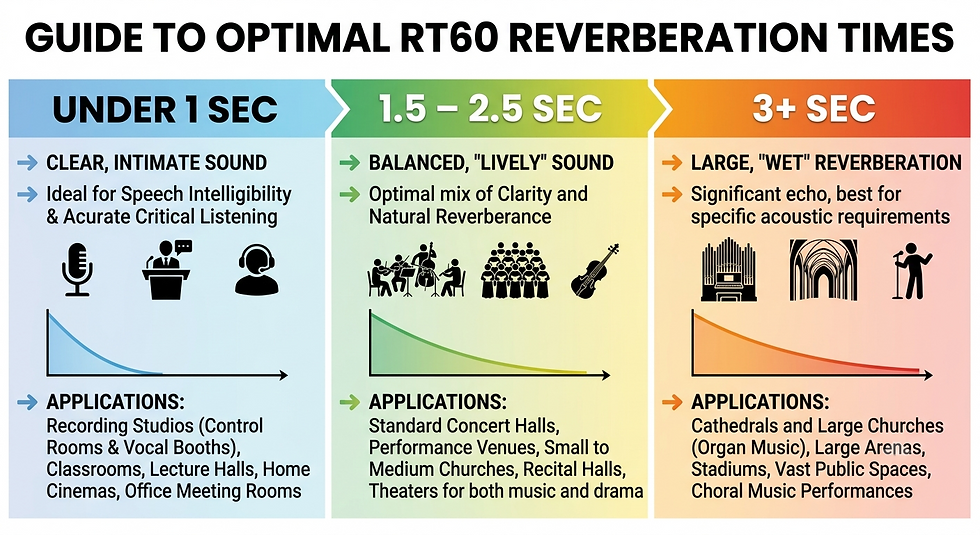
RT60 is the time it takes for sound to decay by 60 decibels after the source stops - in plain terms, how long an echo lingers.
Under 1 second - very "dry," excellent for speech clarity, poor for choral or organ music
1.5–2.5 seconds - the sweet spot most historic sanctuaries were designed around, supportive of both music and reasonably intelligible speech
3+ seconds - glorious for a full pipe organ and choir, but often muddy for spoken word without careful sound reinforcement
Historic Texas churches frequently sit at the higher end of that range because their original architects prioritized music and liturgy over amplified speech - amplification didn't exist yet.
Sound Absorption vs. Reflection
Every surface in a sanctuary either absorbs sound energy or reflects it:
Reflective surfaces: hard plaster, stone, glass
Absorptive surfaces: wood pews, carpet, and the congregation itself
Two things follow from this:
A full sanctuary sounds noticeably "drier" than an empty one, because the congregation functions as an acoustic absorber
Occupied vs. unoccupied RT60 must be measured separately - a church that sounds perfect empty on a Tuesday assessment can sound completely different, and completely wrong, on a packed Sunday
Frequency Balance
Historic materials do not absorb evenly across the frequency spectrum:
Plaster and stone reflect high frequencies aggressively
Low frequencies are allowed to build up unchecked
This combination is part of why organ music can sound "boomy" in restored stone sanctuaries if bass buildup isn't managed
Speech Intelligibility (STI)
Speech Transmission Index measures how clearly spoken words can be understood, independent of how musical the space sounds:
A church can have gorgeous, warm reverberation and still score poorly on STI
Resolving that gap - musical warmth and spoken clarity - is exactly the tension historic Texas church acoustic restoration is designed to solve
Common Acoustic Problems in Aging Texas Churches
Every historic sanctuary is unique, but certain problems appear again and again in Texas church acoustic assessments.
Problem | Typical Cause | Acoustic Effect |
Uneven "hot spots" and dead zones | Cracked or patched plaster | Unpredictable sound reflection |
Flat, lifeless choir or organ sound | 20th-century carpet or drop ceilings | Reverberation stripped away |
Rumble or hiss during quiet passages | Retrofitted HVAC or window units | Raised background noise floor |
Sharp, repeating echo near hard walls | Parallel walls in narrow nave designs | Flutter echo |
Feedback and uneven coverage near the pulpit | Outdated, poorly aimed speakers | Poor speech intelligibility |
Gaps around windows, doors, and rooflines | Structural settling over time | Sound and outdoor noise leakage |
Muddy or "foamy" tone mismatched to the room | Non-historic materials like vinyl or acoustic foam | Incorrect absorption profile |
Reduced insulation and high-frequency reflection | Deteriorated stained glass and window seals | Loss of clarity and temperature control |
A thorough acoustic assessment does not just ask "does this sound good?" It asks why the space sounds the way it does, room by room, surface by surface - the same diagnostic approach used across commercial and historic buildings alike. You can browse examples of these kinds of assessments and fixes in our project portfolio.
The Acoustic Restoration Process, Step by Step
A responsible historic Texas church acoustic restoration generally follows six phases. Skipping any of them is where projects go wrong.
1. Acoustic Assessment and Measurement
Before anyone touches plaster, pews, or paint, the space needs to be measured:
On-site RT60 measurements at multiple frequency bands
Speech Transmission Index testing from the pulpit, altar, or lectern
Background noise floor measurement (HVAC, street noise, mechanical systems)
Impulse-response recordings used to build a digital acoustic model of the room
This baseline data becomes the reference point for every decision that follows.
2. Historical Research and Preservation Compliance
Any building listed on, or eligible for, the National Register of Historic Places - or protected under a local historic district ordinance - must be evaluated against the Secretary of the Interior's Standards for Rehabilitation. In Texas, this often also means coordinating with the Texas Historical Commission (THC).
This phase answers three questions:
What original materials and finishes are documented or still present?
Which acoustic characteristics are historically significant and must be preserved?
What prior alterations were made, and are they reversible?
3. Acoustic Modeling and Simulation
Using the baseline measurements, acoustic consultants build a computer model of the sanctuary to simulate how proposed changes will affect the room before any physical work begins:
New absorptive panels
Altered seating arrangements
Sound reinforcement placement
Their combined effect on RT60, STI, and frequency balance
4. Material Selection
Material choices in a historic acoustic restoration have to satisfy three requirements simultaneously:
Acoustic performance - does it absorb, reflect, or diffuse sound the way the model calls for?
Historic accuracy - does it match the original material's appearance, profile, and installation method?
Durability and maintenance - can the congregation realistically maintain it long term?
This often means specifying custom-matched plaster mixes, reclaimed or historically accurate wood species, and acoustically transparent fabrics that visually disappear into the historic finish while hiding modern absorptive material behind them.
5. Sound Reinforcement and Technology Integration
Modern congregations need clear amplified speech, hearing-assistance compatibility, and often livestream-ready audio - without a forest of visible speakers and cables interrupting a nineteenth-century nave. Best practice generally favors:
Distributed, low-profile speaker systems rather than a single loud cluster, reducing the volume needed at any one point and preserving natural room tone
Digital signal processing (DSP) to shape frequency response and manage feedback without physically altering the room
Hidden or historically camouflaged mounting, using existing architectural features - cornices, balcony fronts, choir lofts - to conceal modern hardware
Assistive listening systems (induction loop or FM/IR systems) to meet accessibility needs discreetly
6. Testing, Fine-Tuning, and Commissioning
After installation, the space is re-measured against the original baseline:
Speaker delay and equalization are adjusted for the live, occupied room
Absorptive panel placement is fine-tuned against real measurements, not just the model
This final stage is what separates a technically correct installation from a sanctuary that actually sounds right to a live congregation

Balancing Preservation Standards With Modern Performance Needs
This is where historic Texas church acoustic restoration becomes genuinely difficult.
Preservation standards prioritize:
Retaining original materials wherever possible
Ensuring any new work is reversible and distinguishable from the original fabric
Preventing changes that would compromise the building's historic integrity or its eligibility for tax credits and grants
Modern performance needs prioritize:
Clear amplified speech for every seat, including balconies and side chapels
Hearing-assistance compliance
Livestream and recording-quality audio
HVAC noise control
The resolution almost always comes down to reversible, minimally invasive intervention:
Instead of tearing out original plaster to add mass-loaded vinyl sound barriers, use a demountable acoustic panel system on a discreet frame that never touches the historic wall surface
Instead of replacing historic wood flooring, concentrate absorptive treatment in a restorable choir loft or under-pew cushion system
Involve a preservation-minded acoustic specialist before construction begins if pursuing federal or state historic tax credits - retroactively justifying completed work is far harder than designing it correctly from the start
Materials and Techniques That Respect History While Improving Sound
Plaster and Masonry Restoration
Original lime plaster behaves differently from modern gypsum plaster, both structurally and acoustically
Matching historic plaster composition - rather than defaulting to standard drywall repair - preserves the reflective character that gives Texas Gothic and mission churches their signature warmth
Wood Restoration and Matched Millwork
Ceiling coffers, wainscoting, and pew ends made from old-growth pine or oak diffuse sound differently than modern dimensional lumber
Skilled restoration carpenters can replicate profiles and joinery methods to maintain both visual and acoustic continuity
Acoustically Transparent Fabric Panels
Stretched over absorptive material and finished to match surrounding trim or wall color
Allows targeted absorption exactly where the acoustic model calls for it
Avoids introducing a visibly modern element into a historic sanctuary
Diffusive Ceiling and Wall Treatments
Diffusion scatters sound in multiple directions, rather than flatly absorbing it (which can make a space feel acoustically "dead")
Controls problem reflections while preserving overall liveliness
Coffered wood ceilings, when restored to their original geometry, often function as natural diffusers
Discreet Digital Sound Reinforcement
Modern line-array and distributed speaker technology no longer requires bulky, visually intrusive hardware
Small-format speakers finished in custom colors to match woodwork or plaster blend into the architecture
Combined with DSP tuning, this delivers clear, natural-sounding reinforcement that most congregants won't notice is there
The same distributed, low-visibility approach is used in office and commercial acoustic upgrades - just adapted to a much older building envelope

Illustrative Example: A Composite Restoration Scenario
To make this concrete, consider a composite scenario drawn from the kind of project acoustic consultants regularly encounter across Central Texas - not a single named building, but a representative case built from common, recurring patterns seen across dozens of similar completed projects.
The starting point: a late-1800s stone sanctuary, originally built by a German immigrant congregation, had accumulated seventy years of well-intentioned but acoustically damaging changes:
Carpet installed in the 1970s to reduce noise complaints
A drop ceiling added in the 1980s to hide new wiring
A pair of oversized speakers bolted directly to the original plaster in the 1990s
What the initial acoustic assessment found:
RT60 had dropped from an estimated historic value near 2.8 seconds to under 1.4 seconds - the carpet and drop ceiling had quietly stripped away the reverberant "bloom" the choir and organ depended on
Speech intelligibility was still poor despite the shorter reverberation, because the aging speaker system produced uneven coverage with a harsh midrange peak
The original coffered wood ceiling, once uncovered, showed only minor water staining - fully restorable
The restoration plan:
Removed the drop ceiling and carpet
Restored the original wood ceiling and stone floor
Reintroduced controlled absorption only where the acoustic model indicated it was needed - primarily behind the choir loft rail, using acoustically transparent fabric matched to the original wood tone
Replaced the two oversized speakers with a distributed, low-profile system tuned with DSP to match the room's restored character
The result: post-restoration measurement showed RT60 returning to roughly 2.3 seconds - slightly shorter than the historic estimate, intentionally, to support modern amplified speech - while speech intelligibility scores improved substantially. The congregation reported that the sanctuary "finally sounded like itself again."

Funding and Grants for Historic Church Restoration in Texas
Acoustic restoration is rarely inexpensive, and congregations often underestimate the funding resources available to offset costs:
Texas Historical Commission grant programs, including the Texas Preservation Trust Fund, which periodically offers matching grants for restoration of designated historic properties
Federal Historic Preservation Tax Incentives, administered through the National Park Service, which can apply to income-producing historic properties and, in some structured arrangements, to portions of church-owned property
National Fund for Sacred Places, a partnership program supporting capital restoration projects at historic houses of worship nationwide, including acoustic and structural work
Local historic district grant and low-interest loan programs, which vary by city but are worth investigating in municipalities like San Antonio, Austin, Galveston, and Fredericksburg
Denominational preservation funds, offered by some dioceses and synods specifically for historic sanctuary maintenance
Because eligibility and application requirements differ significantly by program, congregations should confirm their scope of work with a qualified acoustic specialist before finalizing a grant application, since some funding sources require specific documentation standards to be met from the outset.
Choosing the Right Acoustic Restoration Partner
Not every acoustic consultant or contractor is equipped for historic work, and not every preservation architect has deep acoustic expertise. Look for a team that demonstrates:
Documented experience with historic religious buildings specifically, not just general commercial acoustics
Familiarity with the Secretary of the Interior's Standards and, ideally, prior work coordinating with the Texas Historical Commission
Acoustic modeling capability, not just installation - ask to see before-and-after RT60 and STI data from past projects
A material-first, reversible-intervention philosophy, rather than a default toward demolition and modern replacement
References from congregations, not just commercial clients, since worship-space acoustics have unique requirements around music, liturgy, and multigenerational hearing needs
DeWalls Acoustic Specialties has spent more than two decades solving exactly this kind of layered acoustic challenge across Texas, from historic sanctuaries to modern commercial and residential spaces. You can learn more about our team on our About Us page, see examples of past work in our portfolio, or reach out directly to talk through your sanctuary's specific challenges.

Long-Term Maintenance and Stewardship
Acoustic restoration is not a one-time event - it is the beginning of an ongoing stewardship relationship with the building:
Re-measure periodically, especially after any future renovation, HVAC replacement, or major seasonal humidity swing that could affect plaster and wood
Train facilities staff and volunteers on what not to do - for example, avoiding the temptation to add carpet runners or acoustic foam without consulting the original acoustic model
Maintain sound system firmware and DSP settings, since digital audio processing can drift or require updates over time
Document all restoration work thoroughly, including material specifications and acoustic measurements, so future maintenance teams and historians have a clear record
Revisit the acoustic model before any future capital project, even ones that seem unrelated to sound, since seating changes, flooring updates, or window restoration can all shift room acoustics unexpectedly
A historic sanctuary that has undergone a thoughtful acoustic restoration should be treated the way any historic instrument would be - maintained deliberately, not just repaired reactively. Many of the same noise control principles that apply to ongoing commercial maintenance apply here too.
Frequently Asked Questions
Q: What is acoustic restoration in a historic church?
A: It's the process of measuring, repairing, and improving a historic church's sound - reverberation, speech clarity, and sound reinforcement - while preserving the building's original materials and character.
Q: How long does church acoustic restoration take?
A: Most projects take four to twelve months, depending on scope, historical research needs, and whether historic preservation approval is required first.
Q: Does soundproofing a church change how it looks?
A: Not when done correctly. Historically matched materials and acoustically transparent finishes let treatments blend into the original architecture instead of standing out.
Q: Can you add a modern sound system to a historic church without ruining the acoustics?
A: Yes. Distributed, low-profile speakers paired with digital signal processing deliver clear amplified speech without altering natural reverberation or requiring visible hardware.
Q: How much does historic church acoustic restoration cost?
A: Costs vary by building size and scope, but mid-sized sanctuary projects often range from the low tens of thousands for targeted improvements to several hundred thousand dollars for full restoration.
Q: Is grant funding available for church acoustic restoration in Texas?
A: Yes. Options include Texas Historical Commission grants, the National Fund for Sacred Places, federal historic preservation tax incentives, and some local historic district programs.
Q: Why does an old church sound worse than it used to?
A: Common causes include added carpet or drop ceilings, deteriorated plaster, outdated sound systems, and HVAC noise - all of which reduce reverberation and speech clarity over time.
Q: Do historic churches need preservation approval before acoustic work?
A: If the church is listed on, or eligible for, the National Register of Historic Places, or sits in a local historic district, most changes require review against the Secretary of the Interior's Standards.
Final Thoughts
Historic Texas church acoustic restoration is a discipline that rewards patience, measurement, and genuine respect for what earlier builders got right. The goal is never to make a historic sanctuary sound like a modern auditorium. It is to remove the accumulated damage of decades - well-intentioned or not - and let the building's original acoustic character speak again, while giving today's congregation the clarity and accessibility they need.
Done well, the result is a sanctuary that honors its past and serves its present at the same time: a choir that fills the room the way it did in 1890, and a sermon that reaches the back pew clearly in 2026. If your congregation is starting to plan a project like this, our team is happy to talk through what an assessment would involve - get in touch and we'll take it from there. You can also browse our full range of acoustic and soundproofing services if you're exploring beyond the sanctuary itself.


Comments